Gold Member
 Business License
The separation between LNT and LNnT is >1.7! Wufeng Instruments EX1800 fluorescence method overcomes the problem of HMOs isomer separation
The separation between LNT and LNnT is >1.7! Wufeng Instruments EX1800 fluorescence method overcomes the problem of HMOs isomer separation
EX1800 fluorescence method conquers HMOs isomers
Separation DilemmaWUFENG TECH
Breast milk oligosaccharide detection, Wufeng Instruments delivers the answer sheet for one-shot baseline separation of 7 HMOs
The separation between LNT and LNnT is >1.7!


Foreword/FOREWORD

Countdown to “full formula re-registration” for infant formula
In 2026, the infant formula milk powder industry will usher in the peak of "full formula re-registration" review. The new national standard for HMOs (Breast milk oligosaccharides) has changed ingredients such as 2‘-FL and LNnT from “bonus points” to “must-answer questions”.
But an embarrassing reality is: the product side is already running, but the method side is still chasing.
In October 2023, the National Health Commission officially approved 2’-fucosyllactose (2’-FL) and lactose-N-neotetraose (LNnT) is added to infant formula as a "three new foods", and HMOs have entered the fast lane of compliance application. However, although the national food safety standard "Determination of Breast Milk Oligosaccharides in Food" has been approved as a project, it is still in the draft stage for comments and will take some time to be officially released.
At the same time, regulatory authorities have become increasingly strict in their review of the labeling of HMOs - the National Food Inspection Center clearly required in August 2026 that "HMO", "breast milk oligosaccharides" or similar suggestive expressions must not appear in labels. This means that companies can only rely on accurate quantitative testing data to support formula compliance, rather than relying on marketing rhetoric on labels.
The question arises: How to test HMOs? especiallyLNTThe "twins" of LNnT and LNnT have exactly the same chemical formula (C₂₆H₄₅NO₂₁). They only differ in the connection method between galactose and N-acetylglucosamine (β1-3 vs β1-4). Conventional C18 reversed-phase chromatography cannot separate them at all.
Come on, Wufeng Instruments will give you the answer!
7 HMOs, one shotbaseline separation
Focusing on the Future
Our solution


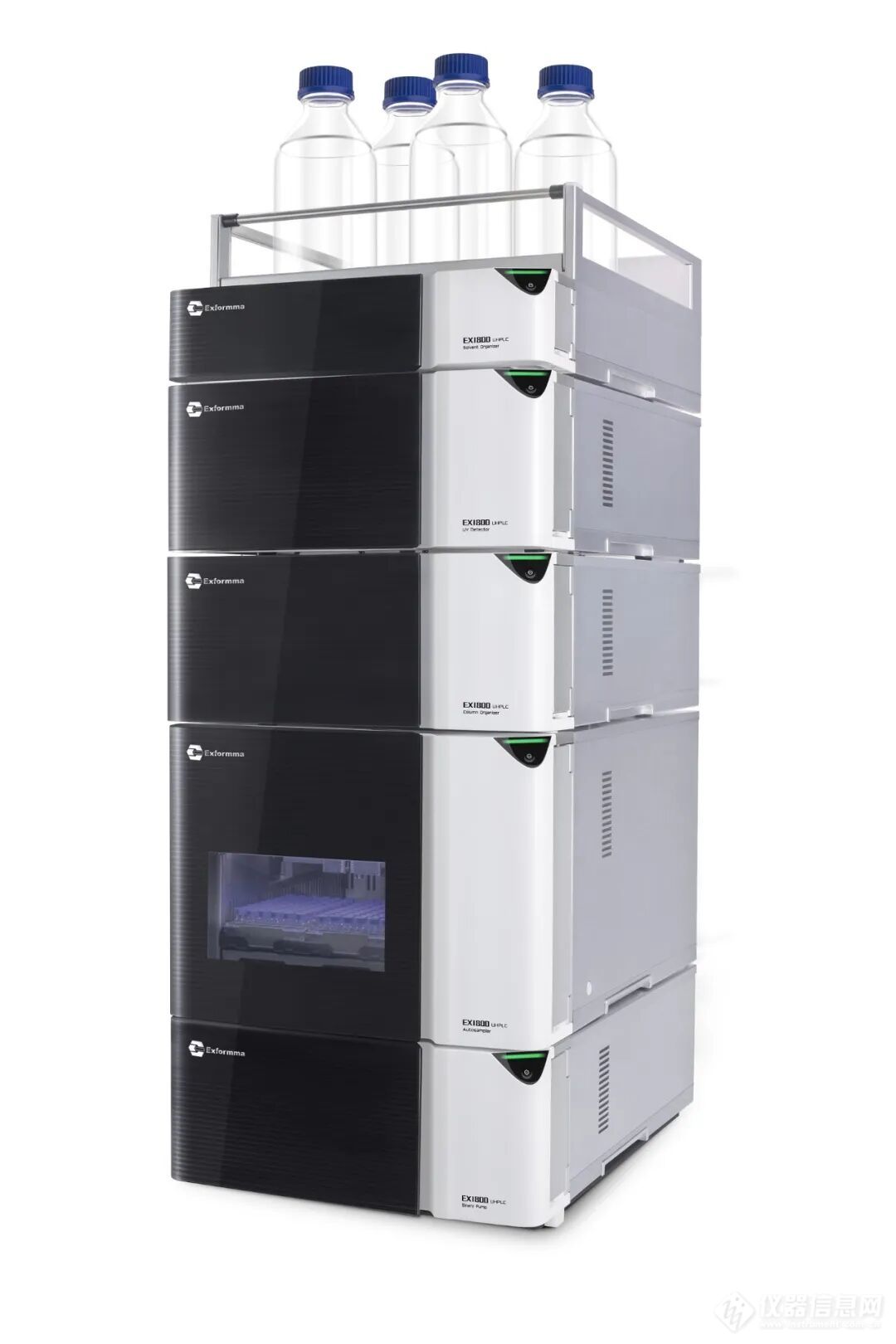
In response to this technical pain point, we established a detection method for seven HMOs in food based on the EX1800 binary high-pressure liquid chromatography system (equipped with a fluorescence detector) and with reference to the chromatographic conditions of the "National Food Safety Standard - Determination of Breast Milk Oligosaccharides in Foods" (draft for comments).
01
Why useFluorescence detector?

HMOs molecules are extremely polar and lack UV-absorbing chromophores, making them almost "invisible" to conventional UV detectors. This solution uses pre-column derivatization (2-aminobenzamide) combined with a fluorescence detector (excitation 330nm/emission 420nm) to convert HMOs without UV absorption into highly fluorescent derivatives, greatly improving sensitivity.
02
Separation—This is the most core indicator of this solution

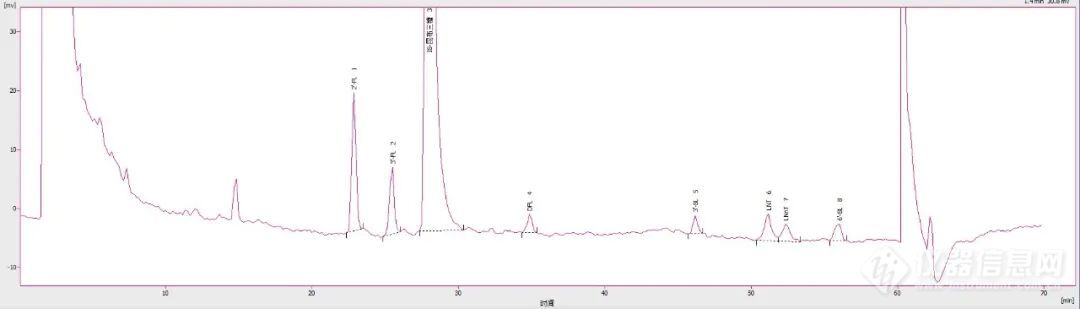
In the separation of 7 HMOs mixed standards (2’-FL concentration 250 mg/L, and the remaining 6 species 75 mg/L each), all adjacent peaks achieved baseline separation. The most critical thing is that the separation of LNT and LNnT, which are highly similar in structure, is >1.7, fully meeting the quantitative requirements. The blank solvent and laminatriose internal standard have no interference on the peaks of the seven HMOs, and the method has good specificity.
03
Sensitivity—meets quantitation limit requirements
The low-concentration mixed standards (2’-FL is 1 mg/L, and the remaining 6 species are 0.3 mg/L), the signal-to-noise ratios are all >10, meeting the standard requirements for the quantitative limit of HMOs.
Linearity - R²>0.9998 across the board.
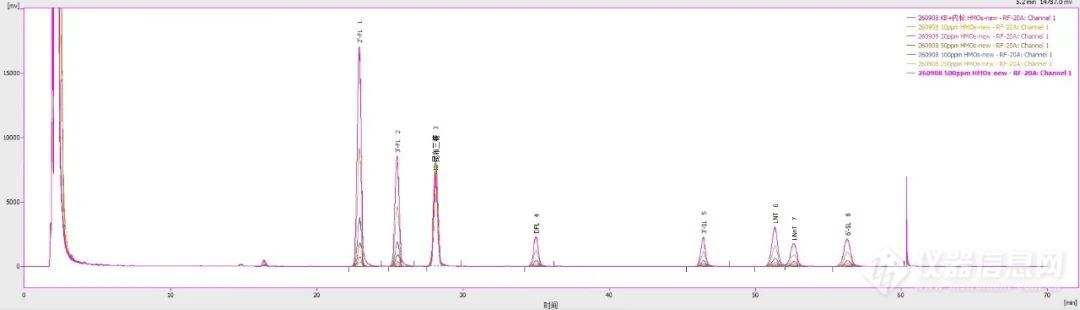
2‘-FL has good linearity in the range of 0~500mg/L, and the remaining six HMOs have good linearity in the range of 0~150mg/L. A standard curve was drawn based on the ratio of the peak area to the internal standard peak area. The correlation coefficients R² were all >0.9998, indicating accurate and reliable quantification.
This method is not only applicable to infant formula, but can also be extended to other dairy matrices. In pure milk samples, after amyloglucosidase enzymatic hydrolysis, 2-aminobenzamide derivatization, acetonitrile precipitation and centrifugation, the 3’-SL content was 11.3mg/100g, and the 6’-SL content was 2.13mg/100g.Method performs stably in real matrices。

Has triple value
Focusing on the Future
Our solution



01
Compliance and forward-looking
Completely refer to the chromatographic conditions of the national standard solicitation draft for "Determination of Breast Milk Oligosaccharides in Foods". Once the standard is officially released, users can migrate directly without redoing it.New development methods.
02
Technical hard power
It has overcome the industry-recognized difficulty of separation of LNT and LNnT isomers, and the data with a separation degree of >1.7 is very convincing among domestic instrument solutions.
03
Credibility of domestic instruments
In this solution, the EX1800 liquid chromatography system (binary pump + fluorescence detector) demonstrated separation capabilities and reproducibility comparable to those of international brands, providing solid application data support for "domestic substitution".