

 Gold Member
 Business License
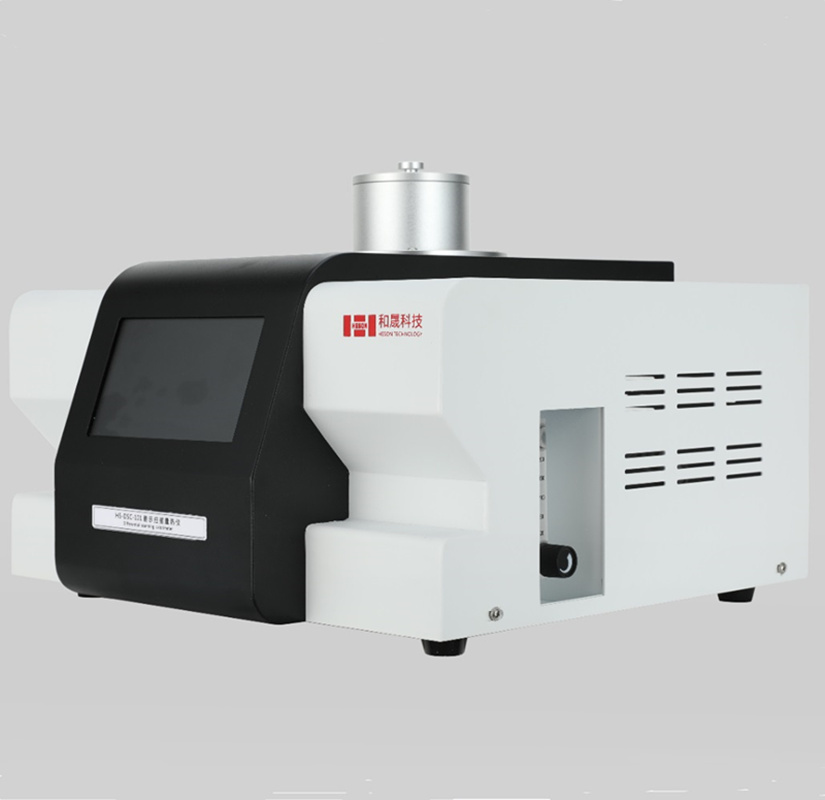
Hesheng HS-DSC-101 Differential Scanning Calorimeter
Product Details
Core Specifications
Applications
Detailed Description
Product introduction:
DSC measures the relationship between temperature and heat flow related to the internal thermal transformation of materials. It has a wide range of applications, especially material research and development, performance testing and quality control. Material properties: such as glass transition temperature. Cold crystallization, phase transition, melting, crystallization, thermal stability, solidification/cross-linking, oxidation induction period, etc. are all areas of research and development of DSC.

Main features:
1. Metal furnace structure, better resolution and resolution and better baseline stability

2. Digital gas mass flow meter, accurately controls the purge gas flow, and the data is directly recorded in the database
3. The instrument can adopt two-way control (host control, software control), with a friendly interface and easy operation.
Technical parameters:
| model | HS-DSC-101 |
| Display mode | 24bit color, 7-inch LCD touch screen display |
| DSC range | 0~±600mW |
| temperature range | Room temperature~600℃ |
| Temperature resolution | 0.01℃ |
| temperature fluctuations | ±0.1℃ |
| heating rate | 0.1~100℃/min |
| temperature repeatability | ±0.1℃ |
| Temperature accuracy | ±0.1℃ |
| DSC resolution | 0.001mW |
| DSC resolution | 0.001mW |
| Program control | Four-stage heating and constant temperature control can be realized, and special parameters can be customized |
| Curve sweep | Heating scan & cooling scan |
| atmosphere control device | Two-way automatic switching (instrument automatically switches) |
| gas flow | 0-300mL/min (other ranges can be customized) |
| gas pressure | gas pressure |
| Data interface | Standard USB interface |
| Parameter standards | Equipped with standard materials (indium, tin, lead), users can calibrate the temperature by themselves |
| Instrument Thermocouple | Three sets of thermocouples, one set for testing sample temperature, one set for testing internal environment temperature of instrument, and one set of furnace overheating self-check sensor |
| Working power supply | AC220V/50Hz |
Test items that can be performed with a differential scanning calorimeter:

Typical DSC test curve:

What is glass transition temperature?
Glass transition temperature (Tg) refers to the temperature corresponding to the transition from glassy state to highly elastic state. Glass transition is an inherent property of amorphous polymer materials and a macroscopic manifestation of the transformation of polymer motion forms. It directly affects the performance and process performance of materials, so it has long been the main content of polymer physics research.
Taking DSC as an example, when the temperature gradually increases and passes the glass transition temperature of the polymer, the baseline on the DSC curve moves in the endothermic direction (see figure). Point A in the figure is the point where it starts to deviate from the baseline. Extend the baseline before and after the transition. The vertical distance between the two lines is the step difference ΔJ. Point C can be found at ΔJ/2. A tangent line from point C intersects the previous baseline at point B. The temperature value corresponding to point B is the glass transition temperature Tg.

Common crystalline plastics include: polyethylene PE, polypropylene PP, polyoxymethylene POM, polyamide PA6, polyamide PA66, PET, PBT, etc.
Amorphous plastics include: polycarbon, ABS, permeable benzene, vinyl chloride, etc. (such as plastic watch cases, TV casings, etc.)
What is the oxidative induction period?
The oxidation induction period (OIT) is the time it takes for a sample to begin an autocatalytic oxidation reaction under high-temperature (200 degrees Celsius) oxygen conditions. It is an indicator to evaluate the material's resistance to thermal degradation during molding, storage, welding and use. The Oxidation Induction Period (OIT) method is a method that uses differential thermal analysis (DTA) to test the accelerated aging of plastics in high-temperature oxygen based on the exothermic reaction when the plastic molecular chain breaks. The principle is: place a plastic sample and an inert reference substance (such as alumina) in a differential thermal analyzer, so that the inert gas (such as nitrogen) in the sample chamber is rapidly replaced with oxygen at a certain temperature. Test the changes in the DTA curve (differential thermal spectrum) caused by the oxidation of the sample, and obtain the oxidation induction period (time) OIT (min) to evaluate the thermal aging resistance of the plastic.


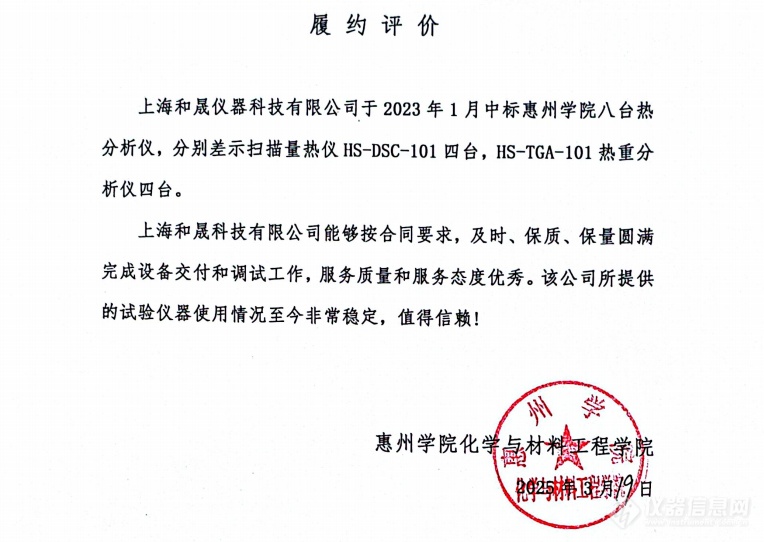


Application examples of Hesheng differential scanning calorimeter in some university research institutes
| 1、 | Research on the preparation technology of cross-linked hydroxypropyl starch | Jilin University |
| 2、 | Preparation of spiral polydiacetylene by asymmetric polymerization induced by circularly polarized light | University of Science and Technology of China |
| 3、 | Analysis of different emulsion polymerization processes and their impact on polymer properties | Wuhan University of Technology |
| 4、 | ADN-based propellant atomization characteristics test and simulation research on the working process of ADN-based thruster | Beijing Jiaotong University |
| 5、 | Research on thermal-electrical characteristics of 18650 power battery core and module thermal management technology | Guangdong University of Technology |
| 6、 | Penetration and defects of resin in wind turbine blades prepared by vacuum-assisted resin infusion method | Qiqihar University |
| 7、 | Controllability of the beaded structure of hot air flow consolidated fiber mesh and its crystallization kinetics | Donghua University |
| 8、 | Study on the effect of redox- and pH-dual responsive mesoporous silica-paclitaxel nano-delivery system on A549 cells | Jinzhou Medical University |
| 9、 | Preparation of polymer electrolytes with enhanced ionic conductivity and their applications in lithium-oxygen batteries | Chengdu University of Technology |
| 10、 | Study on the preparation technology and physical properties of purple sweet potato resistant starch | Jilin Academy of Agricultural Sciences |
| 11、 | Study on the preparation and properties of graphene oxide/polyurea composite materials | Jinan University |
| 12、 | Research on application and physiological functions of soybean oil-based diglyceride edible oil | South China University of Technology |
| 13、 | Research on the structure and properties of friction stir welding of AZ31B magnesium alloy/5052 aluminum alloy dissimilar materials | Hubei University of Technology |
| 14、 | Research on room temperature curing and high temperature resistant silicone coating for titanium alloy | Mechanical Science Research Institute |
| 15、 | Preparation of polymer composite array materials and research on structural size control | West China Normal University |
| 16、 | Development of high toughness powder coating for home appliances | China Electrical Equipment Research Institute Co., Ltd. |
| 17、 | Effect of different extraction temperatures on the physical and chemical properties of silver carp skin gelatin | Hefei University of Technology |
| 18、 | Preparation and application research on porous polymer templates with controllable structure/size | Southwest University of Science and Technology |
| 19、 | Effect of surface modification on the properties of injection molded bonded NdFeB magnets | Mining and Metallurgy Technology Group Co., Ltd. |
| 20、 | Research on long basalt fiber reinforced flame retardant polypropylene | Zhejiang University |
| 21、 | Preparation of PP/CaCO3 composite materials and research on the flexural properties of reinforced concrete | Inner Mongolia Transportation Vocational and Technical College |
| 22、 | Effects of extrusion and aging treatment on the microstructure and mechanical properties of architectural aluminum profiles | Hubei Light Industry Vocational and Technical College |
| 23、 | Research on the application of natural extracts in antioxidant modification of polyolefins | Shandong University of Science and Technology |
| 24、 | Research on interface modification of carbon fiber/epoxy resin matrix composites based on carbazole-based copolymer | Beijing University of Chemical Technology |
| 25、 | Study on the performance of low melting point heavy rare earth alloy grain boundary diffusion sintered Nd-Fe-B magnets | Beihua Institute of Aerospace Industry |
| 26、 | Research on the construction of thermosensitive PNIPAm hydrogel system and its application in smart windows | Wuhan Textile University |
| 27、 | Preparation, structural characterization and calcium absorption-promoting properties of peanut peptide-calcium chelate | Henan University of Technology |
| 28、 | Effect of Nano-TiO2 Dispersion on Cement Hydration and Properties | Hunan University of Science and Technology |
| 29、 | Research on modified graphene-enhanced silicone coating and its properties | Qilu University of Technology |
Some customers' SCI papers using our differential scanning calorimeter
1、Natural compounds from Punica granatum peel as multiple stabilizers for polyethylene
2、Electro-Thermochromic Luminescent Fibers Controlled by Self-Crystallinity Phase Change for Advanced Smart Textiles
3、Carbon fiber/polyetherketoneketone composites. Part I: An ideal and uniform composition via solution‐based processing
4、Isolation and characterization of acid-soluble collagen and pepsin-soluble collagen from the skin of hybrid sturgeon
5、Physicochemical properties of soybean-based diacylglycerol before and after dry fractionation.
6、Water-in-oil emulsions enriched with alpha-linolenic acid in diacylglycerol form: Stability, formation mechanism and in vitro digestion analysis
7、Effects of treatment methods on the formation of resistant starch in purple sweet potato
8、High Lithium Ion Flux of Integrated Organic Electrode/Solid Polymer Electrolyte from In Situ Polymerization
9、Preheat Compression Molding for Polyetherketoneketone: Effect of Molecular Mobility
10、Characterization and experimental investigation of aluminum nitride-based composite phase change materials for battery thermal management
11、Experimental investigation of the flame retardant and form-stable composite phase change materials for a power battery thermal management system
12、Experimental investigation on immersion liquid cooled battery thermal management system with phase change epoxy sealant
13、Experimental Investigation on Thermal Management of Electric Vehicle Battery Module with Paraffin/Expanded Graphite Composite Phase Change Material
Product Overview
This differential scanning calorimeter (DSC) is suitable for the research and development, performance testing and quality control of a wide range of materials. It can measure glass transition temperature, cold crystallization, phase transition, melting, thermal stability, solidification/cross-linking, oxidation induction period and other properties. The instrument adopts a metal furnace structure with high resolution and stability. It is equipped with a digital gas mass flow meter, supports two-way control, has a friendly interface and is easy to operate. The main technical parameters include DSC range of 0~±600mW, temperature range from room temperature to 600℃, temperature accuracy of ±0.1℃ and gas flow rate of 0-300mL/min. This equipment has been successfully used in multiple scientific research projects and university studies, and supports detailed analysis of a variety of material properties.