InstrumentCube
Products

Home/News/[Paper sharing] Tsinghua University Nature sub-journal Natural Catalysis: Network-like copper double sites embedded in semiconductor particles for selective CO₂ photoreduction
Company News

[Paper sharing] Tsinghua University Nature sub-journal Natural Catalysis: Network-like copper double sites embedded in semiconductor particles for selective CO₂ photoreduction

Instrument.com.cn Jan 23, 2026

[Paper sharing] Tsinghua University Nature sub-journal Natural Catalysis: Network-like copper double sites embedded in semiconductor particles for selective photoreduction of CO₂ to C₂H₄

【Paper Sharing】

Tsinghua University Nature Sub-Journal Natural Catalysis: Network-like copper double sites embedded in semiconductor particles for selective photoreduction of CO₂ to C₂H₄


Paper details

Published in journals:Nature Catalysis

Article title:Reticular copper dual sites embedded with semiconductor particles for selective CO2-to-C2H4 photoreduction

author:Qixin Zhou   1, Yan Guo   1,2 & Yongfa Zhu   


summary

The dual reaction sites of carbon-carbon bonding were realized through atomically precise proximity coordination, providing a model platform for the reaction of carbon dioxide to propylene. However, its surface-only distribution pattern results in inefficient injection of photogenerated electrons via long-distance migration from the bulk phase, resulting in insufficient power to drive the continuous electron transfer required for propylene synthesis. Here, we demonstrate a method consisting of semiconductor units (TiO2, polymeric carbonitride, or Design of a network-like dual reaction site photocatalyst composed of WO3·H2O). This system converts carbon dioxide into propylene with a selectivity of 75.5%. The network of copper dual reaction sites facilitates the short-range transfer of photogenerated electrons from the photocatalyst to the active site, ensuring sufficient electron concentration required for all basic steps in the propylene synthesis process. Enhanced electron injection enables even low-intensity irradiation (approx. 0.4 High propylene selectivity can also be achieved under three suns, demonstrating its suitability for solar-driven applications. This study demonstrates the feasibility of converting carbon dioxide into propylene (C2H4) via a photoreaction and provides new insights into multi-electron carbon dioxide photoreactions.
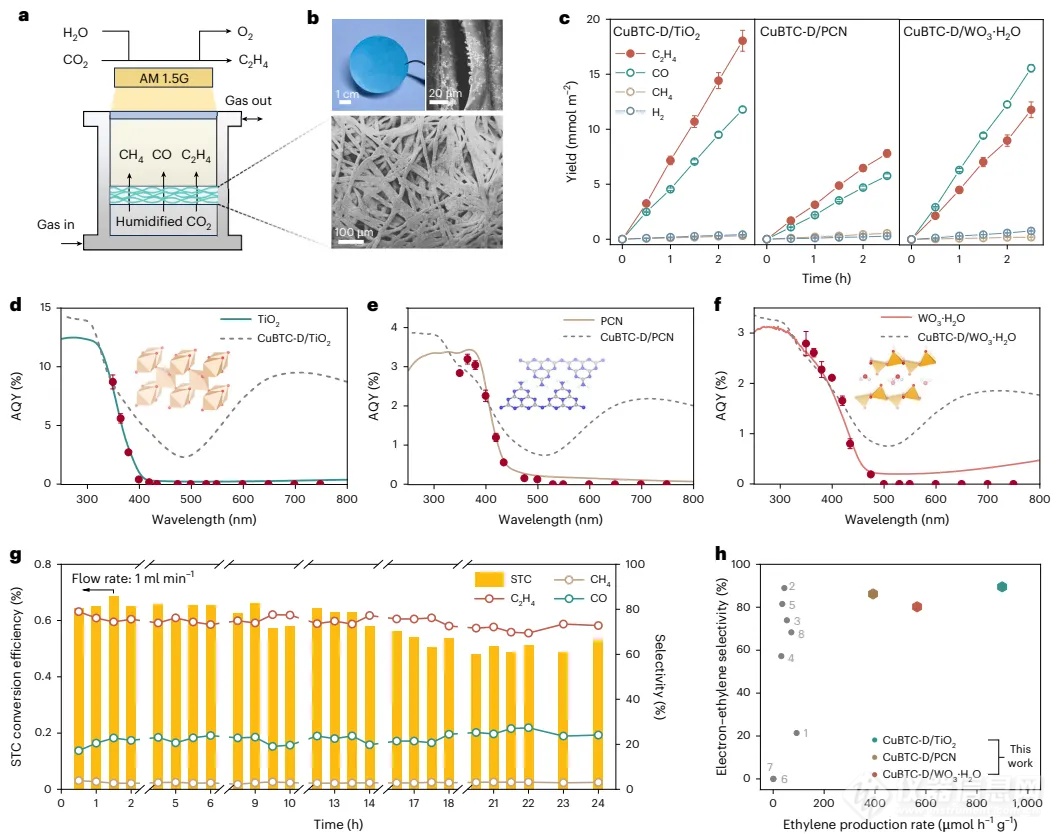

In this article, CuBTC-D (ligand-deficient copper-based metal-organic framework) is the core component of the entire photocatalytic system. Its main role, structural advantages, and reasons for using microwave synthesis can be summarized as follows:
The core role of CuBTC-D
As a "network dual site" carrier
The core function of CuBTC-D is to provide precisely adjacently coordinated copper double sites (Cu₂). These sites are formed through ligand defect engineering and are the key catalytic centers that drive CO₂ molecules to perform C-C coupling and selectively generate C₂H₄.
Build short-range electron transmission channels
By embedding semiconductor particles (such as TiO₂, PCN, WO₃·H₂O) into its micropores, CuBTC-D enables the catalytic site (Cu₂) to be closely adjacent to the photosensitive unit. This structure greatly shortens the distance for photogenerated electrons to migrate from the semiconductor bulk phase to the active site, solving the problem of low electron injection efficiency caused by long-distance migration of traditional surface sites.
Provide a limited reaction environment
The microporous structure of CuBTC-D provides a regular "cage" for the embedding of semiconductor particles. At the same time, its pores also provide a restricted reaction environment for reactants and intermediates, which may be beneficial to specific reaction pathways (such as CHO* coupling), thus improving the selectivity of C₂H₄.


Why is microwave synthesis used to prepare CuBTC-D?
As mentioned in the “Methods” section of the article, CuBTC-D was prepared by microwave hydrothermal method. The synthesis steps are as follows: place CuBTC in a reaction kettle containing a methanol/ethanol mixed solvent, and heat it under microwave at 150°C for 1 hour to induce ligand defects. We can infer from the perspective of material design that the fundamental reasons for choosing this type of microwave synthesis method are:
Efficiently create ligand defects
The key to generating CuBTC-D is to partially remove the BTC ligands in the original CuBTC to form unsaturated coordinated copper nodes. The high-temperature and high-pressure environment provided by the microwave hydrothermal method can accelerate the hydrolysis and removal process of ligands, thereby efficiently and controllably introducing a large number of defects to form the required Cu₂Oₓ clusters.
Ensure the uniformity of defect structures
Compared with the traditional slow solvothermal method, microwave hydrothermal synthesis can achieve faster nucleation and growth, which helps to form more evenly distributed ligand defects throughout the MOF skeleton, thereby ensuring the consistency of the catalytic site (Cu double site).
Improve synthesis efficiency and reproducibility
The microwave hydrothermal method has a short reaction time (1 hour in the article), which can significantly improve the synthesis efficiency and help obtain reproducible material structures between different batches, which is crucial for subsequent research on photocatalytic performance.

picture


Summarize

CuBTC-D plays an indispensable dual role in this photocatalytic system: it is both a provider of catalytic active sites and a nanoreactor that optimizes electron transport paths. The rapid microwave hydrothermal synthesis method is used to construct its key ligand defect structure efficiently and controllably, thereby laying the material foundation for achieving highly selective CO₂-to-C₂H₄ photoreduction reaction. This strategy of "embedding" semiconductor photosensitizers into defective MOFs with well-defined dual sites provides new ideas for designing efficient multi-electron photocatalytic reactions.

picture
recommend
picture
Instrument name:

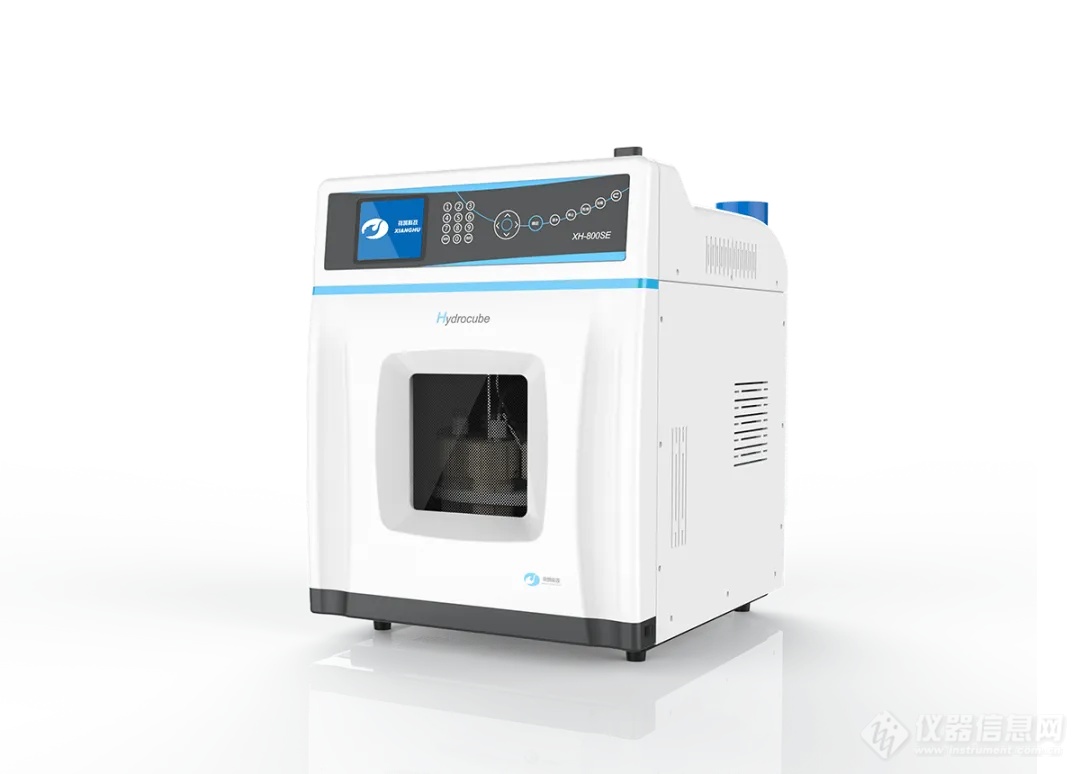
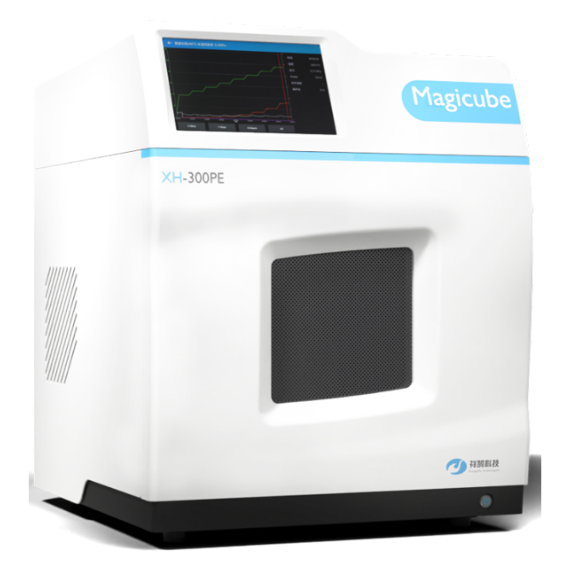
Microwave hydrothermal synthesizer

Instrument model:

  XH-800SE
Usage:

Under closed high-pressure conditions at 150°C, the CuBTC crystal was "vapor-phase etched" for 1 hour with methanol/ethanol mixed steam to directionally remove part of the BTC ligands, forming a "ligand defect" structure (CuBTC-D) rich in unsaturated Cu₂Ox clusters.

This defect structure is the prerequisite for the subsequent embedding of TiO₂, PCN or WO₃·H₂O semiconductor units and the construction of "network double copper active sites"; the degree of defects directly determines the density of Cu₂ sites and the final C₂H₄ selectivity.


Rapid temperature rise: It can reach 150 °C in 10 minutes, shortening the crystallization-etching cycle.

Precise temperature control: PID adjustment of ±1 °C ensures controllable BTC removal amount and good batch repeatability.

High-pressure safety: The explosion-proof outer tank made of PEEK can operate safely under the self-generated pressure of methanol steam (below 60bar).

Small volume and high throughput: 100 mL inner tank can process 1g CuBTC at a time, which can meet the dosage of subsequent gram-level photocatalytic testing. 10 parallel experiments can be scaled up.

No metal contamination: the closed system avoids contact with the stirring paddle or metal kettle wall to maintain the purity of MOFs

Planetary full-tank magnetic stirring (optional): The reactor has built-in magnetic stirring to ensure the uniformity of the reaction system and improve the consistency and reproducibility of the experiment.


XH-800SE provides a controllable, efficient and repeatable synthesis platform for the construction of a highly selective "network double copper site" catalyst for CO₂ photoreduction to produce ethylene through "mild gas phase defectification".




Beijing Xianghu Science & Technology Development Co., Ltd.
Main products: Microwave Digestion System, Microwave Synthesizer, Flow Chemistry Equipment, Ultrasonic Extractor