
Being close to users continues from every meeting, Haineng goes to ARABLAB again
Company News
Oct 30, 2026



The resistivity of ultrapure water is an important indicator for measuring the ion concentration in the water and one of the important indicators for testing the purity of the water. The higher the resistivity, the fewer impurity ions in the water. The core indicator of ultrapure water is extremely low ion content, and its theoretical maximum resistivity can reach 18.2 MΩ·cm at 25°C.
The resistivity of ultrapure water cannot be accurately measured offline because the measurement has high requirements on the environment, operating methods and measuring instruments, and any subtle interference factors will affect the measurement results. Therefore, it is best to use an online conductivity meter/resistivity meter for measurement. The cell constant of the conductivity cell is 0.01cm-1. The equipment needs to have a built-in temperature sensor of 0.1°C and an automatic temperature compensation function.
Hyperpurex
Online detection method
Online testing is suitable for ultrapure water machine outlets, circulation pipelines, semiconductor or pharmaceutical water, and precision experimental water.
Online testing process:
1. Installation and sealing
Place the electrode conductance directly into the flow cell of the ultrapure water circuit, and seal the interface to prevent air leakage.
The water flows in the same direction and the sensor is completely immersed in the water
2. Exhaust
Pass water for 3-5 minutes to completely drain the bubbles in the pipeline. Control the flow rate at 0.5-1L/min to maintain stable laminar flow and avoid the generation of static electricity.
3. Instrument settings
Choose equipment with temperature compensation function and enter the cell constant correctly.
4. Stabilization and calibration
Continue to flow water for 3-10 minutes, wait for the reading to stabilize and confirm the data; regularly calibrate the electrode constant with standard solution
5. Online monitoring
Continuously read the temperature compensation value at 25°C. The resistivity of ultrapure water should be stable at ≥18.2 MΩ·cm.
Key points:Flow-through measurement is required and static detection is prohibited; the entire process is sealed to prevent air from entering; the conductivity cell is regularly cleaned to prevent microbial and organic contamination.
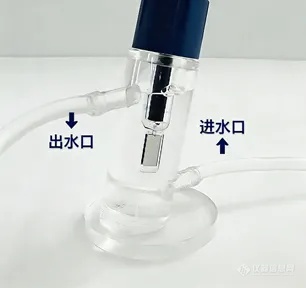
If there is no condition for online testing, but you still want to know the conductivity of water, offline testing can be used as an auxiliary reference method.
Offline detection method:It is suitable for temporary testing in laboratories, scenarios without online monitoring conditions, and sampling of small batches of water samples.
limitation:When ultrapure water is exposed to the air for several minutes, the resistivity drops from 18.2 MΩ·cm to 10 MΩ·cm or even lower. Therefore, the offline test results can only be used as a reference and cannot be used to determine whether the water quality is qualified or not.
Offline detection steps:
1. Instrument calibration
Use standard conductivity solution to calibrate the electrode constant and turn on the temperature compensation mode
2. Container and electrode cleaning
First rinse the container and electrode with the ultrapure water to be measured more than 3 times each to avoid contamination of the water sample caused by residual ions.
3. Rapid sampling
Continuously receive water from the water inlet to ensure full flow and no bubbles. The container should be capped immediately after filling to minimize the contact time between the water sample and the air.
4. Measurement
Place the electrode into the water sample, avoid stirring the water sample and adhering to bubbles, and wait for the reading to stabilize.
5. Record the results
Record the resistivity, water temperature and other data after temperature compensation, and clean the electrode in time after the detection is completed.
Key points:The entire operation must be fast, airtight, and bubble-free; it is forbidden to use glass or ordinary plastic beakers to hold water samples (it is easy to precipitate metal ions); if the reading fluctuates greatly, there is contamination or bubble interference in the surface water sample, and the data deviation is large, the measurement should be re-measured.
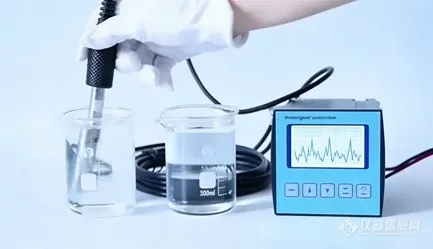
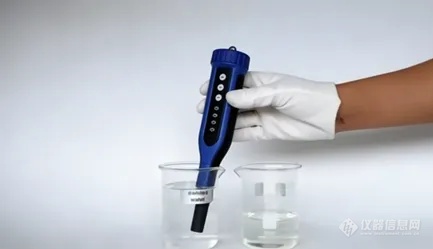
Online vs. offline comparison | ||
project | Offline measurement | Online measurement |
state | Static, open/semi-closed | dynamic, airtight |
accuracy | Low, big error | high |
gas interference | serious | none |
Qualification judgment | Can't judge accurately | Judgment criteria |
Operation difficulty | Simple | Requires installation |
reading | Unstable, large deviation from true value | Stablize |
The resistivity detection of ultrapure water is a key link to ensure the purity of water quality. Online detection has the advantages of dynamic sealing, no gas interference, and stable readings. It can truly reflect the actual condition of water quality and is the first and most reliable method for ultrapure water resistivity monitoring. Offline detection of ultrapure water is easily affected by factors such as air, containers, and the environment. It can only be used as a temporary reference and cannot be used as a basis for determining water quality. In practical applications, appropriate testing methods should be selected based on testing conditions and needs, and operating specifications should be strictly followed to ensure that ultrapure water quality testing results are effective and accurate, and to provide reliable water quality assurance for fields with stringent water quality requirements such as semiconductors, pharmaceuticals, and precision experiments.


When you visit any website, it may store or retrieve information on your browser, mostly in the form of cookies. This information might be about you, your preferences or your device and is mostly used to make the site work as you expect it to. The information does not usually directly identify you, but it can give you a more personalized web experience. Because we respect your right to privacy, you can choose not to allow some types of cookies. Click on the different category headings to find out more and change our default settings. However, blocking some types of cookies may impact your experience of the site and the services we are able to offer.