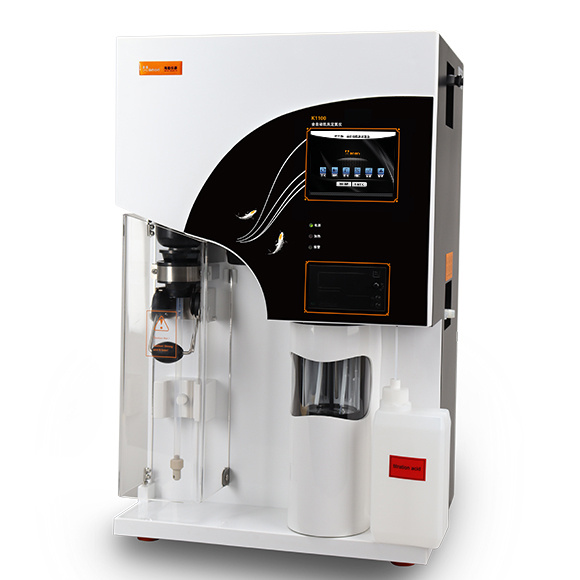
Hegguan nitrogen analyzer fully automatic Kjeldahl nitrogen analyzer HGK-55



Core Specifications
Product Details
HGK-55Fully automatic Kjeldahl nitrogen analyzerDetailed introduction:
HGK-55Fully automatic Kjeldahl nitrogen analyzerIt is a set of automatic intelligent nitrogen or protein measuring instruments designed based on the classic Kjeldahl nitrogen determination principle. It is widely used to detect the content of ammonia, nitrogen, and protein nitrogen in grains, oils, foods, dairy products, beverages, feeds, soil, fertilizers, drugs, and some chemical products. It is an important chemical analysis instrument for product quality testing.
HGK-55Fully automatic Kjeldahl nitrogen analyzerIt uses new long-life design, 32-bit microcomputer intelligent control, LCD color touch screen operation, and Chinese menu-style interface to complete human-machine dialogue operations. The instrument determines the acid-base balance end point of the reaction cup through changes in the three primary colors of red, green, and blue. This technology is famous for its stability and anti-interference.It can prompt to determine whether the ammonia gas is distilled. The instrument is automatically cleaned and automatically calibrated when it is turned on, eliminating the need for manual calibration and avoiding human inconsistencies. It is very suitable for detecting high-nitrogen urea, ammonium chloride and other high-precision samples. Very low-nitrogen samples: soil, sewage, steel, etc. It can meet the new food national standard 20ml sulfuric acid test. Heguan invention patent technology(Patent number:ZL 2022 1 0517820.2)(Kjeldahl nitrogen analyzer that can eliminate errors caused by long intervals in continuous detection).
HGK-55Fully automatic Kjeldahl nitrogen analyzerProduct features:
1. ★Distillation and titration are carried out at the same time and the graph will automatically display whether the ammonia has been completely distilled and whether the titration is at the equilibrium point.
2. ★Able to detect quality control samples and display, analyze and store quality control charts.
3. The minimum titration volume is 0.8μl. The instrument automatically adjusts the minimum titration volume according to the standard acid concentration.
4. The consumption standard acid titration volume range is 0ml-60ml, which is not affected by the volume range of the buret.
5. ★Standard acid concentration range: 0.01-0.5mol/L standard acid (standard acid titration within this range can meet repeatability and recovery rate indicators)
6. It has various safety door detection, reagent level detection, automatic discharge of waste liquid in the digestive tube and reaction cup, real-time detection of cooling water flow and pressure, automatic preheating of the distillation cup, and automatic shut-off of condensation water when the instrument is idle.
7. It has real-time detection and control of the temperature of the reaction cup;
8. Manual and automatic dual modes facilitate the detection of special samples.
9. Add alkali intermittently to ensure that the acid-base reaction is under control.
10. Distillation power is adjustable: 0-100% distillation power is steplessly adjustable to meet the user’s special testing requirements.
11. The internal connecting pipes of the instrument adopt pipes with specific requirements and are free of replacement for 3 years.
12. All reagents are metered and added using pressureless liquid pumps, measured in 1ml.
13. Titration and distillation are carried out simultaneously.
14. The reaction cup is external and is not affected by external light sources.
15. The data and detection conditions are traceable and can store 200,000 sets of sample data, which can meet the data storage requirements within the effective life of the instrument. The USB interface can also output data at the same time.
16. Display, store and analyze quality control data, and can display and print current and historical quality control charts.
HGK-55Fully automatic Kjeldahl nitrogen analyzerParameter indicators: (quantitative value is the acceptance indicator)
1. Measuring range: 0.01-240mg nitrogen (this indicator requires standard acid concentration)
2. Distillation time and capacity: 0.0-9.0 minutes/sample, low-power distillation is not limited by this time.
3. Titration accuracy: ≤0.0012μl/step, minimum titration volume: 0.8ul/step
4. Reproducibility: RSD≤0.4%
5. Recovery rate: >99.5% (can be used as an acceptance indicator)
6. Linear range: RSD <1.0% within the range of 1-4 times the sample volume of the same sample (nitrogen content 1-240 mgN, can be used as an acceptance indicator)
7. Reagent pump volume: 0-150ml, 1ml/level
8. Delay time: 0-3600s (suitable for detecting nitrate nitrogen)
9. Distillation power: 0-1500W adjustable
10. Power supply: AC220V±10%, frequency 50/60HZ
Interpretation of national standard indicators for fully automatic Kjeldahl nitrogen analyzer
------Find needsmatch parametersofNitrogen analyzer
How to find a Kjeldahl that suits your needsNitrogen analyzer, is a question that many buyers or users are confused about.Shanghai Heguan Instrument Co., Ltd.After contacting countless users, I realized the difficulties in purchasing instruments:
Due to the lack of understanding of the essential parameters and functions of the instrument, I am vague about how to connect my actual testing needs with the instrument indicators. I am afraid that purchasing an inappropriate nitrogen analyzer and putting it in the laboratory will turn it into a useless instrument, and that it is difficult to tell whether the parameters are true or false, and I am afraid that I will be deceived.
For this reasonKjeldahl nitrogen analyzerIntroduce and discuss the parameters to solve the pain points of procurement. A parameter concept may contain several meanings, and some parameters are related to each other, so understanding the parameter concept is the best way to eliminate ambiguity.
1. Basic indicators of Kjeldahl nitrogen analyzer
According to the national standard GB/T 33862-2017 technical indicators of Kjeldahl nitrogen analyzer:
1.1 Detection range:0.1-210mgN
This isNitrogen analyzerThe allowable range of nitrogen in the digestive tube during testing. Examine the detection capabilities of the instrument.
1.2 Indication error:The market value error of fully automatic instruments does not exceed1%
Measures the accuracy of a fully automatic nitrogen analyzer, which can be calibrated by calculating artificially defined values.
1.3 Recovery rate: Semi-automatic instrument recovery rate99-101%
Measuring the data accuracy of a semi-automatic nitrogen analyzer (equivalent to the indication error), this is artificially defined.
1.4 Repeatability: The relative standard deviation of the instrument should not be greater than0.5%,6statistical results of data or above.
This indicator is to examine the precision of the instrument itself. It is determined by the quality of the instrument itself and cannot be calibrated.
That's itNitrogen analyzerThere are three technical indicators defined by national standards. Since these three indicators alone cannot accurately describe the characteristics of the instrument, nitrogen analyzer companies have also introduced the following indicators:
1.5, titration accuracy: *.****ul/step
Accuracy: How close a measured value is to the true value (baiduencyclopedia)
Step: The smallest measurement unit of the stepper motor, which reflects the smallest standard acid volume that the titration pump can spit out.
Titration accuracy tells us: the maximum error that may occur in the smallest measurement unit of the titration system. This indicator is a repeatability errorzuidaContributor, the larger the index, the worse the repeatability. This is determined by the instrument design and cannot be calibrated.
1.6, minimum titration volume (ml): The system passesstepper motorThe minimum volume of standard acid pushed out by the burette indicates the resolution of the system and the sensitivity of the instrument is examined. Note that the minimum titration volume ≧ the volume of each step of the stepper motor. Can be calibrated.
1.7,linear range: There is a linear functional relationship between two variables, which is called a linear relationship.
In the Kjeldahl test, there is a linear relationship between the nitrogen content of the digestive tube and the standard acid consumption volume:
y=14.01c(V-V0) =14.01cV-14.01cV0=kx+b
V0 represents the blank volume,ml
c represents the standard acid concentration,mol/L
The above two are definite constants.
Y represents the amount of nitrogen in the digestive tube, mgN.
V represents the standard acid titration volume, unit: ml,
This function tells us that there is a linear relationship between the standard acid titration volume and the amount of nitrogen in the digestive tube.
This indicator tells us: the changes in the amount of nitrogen in the digestive tube and the accuracy range of the instrument’s detection data (some users wonder why some samples are not measured accurately? This is the problem). This is an intrinsic indicator of the instrument and cannot be calibrated.
1.8, Nitrogen analyzerThe standard acid concentration range that can be used is: 0.**---0.**mol/L.
The titration of high-concentration standard acid will not overshoot, and the titration of low-concentration standard acid will not be slow, ensuring the accuracy of the data.
This indicator examines the applicability of the instrument. If the use range of the standard acid is small, it will be difficult to measure high-nitrogen samples, and the error will be large when measuring low-nitrogen samples (some users ignore this indicator and purchase an inappropriate nitrogen determiner). Can be adjusted in a small range.
two, fully automatic nitrogen analyzer8Indicator internalmutualRelationships and meaning to users
2.1. Market value error (recovery rate) and the relationship between repeatability
As mentioned earlier, repeatability is an essential indicator of the instrument, so the indication error includes repeatability error, accuracy error during calibration, and various errors generated by the instrument during testing. Therefore, the error relationship between the two is: indication error ≧ repeatability error.
According to GB/T 33862-2017, the indication error is1%, while the repeatability is0.5%.In line with the logic of the indicator. See Figure 1 below (Shanghai Heguan Nitrogen Analyzer) and Figure 2:

Figure 1

Figure 2
The parameters in Figure 1 describe the indicators normally. Figure 2 shows that if the repeatability error is 1%, there is no guarantee that the recovery rate is99.5%. This argument is contradictory. Users must raise doubts about the recovery rate (this is an important indicator, juedui cannot get away with it).
2.2. Relationship between titration accuracy and repeatability
instrumentInstrument repeatability is related to many aspects: Is the ammonia distilled completely? Are the appropriate reagents added? Whether the distillation is leaking or not are all uncertain factors. If the instrument assembly is normal and the instrument settings are reasonable, the titration accuracy will become the main contributor to the repeatability error. Figure 3 accurately depicts the titration accuracy0.0015ul/step, figure4Titration accuracy shown0.2ul/step if the titration1Ten Thousand Steps Picture3error15ul,Acceptable. And the picture4Allowable error2ml. This is unacceptable. picture4and repeatabilityRSDvalue0.5%There are contradictions. That0.5%The repeatability (an important indicator) must be reasonably doubted (some users are not aware of the relationship between the two indicators and suffer a hidden disadvantage).
2.3. Relationship between detection range and standard acid allowed to be used by the instrument
Once the range of nitrogen content in the digestive tube is determined, the standard acid concentration is determined. At this time, you need to know whether the nitrogen analyzer is suitable for using the standard acid of this concentration?
example:Digestive tubeThere is 120 mgN in it, assuming the titration volume is set at20-30ml,Then we need standard acid in0.28-0.43mol/Lwithin the range. He told us: To detect high-content samples, a nitrogen determiner needs to be able to meet the needs of use.0.4mol/Lor above standard acid. Only this can meet the needs of this sample. Because the higher the standard acid concentration, the more difficult it is to control the fully automatic nitrogen determiner, which is determined during the design. 0.1mol/L standard acid is relatively easy to control. Similarly, if you want to detect low-content samples, such as soil, milk-containing beverages, etc., the instrument needs to meet the 0.01mol/L standard acid (generally, nitrogen analyzer brands will not proactively tell you the use range of the standard acid). Suppose a brand tells you: the detection range is very wide, but does not tell youinstrumentYou have to inquire about the range of standard acids that can be used to confirm that the standard acid concentration can meet your actual needs. (The national standard threshold is too low, users need to worry more)
For example: chemical fertilizers, high-nitrogen chemical products, pure protein powder, etc. require 0.3-0.5mol/L, soil or milk-containing beverages, etc.0.01-0.05mol/LStandard acid, required for general food and feed0.05-0.2mol/L。
A standard acid concentration that is too high can easily lead to excessive titration and bias the data. The ability of the instrument to use high-concentration standard acid is a result of the instrument design. Therefore, users should understand that the instrument can use a standard acid range to meet sample detection needs. Figure 3(Shanghai Heguan Nitrogen Analyzer) clearly use the standard acid concentration range. Figure 4: Measurement range0.1-240mgN,But there is no promise that the standard acid concentration can be used, so you need to ask. If the standard acid concentration you need cannot be guaranteed, then avoid pitfalls. Because the national standards do not have any requirements, only users themselves must be aware.

Figure 3

Figure 4
2.4 Relationship between linear range and repeatability
Note: Repeatability is based on statistical calculations under the same amount of nitrogen, such as 20mgN in each digestive tube. ifDigestive tubeIf the amount of internal nitrogen is different, it is not within the scope of repeatability inspection. Therefore, the repeatability index only represents the accuracy of the amount of nitrogen at this point. However, the amount of nitrogen in the digestive tube was different during the experiment, and there were some large differences. Repeatability indicators do not guarantee data accuracy. The national standard for nitrogen analyzers does not stipulate this. Right nowNitrogen analyzerManufacturers may not make any promises about the repeatability of samples with different amounts of nitrogen, so when looking at a nitrogen analyzer, you need a brand that has a clear commitment to the linear range, such as Heguan. Ensure the consistency of your sample data with different nitrogen amounts. This is very important for laboratories.
3. Understand the meaning of indicator concepts and the relationships between concepts
Through the above discussion, we learned that the technical threshold of the national standard for Kjeldahl nitrogen analyzer is relatively low, and some important indicators are not included in the standard (mainly considering the basic domestic level). This brings a lot of difficulties to users when choosing a nitrogen analyzer. But as long as you understandNitrogen analyzerThe connotation and denotation of the basic indicators, as well as their mutual relationships. If there are no clear indicators or there are conflicting indicators, be wary. In this way, your testing needs can be directly connected to the instrument indicators.
You can be sure: the one you purchasedNitrogen analyzerOn the premise that data accuracy is guaranteed (you can request these indicators as contract attachments), then explore whether other functional categories meet your considerations such as detection, data processing, storage, automation, security, and convenience. If the basic parameters cannot be met, other so-called functions are just castles in the air, and Wanmei's functions cannot replace the accuracy of the data (this must be remembered).
Your rational choice contribution:
3.1. Choose the one that suits your needsNitrogen analyzer, reflects the standard of the laboratory, and also reflects the cost-effectiveness (cheap nitrogen analyzers are not cost-effective).
3.2. The improvement of the level of domestic instruments requires manufacturers' efforts in research and development, higher technical thresholds and national standards, and it also requires users' clear and rational choices. Bring high-quality domestically produced instruments that suit your needs to the experimental table. This is a great introduction to domestically produced instruments.zuidasupport and praise.
3.3. Improve your own abilities and refuse to be haunted by "Li Gui".
3.4, encourage everyone to jointly improve domestic productionNitrogen analyzerstrive for standards