Gold Member
 Business License
Tianlong’s new triple respiratory testing product has been certified and launched!
Recently, the Influenza A/B and Respiratory Syncytial Virus Nucleic Acid Detection Kit (Fluorescent PCR Method) independently developed by Tianlong Technology (National Medical Device Approval No. 20263401882) has been registered and approved by the State Food and Drug Administration and has been officially launched. This product is used to detect influenza A, B and syncytial virus nucleic acids in oral and throat swab samples, providing etiological basis for precise diagnosis and treatment of respiratory tract infections, supporting early antiviral treatment and rational use of drugs, reducing unnecessary antibiotic use, and helping to reduce the risk of severe illness and complications.
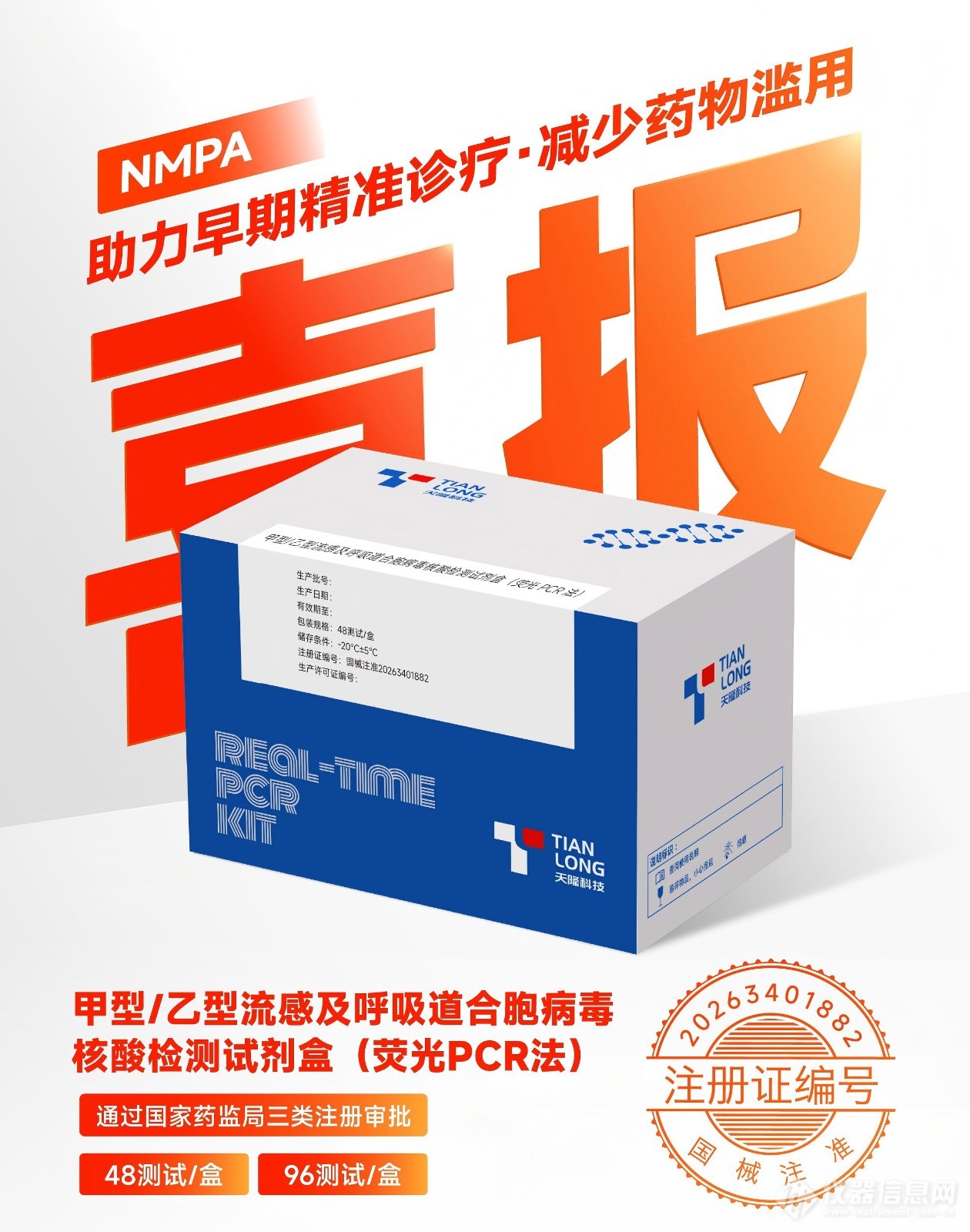
Advantages of Tianlong detection reagents:
High sensitivity:The lowest detection limit is 200 copies/mL, effectively reducing the risk of missed diagnosis of low-load samples
One tube for multiple tests:One tube simultaneously detects influenza A, B and respiratory syncytial viruses
Reliable results:The internal standard is monitored throughout the process to effectively avoid false negatives; the UNG-dUTP anti-pollution system reduces false positives caused by PCR product residues
Easy to operate:With the Tianlong automated extraction and amplification platform, the entire detection process can be completed in about 1 hour, greatly improving detection efficiency.
Respiratory tract infections are caused by various pathogens./B virus and syncytial virus need special attention
Influenza viruses (influenza A and B) and respiratory syncytial virus (RSV) are the main pathogens causing acute respiratory infections worldwide.. According to data from the World Health Organization, about 1 billion people around the world are infected with influenza viruses every year, including 3 to 5 million severe cases and 290,000 to 650,000 related deaths.; Respiratory syncytial virus is an important pathogen causing acute lower respiratory tract infections in children under 5 years old. Relevant dataIt shows that there were approximately 33 million cases of RSV-related acute lower respiratory tract infections among children under 5 years old globally in 2019.。
However, the early symptoms of influenza A, B and RSV infections are highly similar - fever, cough, sore throat and other symptoms are difficult to distinguish, and the epidemic seasons are highly overlapping, and the mixed infection rate remains high.. Research shows that among RSV-positive children, other respiratory pathogens can be detected in up to 35-40%; the overall pathogen co-infection in hospitalized children is 20.4%; RSV can be co-infected with influenza, rhinovirus, etc., making it an important mixed infection pattern in children's respiratory tract.
Authoritative consensus strongly recommends that accurate diagnosis is crucial
Treatment strategies may vary for different pathogens - InfluenzaThere are specific drugs such as oseltamivir and mabaloxavir available. Generally, after symptoms appear,It has the best effect when taken within 48 hours, and can effectively reduce severe illness and mortality. There is currently no specific treatment for RSV, and symptomatic and supportive treatment is the mainstay.. Influenza and respiratory syncytial virus are not bacteria and antibiotics are not effective. Therefore, rapid and accurate pathogen identification and diagnosis are the key to achieving precise clinical medication, reducing antibiotic abuse, and improving patient prognosis.
Currently, laboratory diagnostic methods for respiratory tract infections include virus isolation, antigen and antibody detection, and nucleic acid detection. Among them, nucleic acid testing has become the main recommended testing method in major guidelines and expert consensus due to its short window period, high sensitivity, and good specificity. In particular, multi-pathogen nucleic acid testing technology can quickly detect infectious pathogens and contribute to the differential diagnosis of respiratory pathogens.
The clinical value of Tianlong detection reagents
Let diagnosis return to clinical needs and treatment be based on evidence.
Quickly distinguish pathogens, guide rational use of drugs, and reduce the use of ineffective antibiotics: identify influenza infections, take specific drugs in a timely manner, and reduce severe illness and mortality; Detect RSV infection and implement symptomatic treatment.
Key screening of high-risk groups: Targeting infants, young children, the elderly, and immunosuppressed groups, we can quickly detect severe and high-risk viruses and provide early warning of disease progression.
Assist in nosocomial infection control: quickly identify sources of infection, assist in implementing isolation and protection, and reduce the risk of cross-transmission.
The minimum is sufficient and cost-saving: separate testing one by one will take a long time and consume a lot of samples; the broad-spectrum and large combination package will increase the testing cost. The triple test of A, B and RSV targets clinical high-frequency core pathogens to achieve "minimum enough for accurate screening", balance diagnostic performance and testing cost, and meet the actual needs of rapid outpatient triage.
Deeply explore molecular diagnosis and protect respiratory health. In the future, Tianlong Technology will continue to develop high-value molecular diagnostic products based on real clinical pain points, continue to output more complete detection solutions, empower medical institutions at all levels, and protect the respiratory health of the public.
References:
[1] WHO official website
[2] Li Y ,Wang X , Blau DM , et al. Global, regional, and national disease burden estimates of acute lower respiratory infections due to respiratory syncytial virus in children younger than 5 years in 2019: a systematic analysis[J]. Lancet, 2022,399(10340):2047-2064.
[3] Wanwan Sun, An Zhu, Zhiyong Zhu, et al. Multicenter Study on the Prevalence of Human Respiratory Syncytial Virus Coinfection and Disease Burden Among Hospitalized Children Aged 5 Years and Younger — 5 Prefecture-level Cities, Zhejiang Province, China, 2018−2023[J]. China CDC Weekly, 2025,7(4):137-143.
[4] Expert consensus group on the emergency diagnosis and treatment of acute respiratory viral infections in adults. Expert consensus on the emergency diagnosis and treatment of acute respiratory viral infections in adults [J]. Chinese Journal of Emergency Medicine, 2021, 30(12): 1417.
[5] National Key Laboratory of Diagnosis and Treatment of Severe Infectious Diseases, National Clinical Research Center for Infectious Diseases. Expert consensus on clinical diagnosis and treatment of respiratory tract infections during multi-pathogen epidemics [J]. Chinese Journal of Clinical Infectious Diseases, 2023, 16(6): 1-13.
[6] National Health Commission of the People's Republic of China, State Administration of Traditional Chinese Medicine. Influenza Diagnosis and Treatment Plan (2025 Edition) [J]. Chinese Journal of Clinical Infectious Diseases (Chinese and English), 2025, 18(1): 1.
[7] Chinese Medical Education Association Pediatric Professional Committee, Chinese Medical Association Pediatric Branch Respiratory Group, Chinese Medical Doctor Association Respiratory Physician Branch Pediatric Respiratory Working Committee, etc. Guidelines for Diagnosis, Treatment and Prevention of Respiratory Syncytial Virus Infection in Chinese Children (2024 Physician Edition) [J]. Chinese Clinical Journal of Practical Pediatrics, 2024, 39(10): 733-737.
[8] Zhejiang Provincial Center for Disease Control and Prevention, Children's Hospital of Fudan University, etc. Expert consensus on surveillance, prevention and control of human respiratory syncytial virus infection (2023) [J]. Chinese Journal of Clinical Infectious Diseases, 2023, 16 (05): 337-353.
[9] Chinese Laboratory Medicine Training Project Expert Committee. Expert consensus on the clinical application of nucleic acid detection technology for pathogen diagnosis of adult respiratory tract infections [J]. Chinese Journal of Laboratory Medicine, 2023, 46 (8): 789-797.
View More from This Booth
Tianlong respiratory 7-plex nucleic acid detection reagent has been approved! One tube for multiple inspections, accurate and efficient
Obtained certification for listing! Accurate typing facilitates rapid diagnosis, prevention and control of norovirus infection
Obtained certification for listing! Tianlong parainfluenza virus nucleic acid detection reagent passed NMPA Category III approval