
 Gold Member
 Business License
Popular Science | How to choose particle size analyzer calculation model Mie or Fraunhofer?
Introduction

How to choose between Mie and Fraunhofer? The easiest theoretical pitfall in laser particle size testing!
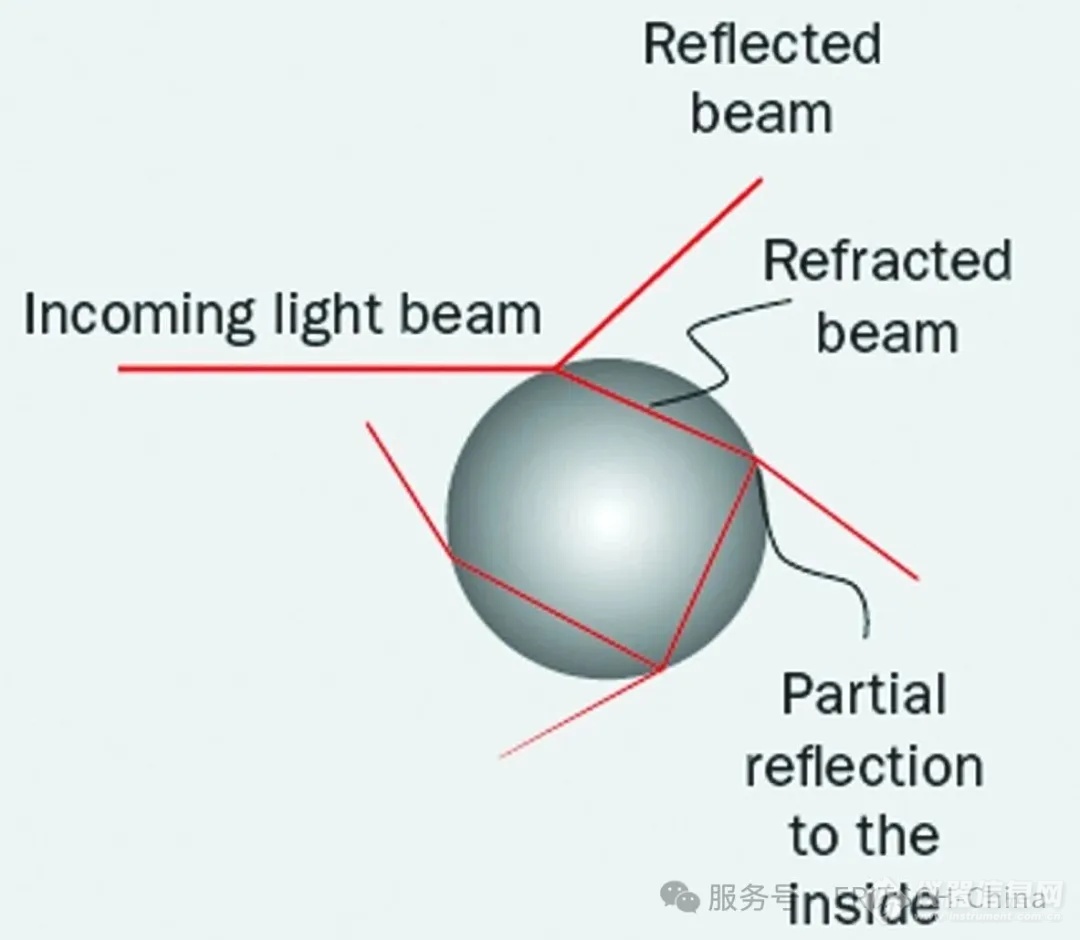
When doing laser diffraction particle size analysis, many users will encounter a very confusing phenomenon:For the same sample, the instrument hardware, sample preparation, and dispersion conditions remain unchanged. Just switching the calculation theory, D50 and D90 directly show obvious deviations.
Many people just default to the default settings of the instrument and never think about whether the model is suitable for their samples. If the theory is chosen incorrectly, no matter how expensive the instrument is or how perfect the pre-processing is, you will not be able to obtain true and reliable particle size results.
Today we use a popular way to dismantle the two core calculation models of laser granularity:Mie theoryandFraunhofer diffraction approximation。
PART 01
The underlying logic of the two computing models
Fraunhofer diffraction theory
It simply equates particles to opaque discs,Only diffraction effects at particle edges are calculated, ignoring the refraction, transmission and absorption of light.
✅Advantages: There is no need to enter the refractive index, and the operation is simple; for large particles (generally >50μm) and opaque mineral powders, the calculation results are reliable enough.
❌Limitations: For sub-micron and ultra-fine particles, significant deviations will occur; for transparent and translucent powders, the results will be distorted.
Mie Mie scattering theory
Completely solve Maxwell's electromagnetic equations, taking into account diffraction, refraction, reflection, and light absorption, and completely restore all interactions between light and particles.
✅Advantages: Suitable for all sizes of particles,Submicron, ultrafine pigments, and ceramic powders must be given priority to use Mie models, in line with the ISO13320 standard’s detection requirements for ultra-fine particles.
❌Limitations:The particle refractive index and absorption coefficient must be entered accurately; inaccurate refractive index parameters will also introduce result errors.。
PART 02
How to choose in practice, one suggestion and judgment principles
Particles are generally larger than 50μm, opaque minerals, refractive index unknown
👉The Fraunhofer model can be used directly.
Examples: sand and gravel, coarse mineral powder, large particle dry plant powder.
The sample contains a large number of submicron/micron fine particles; pigments, ceramics, emulsions, ultrafine fillers
👉The Mie model must be used first and the refractive index parameters must be checked.
Examples: Pigment dispersion, polishing powder, nano ceramic powder.
👉What should I do if I don’t know the exact refractive index of the sample?
- Prioritize checking the literature and manufacturer's material data sheet to obtain the refractive index;
- Do not fill in an estimated value casually. If the refractive index is wrong, the Mie model result will be inferior to the Fraunhofer model;
- 👉If conditions permit, control experiments can be conducted to compare changes in particle size distribution under different refractive indexes.
PART 03
Laboratory high-frequency trap case
Case 1: Submicron red pigment
The vast majority of particles in the sample are concentrated at 0.01-0.05μm. If you misuse the Fraunhofer model, you will mistakenly overestimate the proportion of large particles; switch Mie and fill in the correct refractive index of 2.02 to get the true particle size distribution.
Case 2: Coarse limestone powder, D50>100μm
The grains are coarse and opaque, and the output results of the Fraunhofer and Mie models are almost the same. Fraunhofer is completely adequate for this scenario.
Case 3: Transparent glass beads
Even if the particle size is not small, the Fraunhofer model will bring significant errors due to the light penetrating the particle, and the Mie mode is still recommended.
Conclusion

Some practical suggestions for daily testing
- Do not blindly follow the factory default model of the instrument; when you get a new sample, the first step is to determine the suitability of the model.
- When doing method verification, the model and refractive index must be completely written into the SOP. Do not just record D10/D50/D90. When changing personnel or instruments to reproduce the data, the model parameters must remain consistent.
- The calculation model and refractive index parameters used must be marked in the report to facilitate traceability and reproduction by others.
- When encountering sub-micron level samples, give priority to Mie; if you are not sure about the refractive index, you need to make a comparative evaluation and do not apply blindly.
View More from This Booth

Wet method actual measurement record|Particle size detection of red and yellow pigment dispersions
Micro sample cuvette unit unlocks a new solution for wet particle size analysis of micro samples

Stay away from health scams! How to uncover the disguise of “bad drugs”?