Gold Member
 Business License
Give the knob to AI and leave the judgment to you|Guoyi Quantum Electron Microscope AI Agent
Give the knob to AI and leave the judgment to you|Guoyi Quantum Electron Microscope AI Agent
On October 18, at the 2026 National Academic Annual Conference on Electron Microscopy, National Instruments Quantum officially released the electron microscope AI agent platform CIQTEK SEM Agent. The user only needs to state the task goal, and the agent can call more than 40 tools to autonomously complete the complete characterization process from selection, picture acquisition, image analysis to report writing. During the process, users can observe, take over, and review at any time, and professional judgment is always left in their own hands.
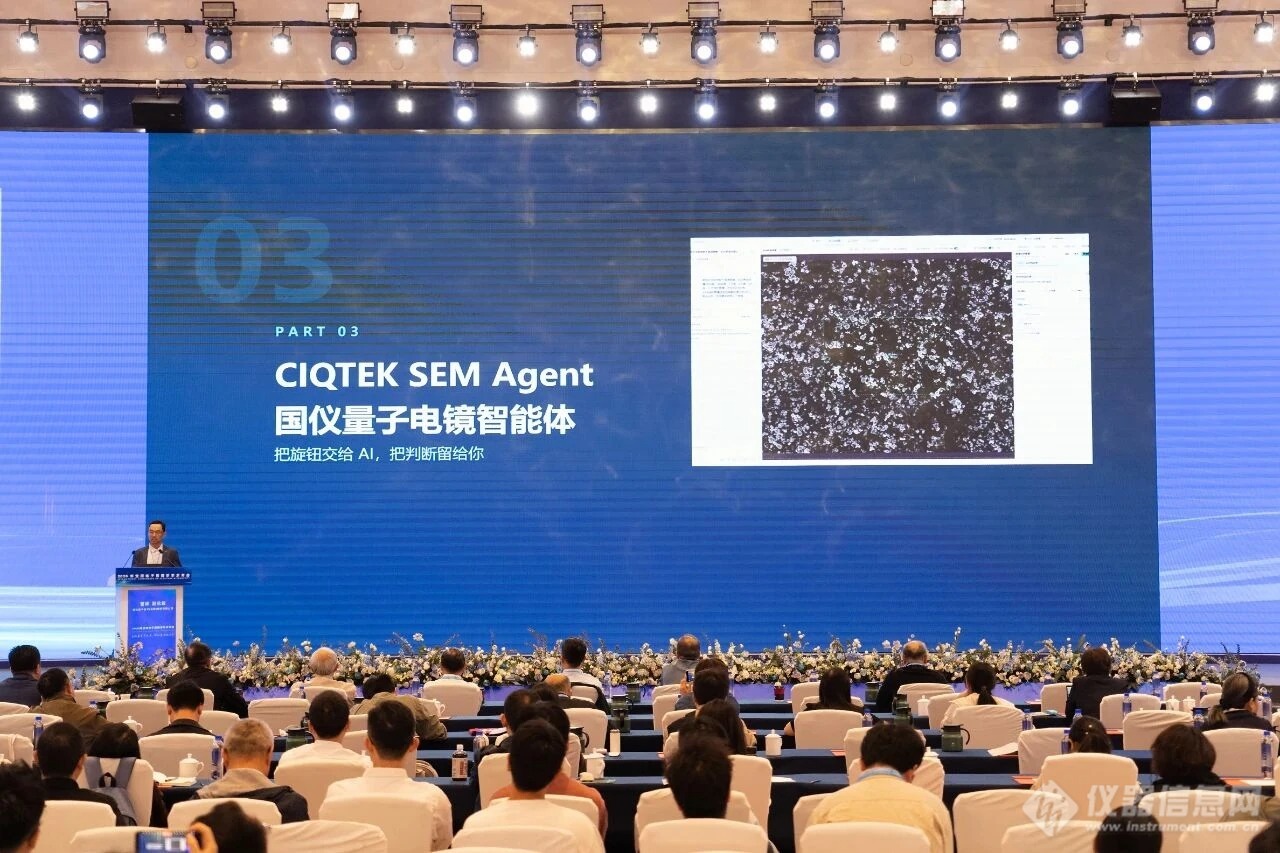
Give the knob to AI and leave the judgment to you
The output of an electron microscope depends not only on the performance parameters, but also on where the operator spends his time.. Adjusting parameters, finding samples, organizing data, and writing reports are all repetitive tasks that take up time that should be spent thinking about scientific issues. The equipment is getting more and more powerful, but people are still tied to the electron microscope.
Many problems are discovered through investigating user needs. Operations rely on experience, and mature methods are often only retained in personal experience and operation records; images, statistics, and reports must be repeatedly moved between different software; with a new task, one often needs to write an additional set of processes. Facing increasingly complex scientific research samples, the traditional manual model can no longer keep up.
Therefore, what users really need is the ability to complete the entire task: take pictures, analyze according to the requirements of this batch of samples, and then compile them into a reviewable report.
CIQTEK SEM AgentJust for this purpose. It is based on the electron microscope user experience and feedback accumulated by Guoyi Quantum for many years, and connects user goals, equipment capabilities and industry knowledge. Users type or speak clearly about the task, and the platform can use more than 40 tools to independently complete the complete task loop of "selecting areas, collecting pictures, image analysis, and writing reports" around scientific issues.
Three core competencies
01Closed loop of automated tasks: collection, analysis, and delivery, all in one go
Users can directly make requests, for example: help me photograph this lithium iron phosphate sample from 2,000 times to 100,000 times, organize the images and analysis results, and give a sample test report.
After the system receives it, it will complete the following steps:
1. Check status and imaging conditions
2. Adjust brightness, focus and eliminate astigmatism
3. Switch the magnification step by step and collect after focusing
4. Judge image clarity and analyze sample characteristics in real time
5. Save images and particle analysis data, and output sample testing reports
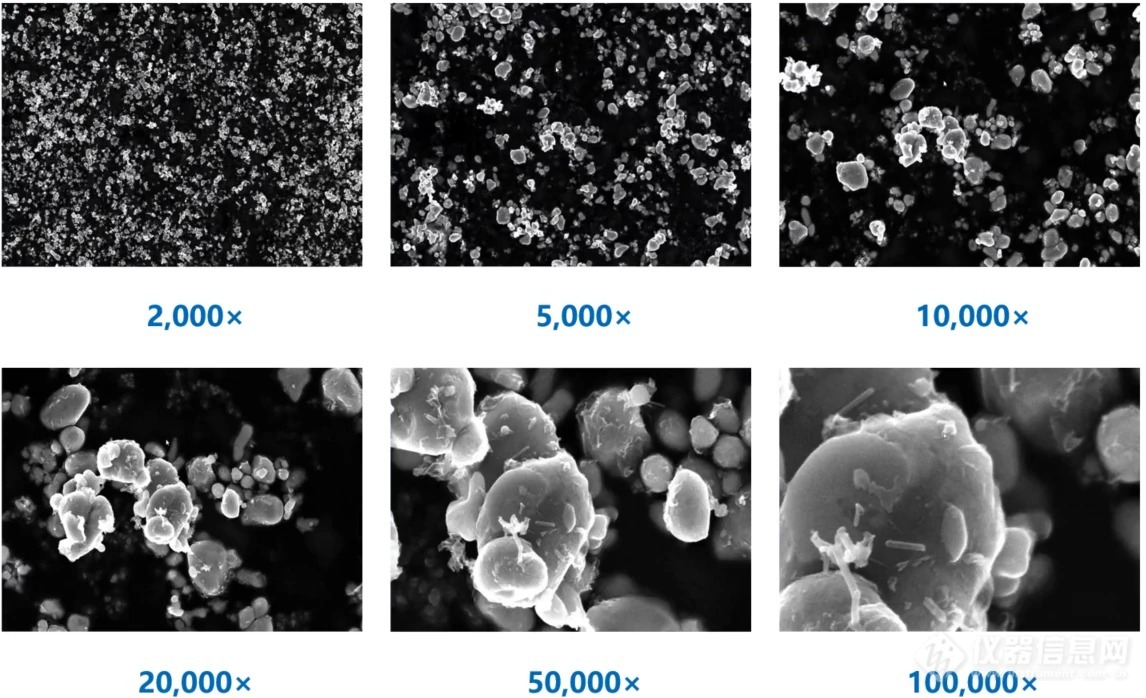 Lithium iron phosphate six-speed magnification image
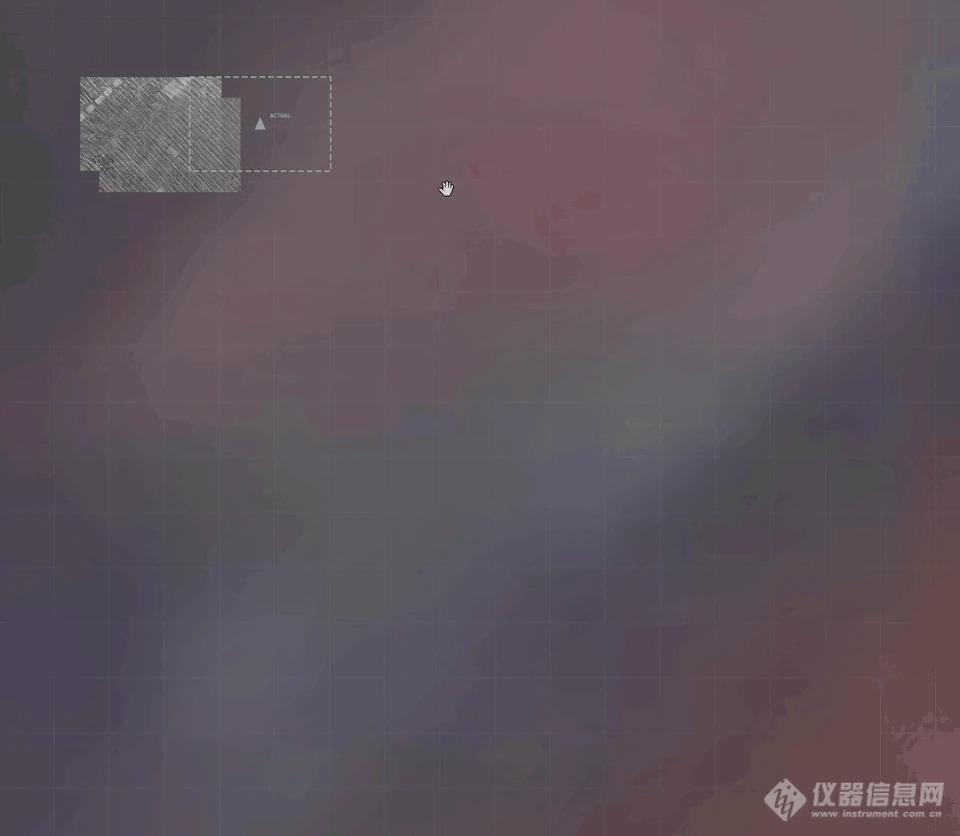
Large-scale collection is a typical task of Agent. In a chip demonstration,AgentAt 1,000 times, 70 points are collected in 7 columns and 10 rows, and each field of view is spliced into a whole. The position of each partial picture can be traced, and the work of manual positioning and post-processing of images is saved.
02Customized image analysis: state the goal, and the Agent gives the method and results
The user states the analysis goals, and the Agent is responsible for organizing the analysis methods and delivering the results. The platform currently supports particle size analysis, diamond wire measurement, nickel layer detection, defect analysis and other scenarios. It can complete segmentation, measurement, statistics and visualization around sample problems, reducing manual tracing, counting and result sorting.
The figure is kept intact to facilitate user review (the colored areas in the following analysis figures are used to distinguish and explain the target structure and do not represent the true color of the material.)
 Particle size and distribution analysis
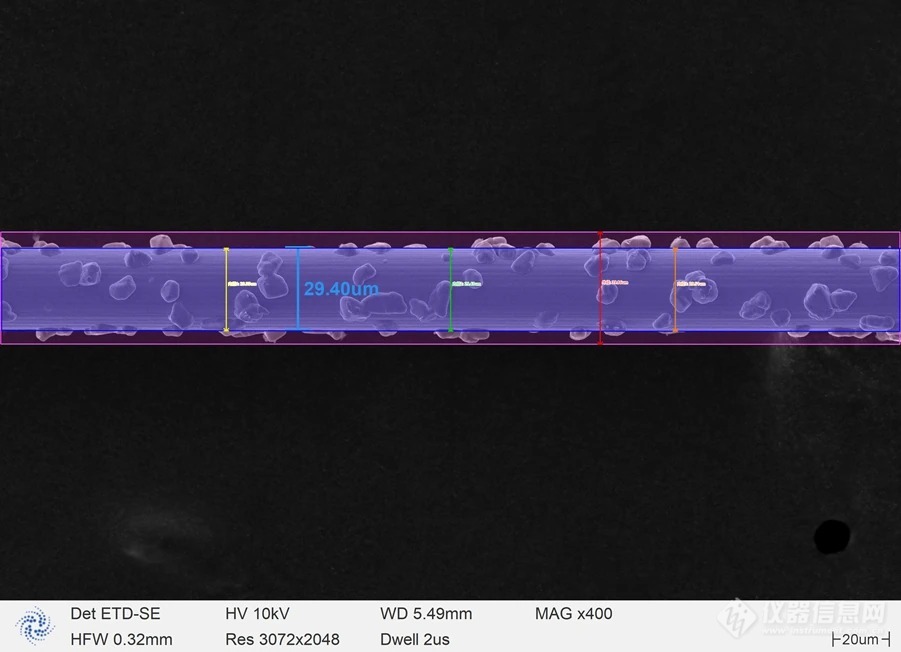 Diamond wire diameter measurement
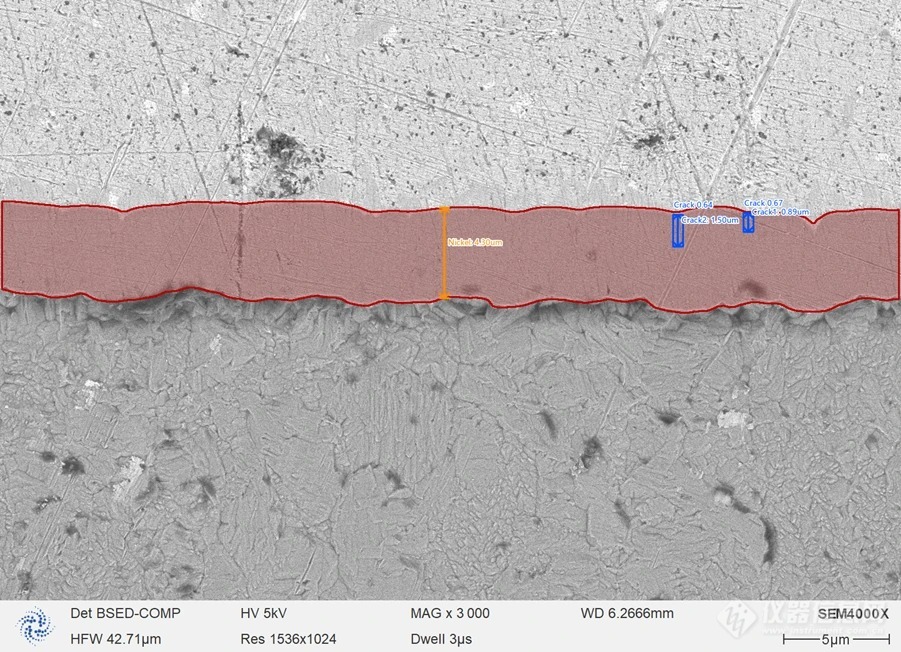 Nickel layer and defect analysis chart
03 Localization Skill: Let a successful experience become a sustainable ability
Skill is not a hard-coded script, but a precipitate of successful experience into an ability that can be called repeatedly, including applicable conditions, operating steps, required scripts and models, and reference materials. Once the method is settled, repeated operations on similar samples can be greatly reduced.
Take the PCB nickel layer shooting as an example: the Agent first reads the Skill to understand the shooting plan and techniques; then calls the model to identify the nickel layer and selects the next target; then tracks the nickel layer according to the Skill and continuously shoots; finally, it cycles through identification, positioning, collection and analysis, and generates a sample analysis report after the task is completed.
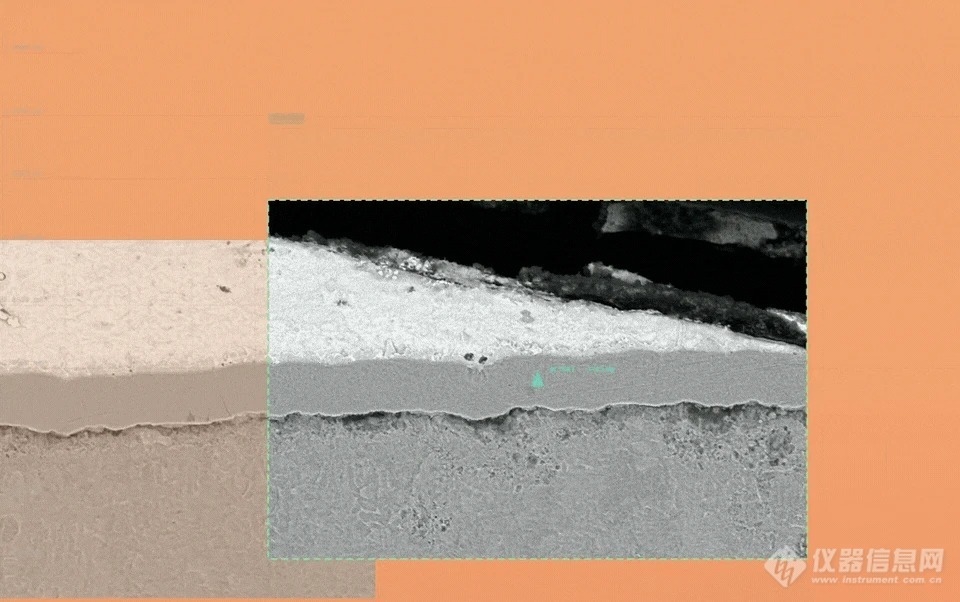 Nickel layer inflection point tracking example
Human-machine collaboration to clarify boundaries
When automating professional equipment, users must maintain control over the process.
CIQTEK SEM Agent can achieve:
observable: View the Agent task steps and execution progress, and understand the current situation at any time.
Can be taken over: Pause the task when adjustments are needed, allowing the user to intervene in key operations.
Can be reviewed: Compare the original image with the analysis results to retain the basis for professional judgment.
The agent is responsible for execution, and the user is responsible for judgment. Intelligence is not achieved overnight.
Capabilities must be made clear, and boundaries must also be made clear.
Intelligent parameter recommendation requires manual confirmation, and the agent gives suggestions, not conclusions.
In some analysis scenarios (such as fracture cause analysis), the experience accumulation is not enough, and the results may not be accurate enough.
Capabilities such as full unattended operation and automatic sample changing are part of the future planning of unmanned laboratories. Currently, automatic collection, image analysis and reporting under user supervision are supported.
Intelligent grading of electron microscopy: from L0 to L5
In the conference report, Guoyi Quantum proposed a six-level development route from L0 to L5, which clearly defined the division of labor boundaries between humans and machines at different stages. From L0 to L5, the machine's participation goes from 0 to 95%, and the human role changes from operator to questioner. Among them, L2 requires people to write the process in advance and be able to run the repetitive process smoothly and stably. However, when the samples are changed and the requirements change, the process must be rewritten. The dividing line between L2 and L3 is also here: L3 does not need to pre-write the process, just stake out and go, the machine will identify, plan and complete the full test by itself.
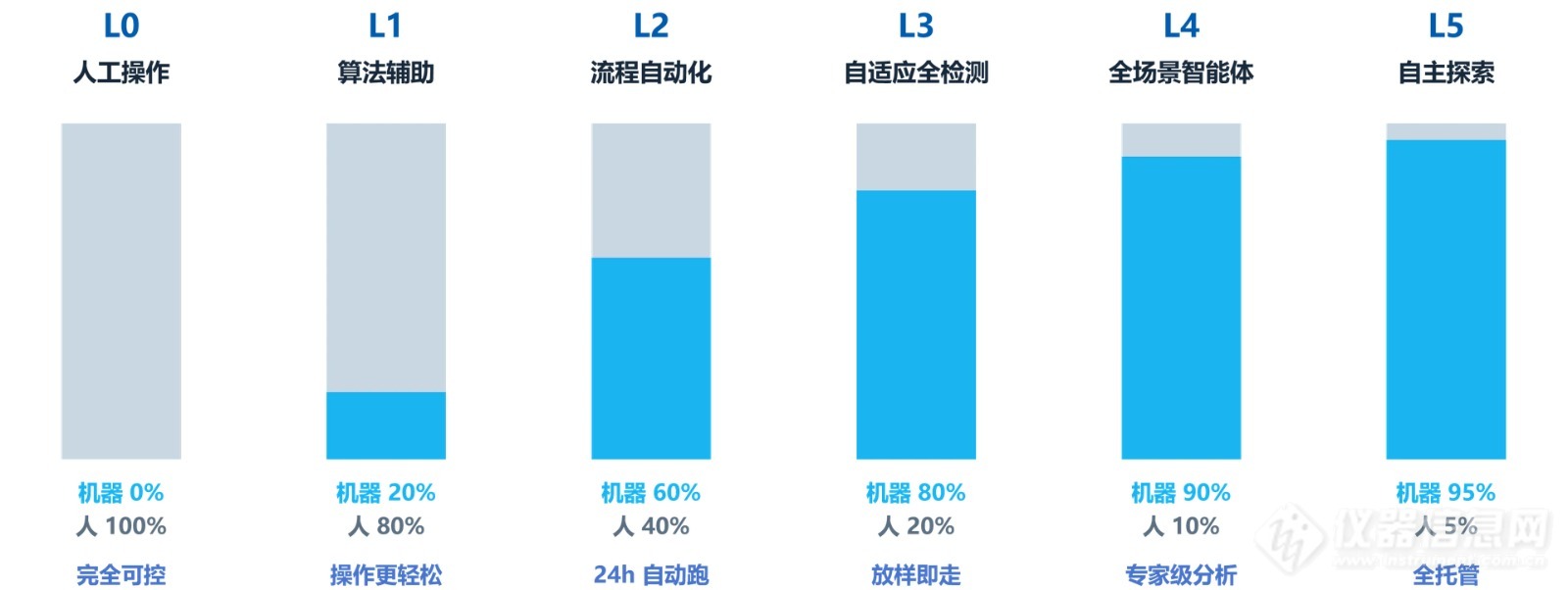
Guoyi Quantum Electron Microscope Intelligent Body is currently inL2 process automation stage, this is the level that is generally implementable in the industry at present, and is also the only way to move towards higher-level intelligence. From being well-made to being well-used, one company cannot complete the journey. Guoyi Quantum calls on the industry to jointly build and share, and to accumulate the methods of various companies into a reusable skill library, and move towards L3 together to make electron microscopy smarter and scientific research more efficient!
View More from This Booth

"Nature Materials"! How is graphene magnetism “seen”? Guoyi Quantum SNVM helps customers realize graphene spin

Guoyi Quantum Scanning Electron Microscope helps high-performance sodium ion batteries! Uncovering the stabilization mechanism of layered oxide cathodes
See the chip clearly and convey trust | Guoyi Quantum Field Emission Scanning Electron Microscope enters CTI CTI Weisibo