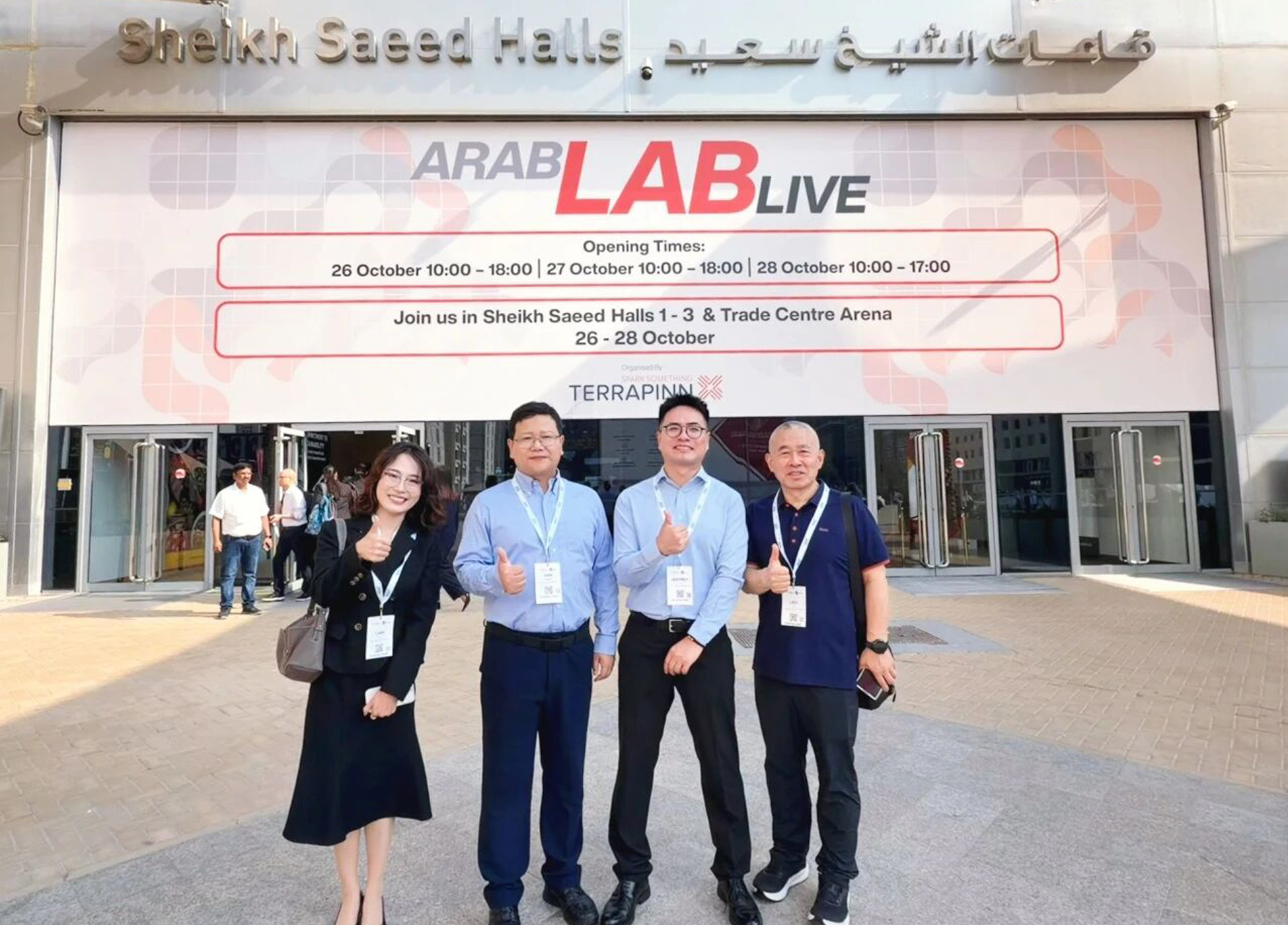
Being close to users continues from every meeting, Haineng goes to ARABLAB again
Company News
Oct 30, 2026

Many people may be curious,How can a desktop device replace a huge synchrotron radiation device?What specific problems can it help researchers solve? The answer lies in real experiments. Behind this report card is our in-depth empowerment of the entire scientific research process: we are not only the capturers of "dynamic processes", but also the ultimate arbiters of "static structures". Our in-situ technology allows scientists to "watch in real time" every critical moment of material transformation:
Insight into the catalytic “black box”:In real electrical, thermal, and photocatalytic reaction environments, the dynamic evolution of the catalyst's atomic structure, electronic state, and chemical valence state can be tracked in real time, and the real active center can be locked.
Decoding the battery secrets:At every moment of battery charging and discharging, the valence cycle and phase change process of electrode materials are monitored in real time, providing the most direct experimental evidence for improving battery performance.
Capture transient intermediates:Many key reaction intermediates are extremely short-lived. Our in-situ technology can capture these fleeting structural information like a "high-speed camera" and solve the mystery of reaction pathways.
Supporting breakthroughs in Peking University’s top journals:In the study of "J Am Chem Soc", the Peking University teamUsing our company's in-situ XAFS,The dynamic transfer of electrons from the Pd core to the Pt shell in the Pd@Pt core-shell catalyst was revealed, and the origin of the electronic structure of its enhanced OH adsorption and resistance to CO poisoning was clarified.
Join hands with Harbin Institute of Technology:In the study of "Nature Communications",Through our in-situ electrochemical cell,It was confirmed that the Cu@In(OH)₃ catalyst stabilizes the highly active Cu⁰-Cuδ⁺ sites through the ohmic contact interface under ampere-level current, achieving efficient nitrate reduction and ammonia synthesis.
Assist Zhejiang University in efficient transformation:In the study of "Nature Communications",The Zhejiang University team relied on our in-situ XAFS toDynamically monitor and confirm ZnO1-xThe critical stabilizing effect of the protective layer on Cu⁺ species reveals the volcano-type relationship between Cu⁺ ratio and ethanol Faradaic efficiency.
If in-situ technology is "process video", then ex-situ testing is "high-definition photos and precise measurements" before and after the reaction. It answers the most fundamental scientific question through detailed analysis of samples before and after the reaction: What does the material become?
In partnership with the National University of Singapore:In the results of "Advanced Materials",Relying on our XAFS systemIt is clarified that the Cu–N₄ coordination center of copper phthalocyanine (CuPc-R) remains intact during the reaction, providing the most direct structural evidence for the origin of the activity of the molecular catalyst.
Analysis of the collaborative mechanism to assist Tsinghua University:In the study "Angewandte Chemie",The Tsinghua team adopts our technology,The coexistence state and electronic structure of single atoms and clusters in the Ru/Co-TiO₂ catalyst were accurately analyzed, and the mechanism for synergistically improving the hydrogen production activity of ammonia borane hydrolysis was revealed.
Support environmental restoration research at Nanjing University:Among the results of "Nature Water",Through our XAFS analysis, the NTU teamRevealed the electron buffering mechanism of uranyl ions captured by Fe–O sites in LiFePO₄ electrode, laying a theoretical foundation for the development of nuclear wastewater remediation technology.
Numbers are results, cases are processes.It is these breakthrough results of cooperation with top research groups that have established the milestone of 400 articles.These cases are just the tip of the iceberg.From single-atom catalysis to high-entropy materials, from lithium-sulfur batteries to CO₂RR,RapidXAFS/XESIt has become an indispensable "sharp tool" in cutting-edge research in the fields of catalysis, batteries, environmental science and other fields.
1.
Full process data capabilities
From initial characterization before the reaction, to in-situ dynamic capture during the reaction, to precise ex-situ qualitative and quantitative analysis after the reaction, we provide complete data solutions covering the entire scientific research chain.
2.
Synchrotron radiation level performance
Ultra-high luminous flux and resolution ensure that whether it is transient capture or fine analysis,Data quality is benchmarked against synchrotron radiation,It is the "data cornerstone" published by top journals.
3.
Full scene adaptability
Compatible with various needs from extreme in-situ environments to routine non-situ testing, it providesDozens of special in-situ reaction cells from high temperature and high pressure, electrocatalysis, photocatalysis to battery charging and discharging,Truly designed for scientists.
4.
Extreme convenience and stability
Desktop design, fully automatic operation, training can be used in half a day.More than 90% of the core components are domestically produced and self-developed.There is no risk of "stuck neck", and the maintenance cost is extremely low, ensuring the continuous scientific research process.
5.
Top academic ecosystem
Choose from more than 200 universities and scientific research institutions,Including the University of Science and Technology of China, Zhejiang University, Tongji University, etc., they have built a strong user community and cooperation network to continue to feed back technology iterations.





When you visit any website, it may store or retrieve information on your browser, mostly in the form of cookies. This information might be about you, your preferences or your device and is mostly used to make the site work as you expect it to. The information does not usually directly identify you, but it can give you a more personalized web experience. Because we respect your right to privacy, you can choose not to allow some types of cookies. Click on the different category headings to find out more and change our default settings. However, blocking some types of cookies may impact your experience of the site and the services we are able to offer.