
 Gold Member
 Business License
Paper sharing|ASGPR mediates liver cancer targeting chitosan nanoparticles, SCIENTZ‑10N freeze dryer facilitates sample preparation
01Paper abstract
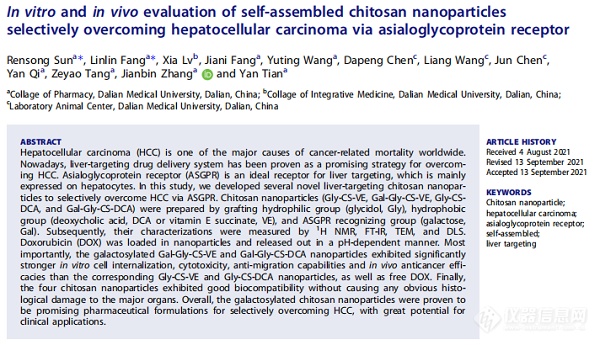
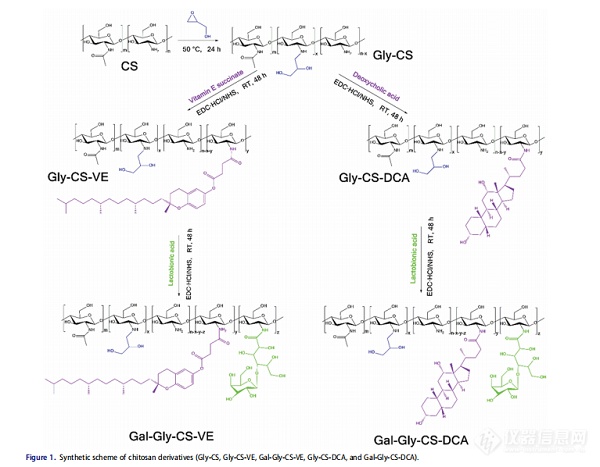
Ningbo Xinzhi Biotechnology Co., Ltd. (Scientz) SCIENTZ-10N freeze dryer supports the research on the preparation of chitosan nanoparticles. This carrier showed better tumor inhibition effect than free drugs and good biocompatibility in the H22 tumor-bearing mouse model. Hepatocellular carcinoma (HCC) is one of the leading causes of cancer-related deaths worldwide. Nowadays, liver-targeted drug delivery systems have proven to be a promising strategy to overcome HCC. Asialoglycoprotein receptor (ASGPR) is an ideal receptor targeting the liver and is mainly expressed on hepatocytes. In this study, we developed multiple novel liver-targeted chitosan nanoparticles aimed at selectively overcoming HCC through ASGPR. These chitosan nanoparticles (Gly-CS-VE, Gal-Gly-CS-VE, Gly-CSDCA and Gal-Gly-CS-DCA) are prepared by grafting a hydrophilic group (glycidyl alcohol, Gly), a hydrophobic group (deoxycholic acid, DCA or vitamin E succinate, VE) and an ASGPR recognition group (galactose, Gal).
Subsequently, ¹H NMR, FT-IR, TEM and DLS were used to characterize and analyze it. Doxorubicin (DOX) was loaded into nanoparticles and released in a pH-dependent manner. Experimental data show that galactosylated Gal-Gly-CS-VE and Gal-Gly-CS-DCA nanoparticles showed strong cell internalization ability and cytotoxicity in in vitro experiments, and showed certain anti-cancer effects in in vivo experiments. Finally, all four chitosan nanoparticles showed good biocompatibility and did not cause obvious histological damage to major organs. Overall, galactosylated chitosan nanoparticles have proven to be a promising pharmaceutical formulation to selectively overcome HCC and hold great promise in clinical applications.
02Xinzhi product support
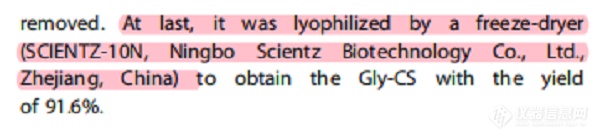
At last, it was lyophilized by a freeze-dryer (SCIENTZ-10N, Ningbo Scientz Biotechnology Co., Ltd.,Zhejiang, China) to obtain the Gly-CS with the yield of 91.6%.
Finally, a freeze-drying machine (SCIENTZ-10N, Ningbo Xinzhi Biotechnology Co., Ltd., Zhejiang, China) was used for freeze-drying, and Gly-CS was finally obtained with a yield of 91.6%.
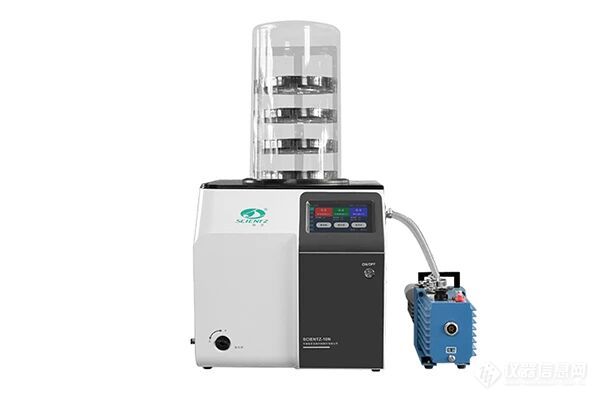
After the Gly-CS product is synthesized, the SCIENTZ-10N freeze dryer of Ningbo Xinzhi Biotechnology Co., Ltd. is used to complete the freeze-drying process to obtain the target product, with a product yield of up to 91.6%. In the preparation of samples such as polymer derivatives, nanocarriers, and biopolymers, freeze-drying can protect the sample structure to the greatest extent and avoid active components from being damaged by heat. It is an indispensable pre-treatment equipment for the research and development of nanomedicines.
03Research results
Material characterization
Successfully synthesized a series of amphiphilic chitosan derivatives; the nanoparticles are spherical, with a particle size of 150-200nm, and good dispersion; the drug-loaded nanoparticles have pH-responsive drug release, and the acidic tumor microenvironment accelerates the release of doxorubicin.
in vitro cellular level
The galactose group mediates ASGPR receptor recognition and improves the uptake of nanoparticles by HepG2 liver cancer cells; it exhibits certain tumor cell killing and migration inhibition effects.
In vivo animal efficacy
In the H22 tumor-bearing mouse model, the tumor inhibitory effect of galactose-modified nanoparticles is better than that of free drugs and non-targeted nanoparticles.
biosecurity
Blood biochemical indicators and H&E tissue section results of major organs prove that the carrier has good biocompatibility and no obvious organ toxicity.
Source of the paper:
In vitro and in vivo evaluation of self‑assembled chitosan nanoparticles selectively overcoming hepatocellular carcinoma via asialoglycoprotein receptorDrug Delivery, 2021.28 (1):2071‑2084|DOI: 10.1080/10717544.2021.1983077|Dalian Medical University
View More from This Booth

Meet SCIENTZ at Analytica China 2026
Paper sharing | Xinzhi JY92-IIDN facilitates the study of ultrasound-assisted L-glutamic acid crystallization, revealing the kinetic mechanism of polymorphic transformation for the first time
Paper sharing | Xinzhi SCIENTZ-12N/D freeze dryer facilitates research on the regulation of functional groups of two-dimensional carbon nanosheets
Paper sharing | Can pH 1.0 also grow? Xinzhi MGC-500 monitors the growth curve of Enterococcus faecium in extreme environments throughout the process