
 Gold Member
 Business License
NanoTemper's new variable temperature control | gives you more confidence in in-depth characterization of protein stability
In biopharmaceutical R&D, a single thermal scan often cannot tell us the whole truth. Take trastuzumab (Herceptin) as an example: the conventional thermal denaturation curves of the two buffer systems differ slightly, TmThe values are so similar that traditional experiments can hardly distinguish which buffer is "safer". But in actual development, choosing the wrong buffer can mean huge downstream risks—irreversible aggregation, quality batch failure, and even project delays. This is exactlyPrometheus Panta temperature control (Temperature Control)The significance of the debut of new features.
What is Temperature Control?
Temperature Control is a newly launched measurement mode in PR. Panta Control software, providing two experimental forms:
Temperature Cycling: Let the temperature rise and fall repeatedly according to a custom curve to simulate real thermal stress scenarios
Temperature Stepping: Gradually raise the temperature in a controlled step manner to finely analyze the protein behavior at each temperature node
Both modes can simultaneously collect nanoDSF, backreflection, DLS and SLS data - one experiment, multi-dimensional deep insights.
Why is this important? ——Revealing the irreversible expansion
Back to the Herceptin case:
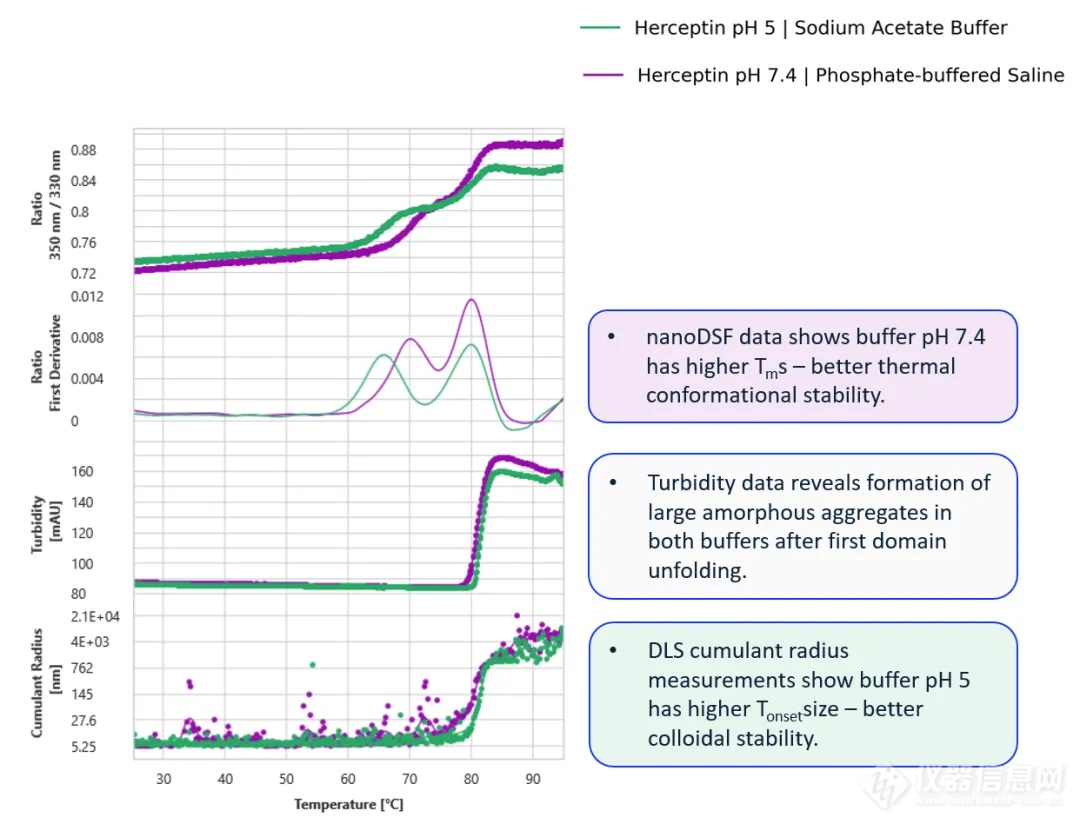
Figure 1: Conventional thermal denaturation multiparameter curves of Herceptin in sodium acetate buffer (pH 5, green) and PBS (pH 7.4, purple). From top to bottom: nanoDSF ratio curve, ratio first derivative, turbidity (Turbidity) and DLS particle size (Cumulant Radius)Change curve with increasing temperature.
It can be seen from the first derivative peak position that T under the condition of pH7.4mThe value of 1 is slightly higher; the turbidity curve shows that a large number of amorphous aggregates appear in both buffers after the first domain unfolds; the DLS data shows the aggregation onset temperature of pH5 (Tsize) slightly higher. However, the differences in the overall curves are subtle - it is difficult to confidently make a conclusion based on this set of data aloneoptimal preparationselection, which is where the Temperature Control mode comes into play.
In normal mode, the two curves are almost "even". After switching to Temperature Cycling mode, the picture is completely different:
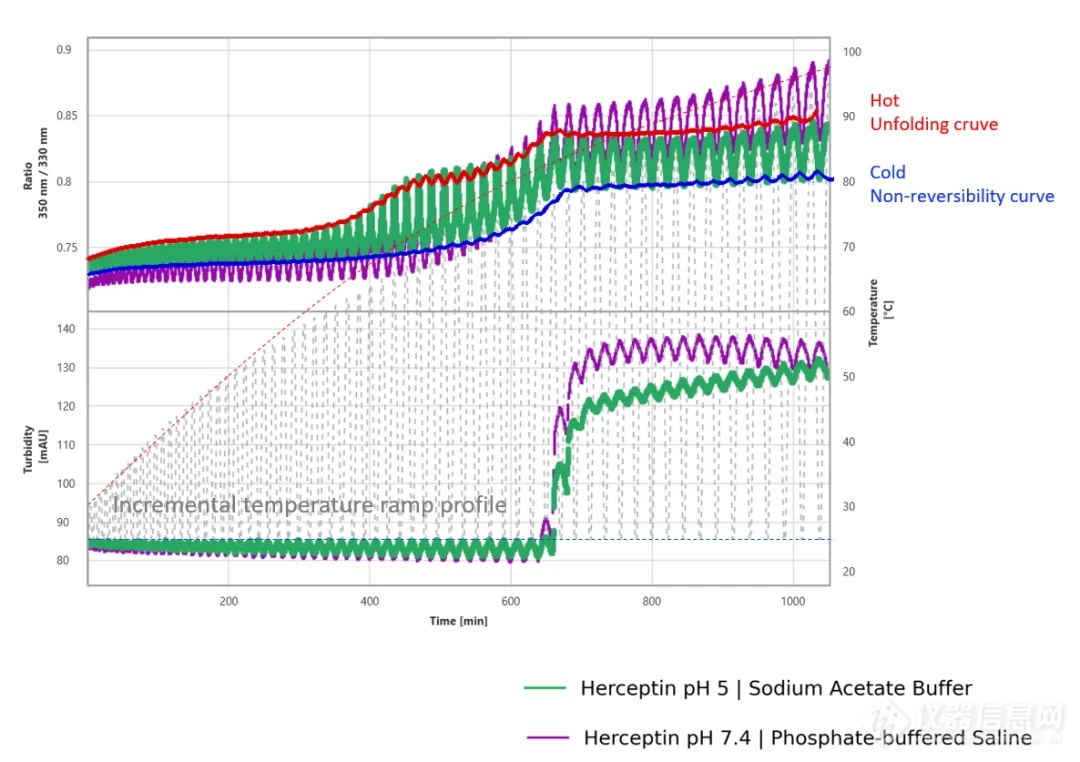
Figure 2: Herceptin’s nanoDSF ratio raw data in Temperature Cycling mode.
The gray dotted line is the incremental ramp profile, and green and purple represent the two buffer systems respectively. The upper data points of each data trajectory are composed of"Thermal curve"(hot curve, reflecting the expansion process), composed of lower end data points"cold curve"(cold curve, reflecting the degree of irreversible unfolding), both of which together reveal the stability behavior of the protein.deep information。
After further extracting the first derivative of the cold/hot curve, the conclusion is clear at a glance:
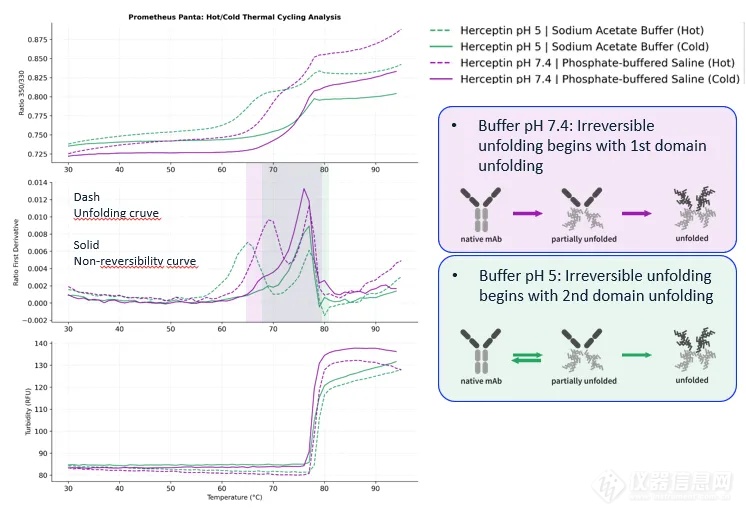
Figure 3: First derivative analysis of the reversibility of thermal expansion of Herceptin in two buffers. The dotted line is the hot curve (expansion curve), the solid line is the cold curve (irreversible expansion curve), and the colors correspond to the respective buffer systems.
pH 7.4 (purple): The first peak of the cold curve appears simultaneously with the hot curve, indicating that irreversible unfolding occurs when the first domain unfolds, and there is a risk of aggregation at any temperature. pH 5 (green): The peak of the cold curve is delayed until the second domain is unfolded, resulting in a wider stability window and significantly reduced risk of aggregation. in conclusion: Sodium acetate buffer (pH 5) should be selected to avoid the risk of irreversible unfolding of the CH2 domain of Herceptin。
Temperature Control covers the entire R&D process
R&D stage | core value |
Developability assessment | Early screening of candidate molecules prone to irreversible aggregation under mild thermal stress |
Downstream process development | Clarify the safe operating temperature range of downstream processes and support the design space definition of the filling-finishing process |
Formulation development | Rank formulation conditions based on thermal reversibility curves and define temperature exposure limits |
AI-ready data unlocks more possibilities
Panta data can be exported to Excel, CSV and JSON formats. With LLM tools, scientists can flexibly customize the data analysis process - the combination of high-density nanoDSF data and AI tools allows stability characterization to move from "experiment" to "decision-making".
As an industryonlyA platform that combines Temperature Cycling and Stepping with multi-parameter simultaneous detection, Prometheus Panta helps biologics development teams:
Early identification of high-risk candidate molecules and agents
Deeper understanding of protein stability mechanisms
Make confident development decisions faster

Attention Existing Panta Users‼ ️
The Temperature Control function has been launched with PR.Panta Control v1.11 and can be unlocked through software upgrade without purchasing new instruments. The limited-time promotion is ongoing, please contact our technical team for details.
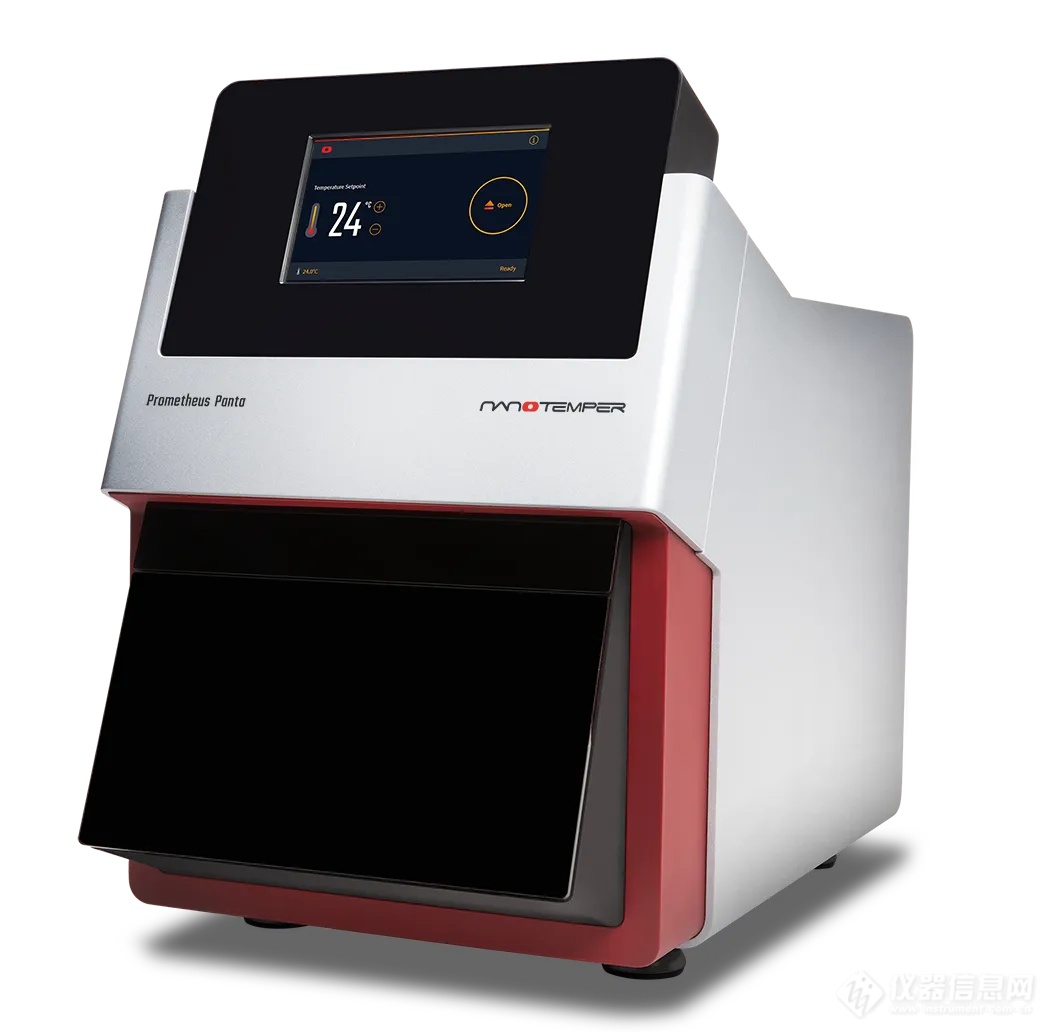
Prometheus Panta Protein stability analysis platform
"Comprehensive characterization of protein conformation, colloidal and chemical stability"
Four major technical modules: Micro differential scanning fluorescence nanoDSF, backreflection, dynamic light scattering DLS, static light scattering SLS, can be flexibly upgraded and can be turned on at the same time
No need to label samples: Utilizes protein endogenous fluorescence detection without adding dyes, and can perform label-free Thermal Shift Assay
Easy to operate: Only 10μL sample is required, loaded through capillary action, and detected immediately by “sucking” and “releasing”
The automated robotic arm can be upgraded to achieve fully automatic and unattended operation.
Detergent compatible for detection of high viscosity samples
No fluid flow system, maintenance-free
View More from This Booth

New Product | Monolith Omni, a one-stop solution for multifunctional molecular interaction and stability analysis

Academician Rao Zihe’s team makes intensive reading | NanoTemper helps you pass the structural biology challenges with one click

Look at "AI + high-precision characterization" to increase the "stability" of China's innovative drugs overseas