

 Gold Member
 Business License
Environmental monitoring station selection dilemma: How portable mass spectrometers can solve the problem of on-site trace detection
Equipment selection for environmental monitoring stations seeks a balance between accuracy, efficiency and operability. Traditional laboratory mass spectrometers often take several days from sampling to reporting, making it difficult to deal with sudden pollution incidents. This article combs through the three contradictions of on-site trace detection, analyzes the technical response of portable mass spectrometers in terms of sensitivity, analysis speed and operating threshold, and gives applicable scenarios and selection considerations for on-site detection of water quality and atmosphere.
Equipment selection for environmental monitoring stations is essentially about finding a balance between accuracy, efficiency and operability. Although traditional laboratory mass spectrometers have high sensitivity, the steps of sample transportation, pre-processing, instrument preheating, etc. are superimposed, so it often takes several days from sampling to issuing a report. For sudden water pollution events or abnormal atmospheric emissions, this lag means that the decision-making window is compressed or even missed.
The triple contradiction of on-site testing
The selection dilemma faced by environmental monitoring stations can be summarized into three dimensions.
The first is the contradiction between sensitivity and portability. The detection limit of laboratory mass spectrometers can reach the ppt level (parts per trillion), but the equipment is bulky and has strict requirements on environmental temperature and humidity, making it impossible to move to the sampling site. Although portable equipment solves the space problem, it often compromises on core indicators such as ionization efficiency and mass resolution, resulting in a decrease in the detection ability of trace substances.
The second is the contradiction between analysis speed and data quality. On-site rapid screening usually relies on semi-quantitative methods such as test strips and portable photometers, which can provide results within a few minutes, but cannot complete qualitative confirmation. This type of method is not reliable enough when the detection target is volatile organic compounds (VOCs) or polycyclic aromatic hydrocarbons (PAHs) that require precise identification of molecular structures.
The third is the contradiction between operating threshold and staffing. The operation of mass spectrometers usually requires professional training, and the technical staff of grassroots environmental monitoring stations is limited, making it difficult to equip full-time mass spectrometer analysts. If the equipment is too complex, the actual usage rate will be far lower than the purchase expectation.
Why mass spectrometry is suitable for on-site trace detection
The core advantage of mass spectrometry lies in the physical quantity "mass-to-charge ratio" - which directly corresponds to the intrinsic properties of the molecule, rather than relying on color changes or electrical signal drifts due to chemical reactions. This means that mass spectrometry data has higher confirmability and can distinguish isomers and identify unknown contaminants.
To miniaturize and deploy mass spectrometry technology to the field, key engineering issues that need to be solved include: the stability of the ion source (vibration and temperature fluctuations in the field environment are much greater than in the laboratory), the miniaturization of the vacuum system (traditional molecular pumps are large in size and have high power consumption), and the automation of data collection and analysis (to reduce manual intervention). The degree of breakthrough of these technical bottlenecks determines whether the portable mass spectrometer can truly replace the traditional process of "sampling-submitting for inspection-waiting for reports".
Trace analysis capabilities of Anyipu portable mass spectrometer
Suzhou Anyipu's technological accumulation in the field of portable mass spectrometers is reflected in its systematic response to the above-mentioned engineering problems.
In water quality testing scenarios, the challenge that equipment needs to deal with is matrix interference—dissolved organic matter and inorganic salts in water samples will compete with target pollutants for ionization efficiency. By optimizing ionization parameters and mass filtration strategies, the Anyip portable mass spectrometer can maintain the detection capability of trace organic pollutants in complex matrices. For common target substances such as benzene series, chlorinated hydrocarbons, and pesticide residues in surface water and industrial wastewater, the equipment can complete the entire process analysis from sampling to qualitative and quantitative analysis on site, and the detection limit meets the requirements of environmental monitoring standard methods.
In atmospheric detection scenarios, the response speed of the equipment and the efficiency of gas sampling are key. Anyipu portable mass spectrometer uses direct injection or thermal desorption pre-concentration to complete the screening and confirmation of VOCs in the air within minutes. For chemical park boundary monitoring and emergency traceability of sudden air pollution incidents, this capability can compress the analysis cycle that originally took days to the hour level.
Simplified design of operating procedures
The actual value of the equipment depends not only on the technical indicators, but also on the operator's ability to stably reproduce these indicators in real scenarios. The design idea of the operation process of Anyipu portable mass spectrometer is to reduce the impact of human variables on data quality.
In the sampling process, water quality testing uses standard sampling bottles to collect and inject samples directly, while atmospheric testing collects gas samples through sampling tubes or Soma tanks, without complex on-site pre-processing. After the instrument is started, the system automatically completes preparations such as vacuum establishment and parameter calibration. The operator only needs to select the corresponding detection method template. During the data acquisition phase, the built-in spectral library matching algorithm automatically compares the measured mass spectrum with the standard spectrum to provide qualitative results and concentration estimates. The entire process, from startup to report issuance, can typically be completed within 30 minutes.
This design lowers the operational threshold—technicians at grassroots monitoring stations can operate independently after short-term training without relying on on-site support from mass spectrometry experts.
Pragmatic considerations for technology selection
When an environmental monitoring station evaluates a portable mass spectrometer, the core indicators that need to be paid attention to include: whether the detection limit of the target pollutant meets the requirements of local emission standards or environmental quality standards, whether the time consumed by a single analysis matches the time window of emergency response, and whether the maintenance cycle of the equipment and the cost of consumables are within the budget.
The technical route of Anyipu portable mass spectrometer is to seek an engineering balance between trace detection capabilities and on-site operability. It is not intended to replace high-precision mass spectrometry analysis in laboratories, but to fill the capability gap in the "on-site rapid confirmation" link - allowing monitoring stations to obtain reliable data as soon as possible when facing unexpected pollution incidents, instead of waiting for laboratory reports days later.
View More from This Booth

Liquid chromatography mass spectrometry-Anyipu TQ9100 method for detecting the content of fat-soluble vitamins in human serum

Method for determination of 36 antibiotic drugs in pork using Anyeep TQ9120 ultra-high performance liquid chromatography tandem mass spectrometry system

Liquid Chromatography-Mass Spectrometry-Method for Detection of 17 Perfluorinated Compounds in Drinking Water
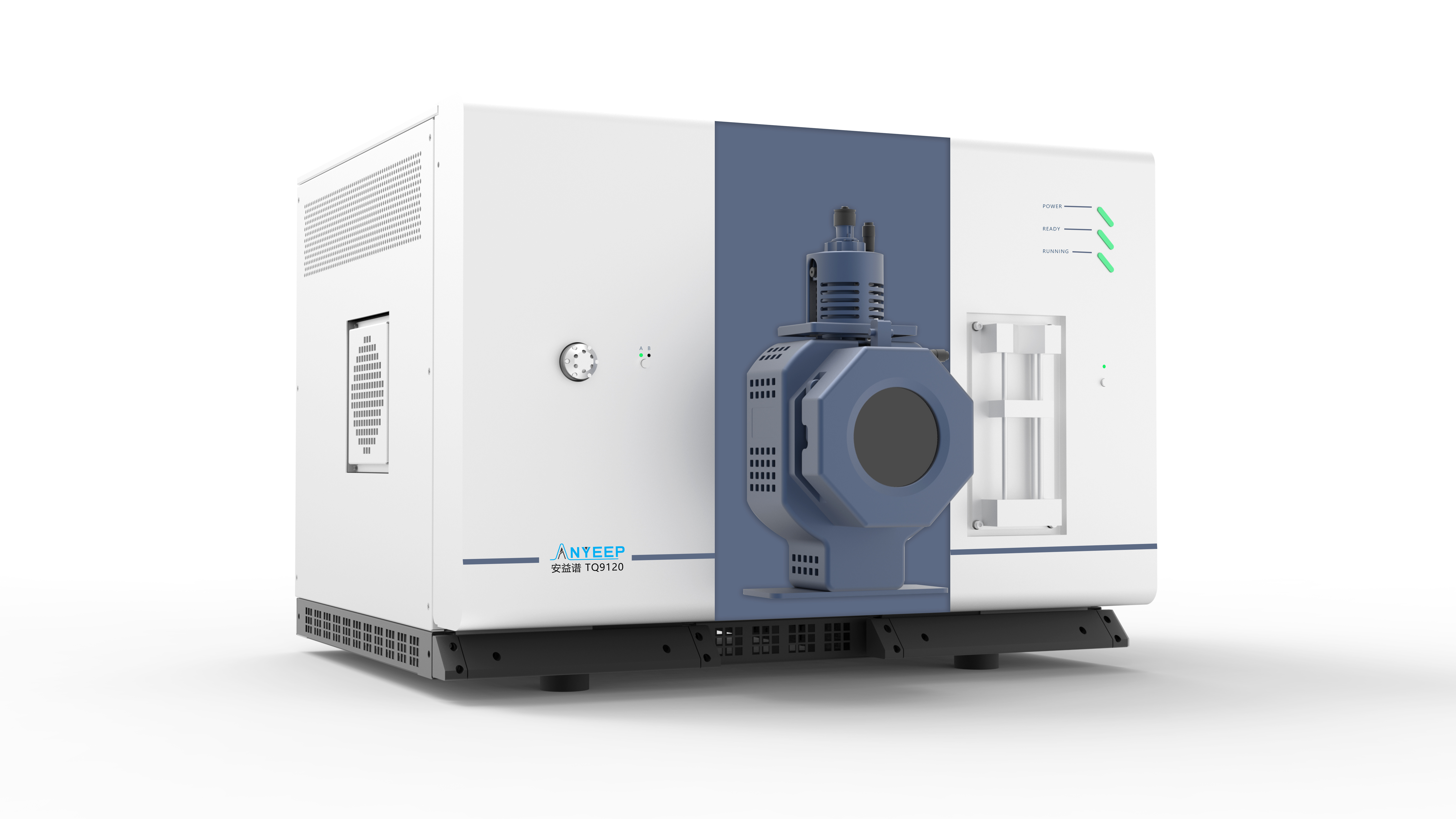
Method for determination of 9 organophosphorus in aquatic products using Anyeep TQ9120
Recommended Products
