

 Gold Member
 Business License
Liquid Chromatography-Mass Spectrometry-Method for Detection of 17 Perfluorinated Compounds in Drinking Water
introduction
Perfluorinated compounds are persistent and bioaccumulative,Accumulation levels hundreds to thousands of times higher than known organochlorine pesticides and dioxins。Perfluorinated compounds have various toxicities such as reproductive toxicity, mutagenic toxicity, developmental toxicity, neurotoxicity, and immunotoxicity. They are a type of environmental pollutant with systemic multi-organ toxicity.. "GB 5749-2022 Hygienic Standards for Drinking Water" clearly stipulates the detection limits for perfluorooctanoic acid, perfluorooctane sulfonate, etc. in drinking water.
This article developed a method for the simultaneous detection of 17 perfluorinated compounds in drinking water based on the relevant requirements for the detection of perfluorooctanoic acid in Section 84 of "GB/T 5750.8-2023 Standard Test Methods for Drinking Water Part 8: Organic Indicators".
Instruments and reagents
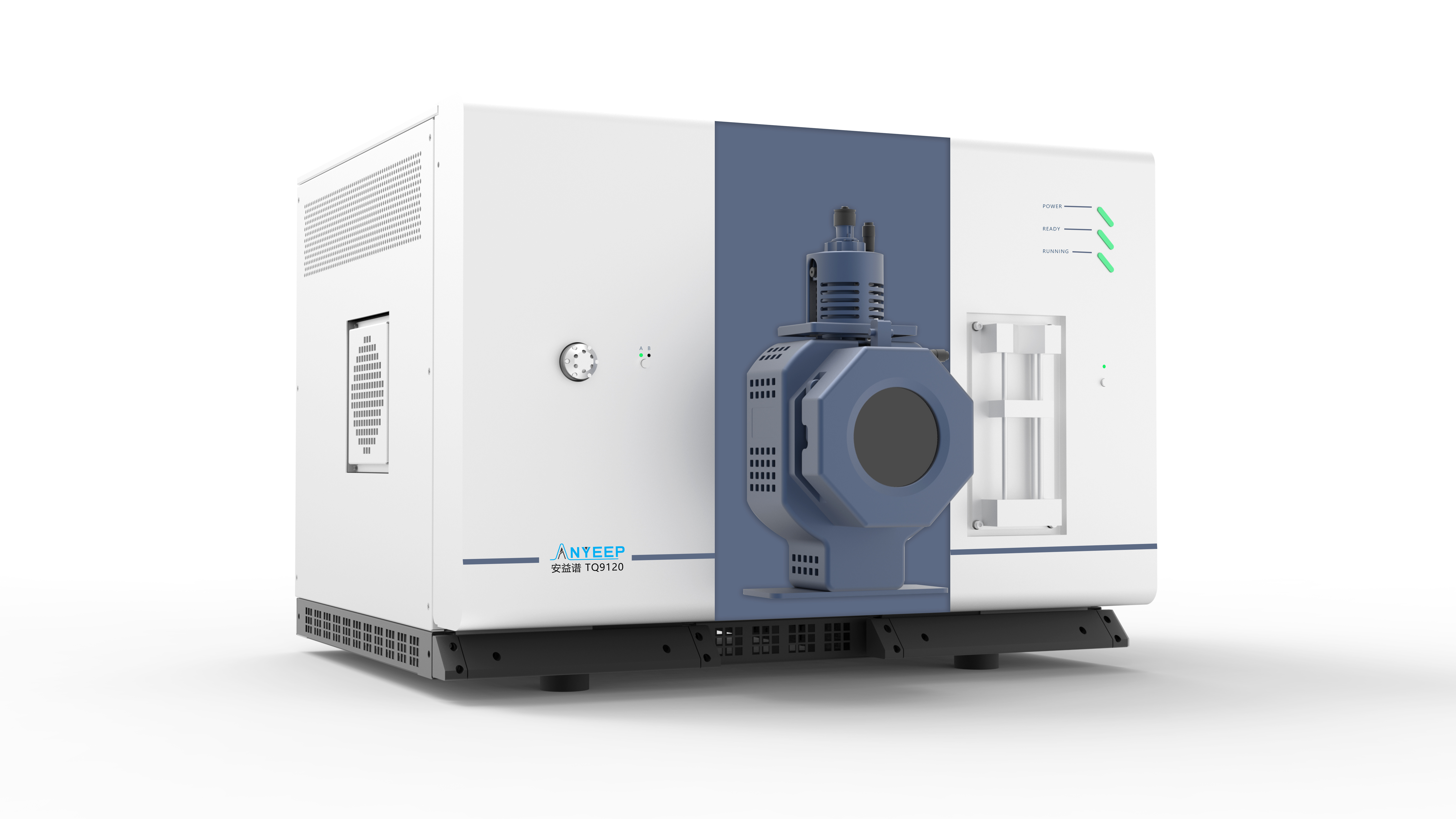
Anyeep TQ9120Ultra-high performance liquid chromatography tandem mass spectrometry system
Methanol (mass spectrometry pure, Thermo Fisher Company, USA)
Acetic acid, ammonium acetate(Chromatographypure,German Merk Company)
ammoniawater(Analytically pure, Shanghai Anpu)
Mixed standards of 17 perfluorinated compounds(Beijing Tan Mo,81589x)
3 kinds of perfluorinated compounds internal standard mixed standard (Beijing Tanmo, 83216x)
Anion exchange solid phase extraction column(Shanghai Anpu, SBEQ-CA3881)
liquid phase conditions
Mobile phase A:water, containing 5mM ammonium acetate
Mobile phase B: methanol
column: Waters Acquity UPLC BEH C18,1.7 µm, 2.1 × 100 mm
flow speed: 0.3 mL/min
column temperature: 40 ℃
Injection volume: 5 μL
Mass spectrometry conditions
Ionization source: Electrospray ionization source (ESI-)
source temperature Spend: 550 ℃
Spray voltage: 4500 V
gas curtain gas: 30 psi
fog change gas: 60 psi
auxiliary help gas: 60 psi
bump Collide gas: 11
Scan mode:MRM
Gradient elution procedure
time min | A % | B % | Flow rate mL/min |
0.0 | 80 | 20 | 0.3 |
1.5 | 60 | 40 | 0.3 |
10.0 | 10 | 90 | 0.3 |
10.1 | 2 | 98 | 0.3 |
12.0 | 2 | 98 | 0.3 |
12.1 | 80 | 20 | 0.3 |
14.0 | 80 | 20 | 0.3 |
MRM parameters of the analyte
Object to be tested | Q1 ion | Q3 ion | CE(V) | DP(V) |
PFBA perfluorobutyric acid | 212 | 169* | 2 | 30 |
212 | 97 | 2 | 30 | |
PFPeA perfluoropentanoic acid | 263 | 219* | 45 | 30 |
263 | 69 | 4 | 30 | |
PFHxA perfluorohexanoic acid | 313 | 269* | 15 | 30 |
313 | 119 | 4 | 30 | |
PFHpA Perfluoroheptanoic acid | 363 | 319* | 14 | 30 |
363 | 169 | 2 | 30 | |
PFOA perfluorooctanoic acid | 413 | 369* | 12 | 30 |
413 | 169 | 2 | 30 | |
PFNA Perfluorononanoic acid | 463 | 419* | 14 | 30 |
463 | 169 | 2 | 30 | |
PFDA Perfluorodecanoic acid | 513 | 469* | 14 | 30 |
513 | 219 | 5 | 30 | |
PFUnDA Perfluoroundedanoic acid | 563 | 519* | 15 | 60 |
563 | 319 | 6 | 60 | |
PFDoDA perfluorodecanoic acid | 613 | 569* | 20 | 60 |
613 | 169 | 6 | 60 | |
PFTrDA Perfluorotridecanoic acid | 663 | 619* | 22 | 60 |
663 | 169 | 6 | 60 | |
PFTeDA perfluorotetradecanoic acid | 713 | 669* | 24 | 90 |
713 | 169 | 10 | 90 | |
PFHxDA perfluorohexadecanoic acid | 813 | 769* | 28 | 120 |
813 | 169 | 12 | 120 | |
PFODA perfluoroctadecanoic acid | 913 | 869* | 38 | 120 |
913 | 169 | 58 | 120 | |
PFBS perfluorobutane sulfonate | 299 | 80* | 56 | 90 |
299 | 99 | 68 | 90 | |
PFHxS PFHxS | 399 | 80* | 68 | 120 |
399 | 99 | 70 | 120 | |
PFOS PFOS | 499 | 80* | 68 | 150 |
499 | 99 | 80 | 150 | |
PFDS perfluorodecanesulfonic acid | 599 | 80* | 80 | 180 |
599 | 99 | 2 | 180 | |
PFHxA-13C2 | 315 | 270 | 15 | 30 |
PFOA-13C4 | 417 | 372 | 12 | 30 |
PFOS-13C4 | 503 | 80 | 68 | 150 |
Note: * is the quantitative ion transition
Sample processing
Measure 1 LWater sample to be tested,Join 4.625 g ammonium acetate, acetic acidadjustpHto 6.8 - 7.0,Add to each liter of water sample100 μg/LIsotope internal standard mixed standard solution 100 μL,Mix well,0.22 μmcellulose acetate membranefilter.
Use a pre-activated weak anion exchange solid-phase extraction column for extraction (use a mass fraction of 0.1% in sequenceAmmonia-methanol solution5 mL, methanol7 mLand pure water10 mLactivation), control the flow rate at about 8 mL/min, use 5 mL of 25 mM ammonium acetate solution (acetic acid to adjust pH = 4.0) and 12 mL of pure water to rinse, drain for 15 min, and use in sequenceMethanol5 mLand ammonia-methanol solution7 mLperform elution,Collect all eluates。40 ℃Blow nitrogen until dryness, and reconstitute with 1 mL of methanol-water solution (methanol:water 3:7, v/v). 5μL injection.
linear range
Object to be tested | retention time min | detection limit μg/L | Method detection limit ng/L | linear range μg/L | linear equation 1/x2 | Correlation coefficient r2 |
PFBA | 2.31 | 0.2 | 0.2 | 0.5-200 | Y = 194.496 * x + 73.7965 | 0.9935 |
PFPeA | 3.96 | 0.2 | 0.2 | 0.5-200 | Y = 1125.76 * x + 15.1260 | 0.9991 |
PFBS | 4.39 | 0.01 | 0.01 | 0.02-200 | Y = 596.905 * x + 1.52550 | 0.9950 |
PFHxA | 5.43 | 0.02 | 0.02 | 0.1-200 | Y = 1473.82 * x + 6.25335 | 0.9976 |
PFHpA | 6.59 | 0.02 | 0.02 | 0.1-200 | Y = 1649.93 * x + 8.86020 | 0.9978 |
PFHxS | 6.70 | <0.01 | <0.01 | 0.01-200 | Y = 463.553 * x + 0.59411 | 0.9952 |
PFOA | 7.48 | 0.2 | 0.2 | 0.5-200 | Y = 1920.98 * x + 4.80332 | 0.9979 |
PFNA | 8.26 | 0.02 | 0.02 | 0.1-200 | Y = 2106.58 * x + 23.5707 | 0.9959 |
PFOS | 8.28 | 0.01 | 0.01 | 0.02-200 | Y = 380.290 * x + 1.39007 | 0.9944 |
PFDA | 8.89 | 0.02 | 0.02 | 0.1-200 | Y = 317.343 * x + 1.99813 | 0.9941 |
PFDS | 9.44 | 0.01 | 0.01 | 0.02-200 | Y = 270.518 * x + 0.35341 | 0.9930 |
PFUnDA | 9.45 | 0.02 | 0.02 | 0.1-200 | Y = 2243.58 * x + 15.3498 | 0.9911 |
PFDoDA | 9.91 | 0.02 | 0.02 | 0.1-200 | Y = 109.115 * x + 0.06470 | 0.9953 |
PFTrDA | 10.31 | 0.02 | 0.02 | 0.1-200 | Y = 89.6985 * x + 0.51377 | 0.9908 |
PFTeDA | 10.64 | 0.1 | 0.1 | 0.2-200 | Y = 1547.08 * x + 21.4153 | 0.9912 |
PFHxDA | 11.19 | 0.2 | 0.2 | 0.5-200 | Y = 450.902 * x + 21.1795 | 0.9979 |
PFODA | 11.61 | 0.2 | 0.2 | 0.5-200 | Y = 109.504 * x + 14.6840 | 0.9935 |
Summarize
In this paper, an ultra-high performance liquid chromatography tandem mass spectrometry system (Anyee p TQ9120) Analysisdrinking watermiddle17 perfluorinated compoundsdetection method. It can be seen from the results that this method has excellent sensitivity, stability and linear range.The recovery rate meets the national standard requirements.Available forPerfluorinated compounds in drinking waterRoutine analytical testing.
View More from This Booth
Liquid chromatography mass spectrometry-Anyipu TQ9100 method for detecting the content of fat-soluble vitamins in human serum
Environmental monitoring station selection dilemma: How portable mass spectrometers can solve the problem of on-site trace detection

Method for determination of 36 antibiotic drugs in pork using Anyeep TQ9120 ultra-high performance liquid chromatography tandem mass spectrometry system
Method for determination of 9 organophosphorus in aquatic products using Anyeep TQ9120
Recommended Products
