

 Gold Member
 Business License
The new version of the "Measures for the Classification of Radiographic Devices" is implemented: the CT classification and determination methods usher in important adjustments
Starting from October 15, 2026, the new version of the "Measures for Classification of Radiation Devices" (Announcement No. 44 of 2026) jointly issued by the Ministry of Ecology and Environment and the National Health Commission will be officially implemented, and Announcement No. 66 of 2017 will be abolished at the same time. Compared with the old version, this revision has made important adjustments in document attributes, classification principles and judgment methods. The key points of the new and old regulations are compared as follows:
1. Synchronous upgrade of file attributes and legal levels
This revision is not just a partial adjustment to the classification table, but a systematic revision of the radiation device classification system. The name of the document, the subject of the document and the basis of the higher-level law are all updated simultaneously.
The main changes are as follows:
First, adjust the nature of documents.The original equipment classification list has been revised to a complete management method covering classification principles, term definitions and identification rules.
second,Post body updated. With the institutional reform, the former Ministry of Environmental Protection and the former National Health and Family Planning Commission were restructured into the Ministry of Ecology and Environment and the National Health Commission.
Third, the legal basis is improved。The new version of the method is based on《bornstate loopEnvironmental Code" is the primary legislative basis, and the classification of radiation devices is officially included in the codex system; the original supporting document "Safety License Management Measures" is no longer used as the legislative basis, and the system level is increased accordingly.
2. The classification framework remains unchanged and the judgment logic is adjusted.
The new version of the measures continues to use the three-level classification of I, II, and III. The overall framework of classified management of medical and non-medical devices remains unchanged. The main change lies in the determination method.
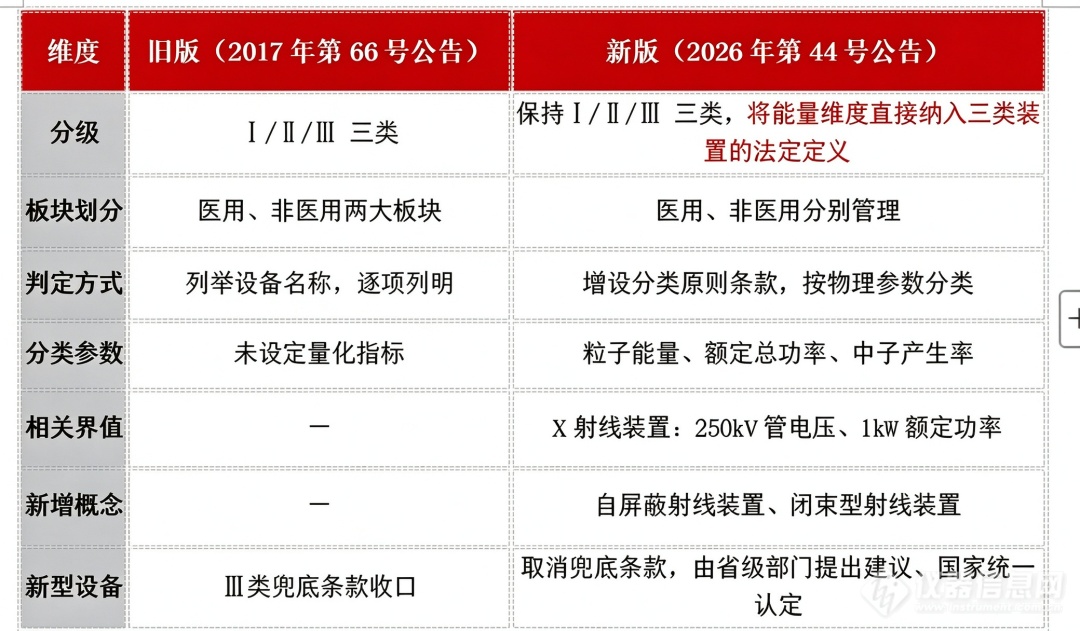
Old version judgment method:The main method is to list the name of the equipment, list the device type item by item, and use footnotes to deal with special situations; Class III devices have a safety clause to classify other X-ray devices that cannot be exempted into this category.
New version judgment method:The classification remains unchanged, and new classification principles and clauses are added to comprehensivelyparticle energy, rated total power, neutron generation rate and other physical parameters are classified; self-shielding radiation devices and closed-beam radiation devices are added as legal basis for downgrading equipment, and the definitions are clear; the blanket clause is cancelled, and new equipment not included in the list will be issued by the provincial ecological environment department and reported to the Ministry of Ecology and Environment for unified identification.
Generally speaking, classification determination has shifted from equipment name to physical parameters. Hazard results and physical parameters correspond to each other, forming the legal basis for this parametric classification.,Management methods are further moving towards quantification and standardization.
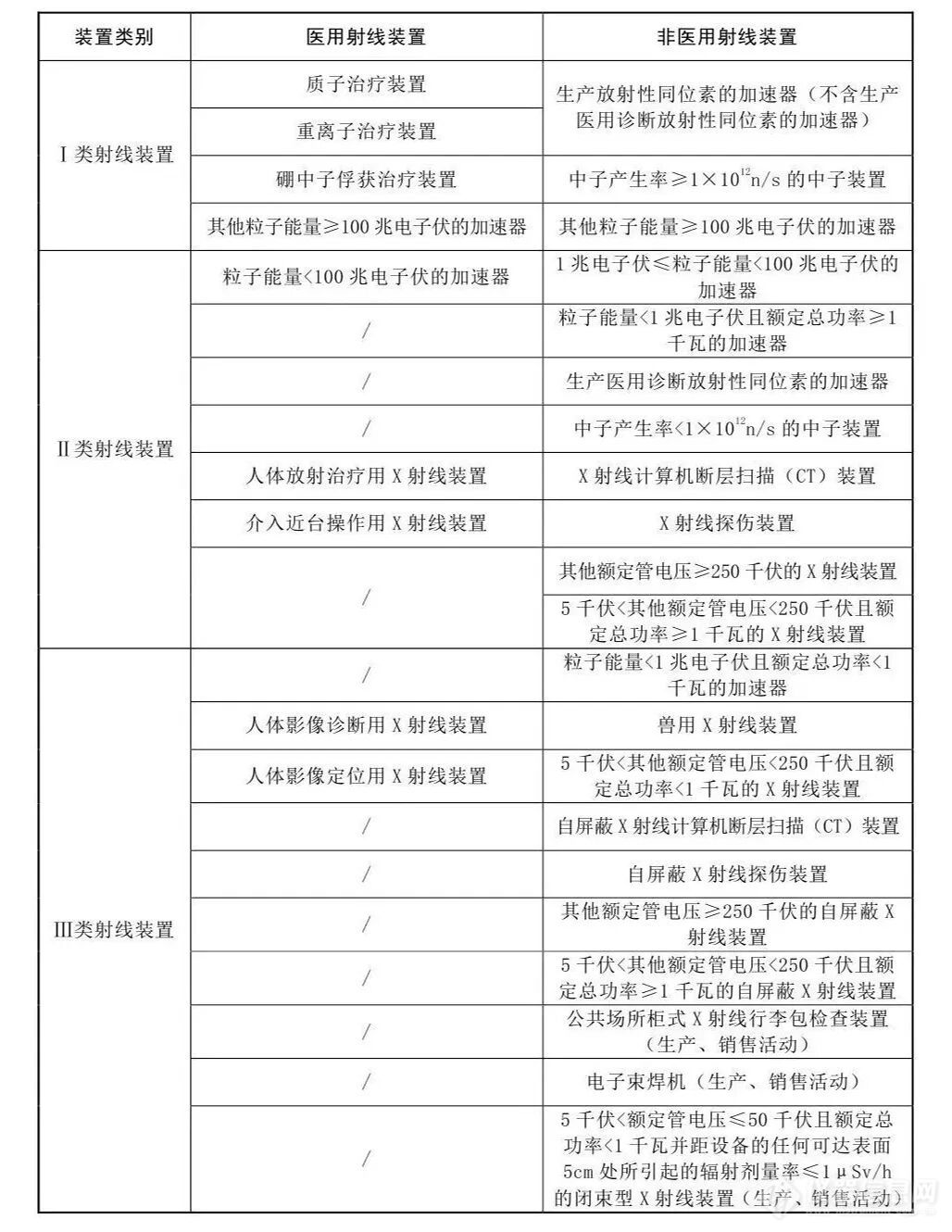
3. Comparison of key clauses: Changes in four aspects require special attention
1. Newly addedSelf-shielding, closed beam typeTwo legal terms, single-column gears, supporting the use of end-down categories
Old rules:There is no clear definition of "self-shielding" and "closed-beam type". It is only briefly mentioned in the remarks and cannot be used as a basis for classification downgrade. The production, sales and use classification of the device must be consistent.
New rules:The text of the method adds term definitions and uses these two types of structural characteristics as the basis for classification and determination:
Self-shielding device: It has a standard model and size, the human body cannot enter the shielding body, and the shielding body constituting the device is designed and manufactured integrally with the main structure of the device. Without additional shielding, the radiation dose rate at 5cm outside the shielding body does not exceed 2.5μSv/h, andA ray device that prevents any part of the human body from entering or staying within the shielding body of the device when the beam is released.
Closed beam radiation device:
X-ray equipment characterized by a structure that prevents any part of the human body from entering the useful beam area, such as an electron microscope,Electron beam welding machinewait.
2. Introduction of acceleratorParticle energy + rated total power double threshold determination
Old rules:The accelerator only looks at a single indicator of particle energy, ≥100MeV is classified as Category I, and <100MeV is Category II, with no power constraints.
New rules:The accelerator is jointly determined by the dual parameters of particle energy + rated total power, and the two indicators jointly constrain the category.
3. Neutron devices are classified into independent categories.High and middle school students are directly classified into Category I
Old rules:Neutron generators are uniformly placed in Category II, noneutron yieldQuantitative threshold, there is no independent classification system for neutron devices, and there is no clear entry for BNCT.
New rules:There are separate judgment items for neutron devices, with neutron output as the core quantitative indicator:
Neutron source device with neutron yield ≥1×10¹² n/s (including BNCT boron neutron capture therapy device) → Class I radiation device
Neutron source device with neutron yield <1×10¹² n/s → Category II
4. Medical X-ray devices are changed from "by equipment" to "by clinical use"
Old rules:The medical entries in the 2017 edition are listed by equipment type: X-ray devices for angiography, X-ray CT devices for medical use, diagnostic X-ray devices for medical use, oral (dental) X-ray devices, radiotherapy simulation positioning devices, X-ray blood irradiators…
New rules:No longer just look at the hardware model, but with clinical use and operational risk as the core of the judgment, it is divided into four categories: X-rays for human radiotherapy (Class II), X-rays for interventional near-stage operations (Class II); X-ray devices for human imaging diagnosis (Class III), and X-ray devices for human image positioning (Class III).
4. Connection of classification results with environmental assessment and permit processing
The radiation device category directly corresponds to the environmental impact assessment document type and the radiation safety license approval level:
Class II radiation device:An environmental impact report form needs to be prepared, which must be approved by the ecological environment department and reviewed by experts. There are many steps in the process.
Class III radiation device:You only need to fill in the environmental impact registration form online and complete the filing. No approval or review is required.
Execution connection tips:
Classification downgraded: Self-shielding flaw detection equipment and low-energy and low-power accelerators are adjusted from Category II to Category III, and the relevant environmental impact assessment and certification costs are reduced accordingly;
Upgraded classification: High-injection neutron generators have been raised to Category I, and management requirements have been increased accordingly;
Certificate connection: The issued radiation safety license will continue to be valid within the validity period; the new version of the classification standards will only apply when changing, extending, or re-applying. It is recommended that relevant units confirm the specific implementation standards with the local ecological environment authorities in a timely manner.
View More from This Booth
Customer Literature | Research on micro-nano hemostatic materials based on beetle pulse jet bionic structure
Customer Literature | Research on surface structure analysis and osseointegration performance of titanium alloy based on nano-cerium oxide coating
Aoying Case | Digital model comparison (comparison between physical object and design model): efficient and excellent non-destructive inspection method for the quality of plastic (casting) parts

Aoying Science | The difference between DR and CT: the "fluoroscopy eye" and "tomography microscope" of non-destructive testing
Recommended Products

Always Imaging metrology microfocus industrial CT system AX-3000CT-M
US$ 489510.00-769231.00
Model:AX-3000CT-M