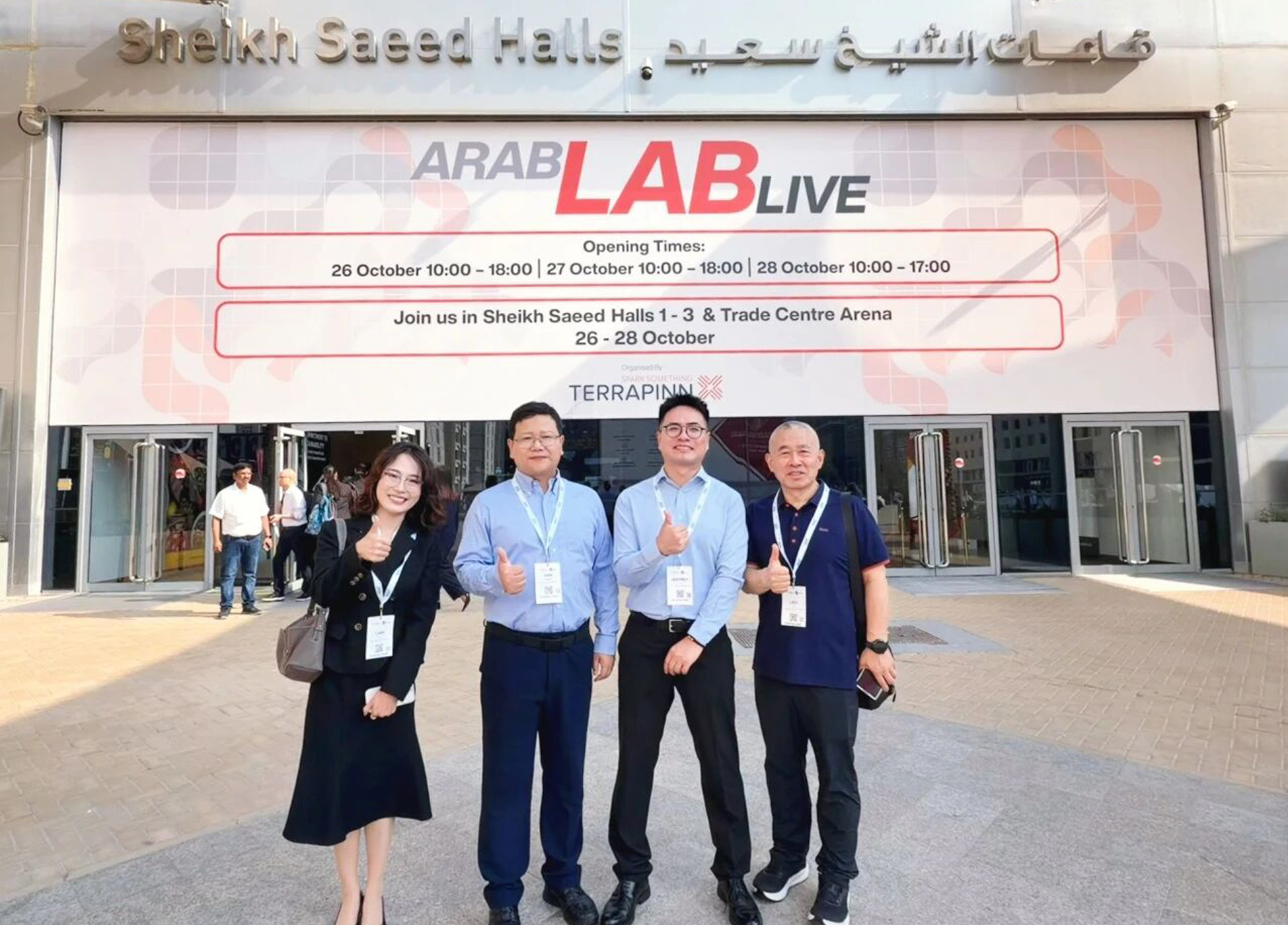
Being close to users continues from every meeting, Haineng goes to ARABLAB again
Company News
Oct 30, 2026

【Support scientific research】Germany's Leibniz Institute of Catalysis uses XRD to uncover the mystery of CO₂ hydrogenation catalyst deactivation
Leibniz Institute for Catalysis, Germanyresearch teamTime-resolved in-situ characterization technology (including STOE in-situ XRD) combined with transient kinetic analysis was used to deeply reveal the structural evolution and deactivation mechanism of α-Fe₂O₃ catalyst in CO₂ hydrogenation reaction. The study found that carbon deposition, rather than iron carbide oxidation, was the primary cause of catalyst deactivation.Related articles titled "Understanding of the Fate ofα-Fe₂O₃ in CO₂ Hydrogenation through Combined Time-Resolved In Situ Characterization and Microkinetic Analysis"Published in "ACS Catalysis》。
Research background: CO₂ hydrogenation and iron-based catalysts
CO₂ hydrogenation to produce high-value chemicals and fuels is an important way to achieve carbon neutrality. Iron-based catalysts have attracted much attention due to their combined reverse water gas shift (RWGS) and Fischer-Tropsch synthesis (FTS) activities. However, under reaction conditions, the catalyst will undergo complex phase transitions, and there are still many controversies about its active phase composition, surface species, and deactivation mechanism. In particular, the traditional view is that iron carbide oxidation is the main cause of deactivation, but this study puts forward different opinions on this.
In-situ characterization technology: revealing the true state of the catalyst
In order to track the evolution of the catalyst under real reaction conditions, the research team comprehensively used a variety of time-resolved in-situ characterization methods.
The researchers put the α-Fe₂O₃ sample into a quartz capillary tube.STOE HT2 in-situ reactorProgrammed temperature rise processing is performed within.STOE STADI PPowder X-raydiffractometerXRD patterns were continuously collected to monitor the dynamic transition of iron phase in the entire process from H₂ reduction to CO₂ hydrogenation in real time.
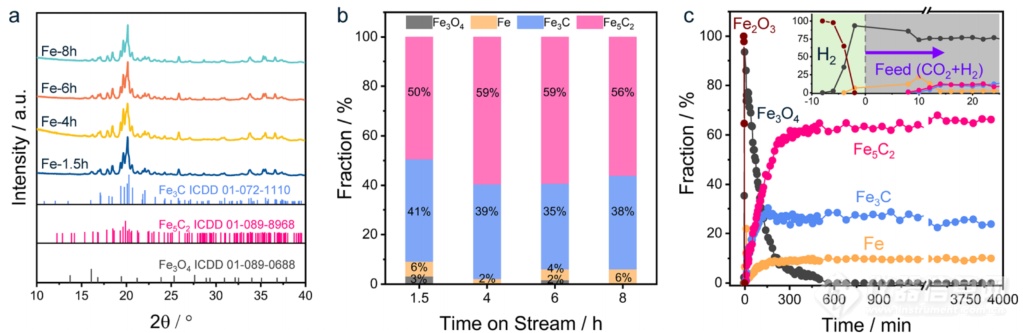
Figure 1 (a)at 300℃, the waste catalyst Fe collected after 1.5, 4, 6, and 8 hours of CO₂ hydrogenation reaction under the conditions of raw gas ratio CO₂:H₂:N₂=1:11:7.-1.5h、Fe-4h、Fe-6h、Fe-XRD pattern at 8h. (b) Based on the XRD pattern in (a), the phase composition of the spent catalyst obtained by Rietveld full spectrum fitting quantitative phase analysis (QPA). (c) at 350℃, respectively using H₂:He=1:1 or CO₂:H₂:He=1:3:1 raw gas for in-situ XRD characterization, and quantitative analysis obtained the time evolution rules of different iron-containing phases during the CO₂ hydrogenation process.
Experimental results show:
α-Fe₂O₃ is quickly reduced to Fe₃O₄ in H₂, and then metallic Fe is generated。
After the CO₂/H₂ reaction gas is introduced, Fe₅C₂ and Fe₃C are formed rapidly and remain stable for up to 3900 minutes of reaction time.。
No oxidation of iron carbides to Fe₃O₄ was observed, this discovery challenges the traditional inactivation mechanism。

The truth about deactivation: Carbon deposition is the “culprit”
Since the iron carbides are not oxidized, why does the catalyst activity decrease with run time?
Combining in-situ Raman spectroscopy and quasi-in-situ XPS analysis, the research team found:
1、After 240 minutes of reaction, obvious D bands (~1325 cm⁻¹) and G bands (~1595 cm⁻¹) appeared in the Raman spectrum, indicating the gradual accumulation of graphitic carbon deposits.。
2. In the XPS C 1s spectrum, the intensity of the graphitic carbon peak at 284.8 eV increases with time.
3、These carbon depositsHinders the adsorption and activation of H₂ and CO₂。
Transient Dynamics: Quantifying the Effects of Deactivation
The study further used steady-state isotope transient kinetic analysis (SSITKA) and time-resolved analysis of products (TAP) to quantify the impact of carbon deposition from a kinetic perspective.
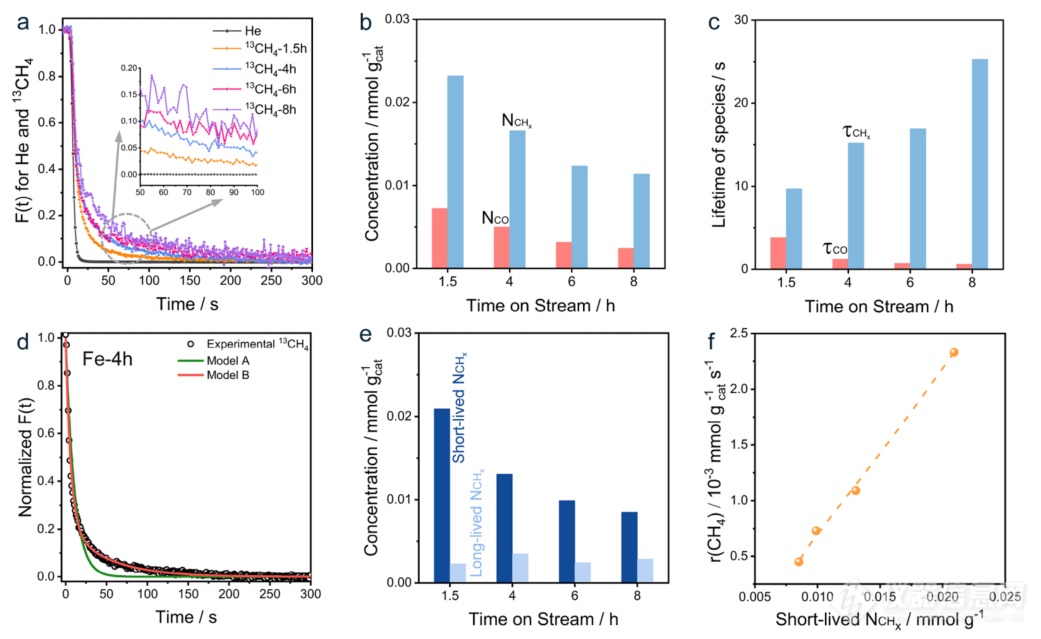
Figure 2(a) Normalized response curves of He and ¹³CH₄ during switching from ¹³CO₂:H₂:He:Ar = 1:11:0.5:6.5 back to ¹²CO₂:H₂:Ar = 1:11:7 after different times on the CO₂-FTS reaction stream. (b) Total concentration of surface intermediates producing CO or CH₄ after different times on the CO₂ hydrogenation reaction stream. (c) Overall average residence time of surface intermediates producing CO or CH₄. (d) Comparison of the experimental normalized ¹³CH₄ transient response of the Fe-4h sample with data fitted using Model A and Model B (see Scheme S1 in the Supporting Information). Note: The experimental normalized ¹³CH₄ transient response shown in Figure d has been corrected for gas phase retention effects. (e) Concentrations of long-lived and short-lived surface intermediates that generate CH₄. (f) The relationship between the CH₄ generation rate and the concentration of short-lived intermediates that generate CH₄.
Key findings:
1、Both the CO₂ adsorption rate constant and the surface dissociation rate constant decrease with reaction time.。
2、H₂ activation ability is also significantly reduced。
3、The formation of CH₄ involves two types of surface intermediates: Short-lived intermediates (high activity) and long-lived intermediates (low activity). Carbon deposition preferentially covers active sites corresponding to short-lived intermediates, resulting in reduced hydrocarbon selectivity.。
Conclusion and outlook
This study passedThe organic combination of time-resolved in-situ characterization and transient dynamics analysis, the following important conclusions are drawn:Carbon deposition is the main cause of deactivation of iron-based catalysts under normal pressure CO₂ hydrogenation conditions, rather than the traditionally thought of iron carbide oxidation;Carbon deposition mainly inhibits the activation steps of H₂ and CO₂, and preferentially blocks the hydrocarbon generation path.;Increasing the H₂ partial pressure can slow down the carbon deposition rate and extend the catalyst life。This work provides a new perspective on understanding the dynamic behavior of iron-based catalysts in CO₂ hydrogenation, and also points the way to the development of more stable and efficient catalysts.
aboutSTOE STADI P powderX-raydiffractometer
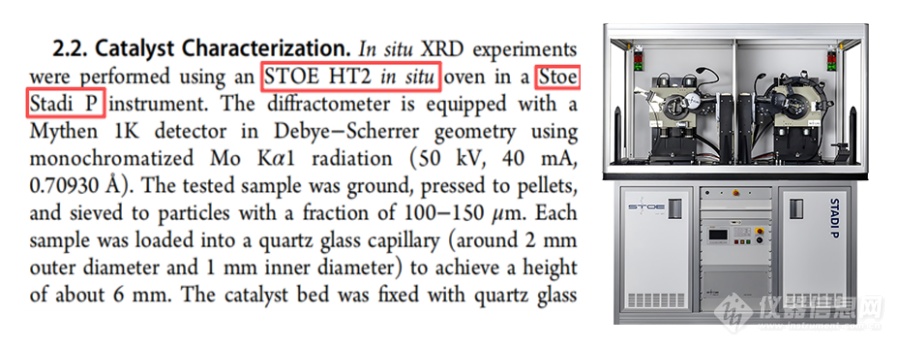
Figure 3Paper screenshot+STOE STADI P powderX-raydiffractometer
This studymiddleSTOE STADI P powderX-rayDiffractometer for in situ studies of catalysisIt shows the following characteristics:
high resolution:Using Ge(111) monochromatic Mo Kα₁ radiation to ensure that the diffraction peaks are clearly identifiable。
Flexible in-situ attachment:The HT2 in-situ reactor supports gas switching and programmed temperature rise to simulate real reaction conditions.。
Fast data collection:The Mythen 1K detector can continuously record spectra during dynamic processes and capture transient changes in physical phases.。
Quantitative analysis ability:Combined with Rietveld quantitative phase analysis, the content evolution of each iron phase can be accurately obtained。
About Steady State Isotope Transient Kinetics Analysis (SSITKA)
SSITKA technology can identify the abundance of intermediates and their kinetic parameters. Its limitation is that it cannot directly characterize the structure of surface reaction intermediates and directly monitor their surface reactions, while in-situ infrared technology allows direct observation of adsorbed species under reaction conditions. Will SSITKAOrganically combined with FTIR, it can correctly characterize surface intermediate species, including their chemical structure and surface coverage, and distinguish adsorption reactive species from non-reactive species. There are currently mature commercial SSITKA products on the market.likeBeijing Jingwei Gaobo Instrument Co., Ltd. AMI-300TKA in-situ infrared characterization instrument。
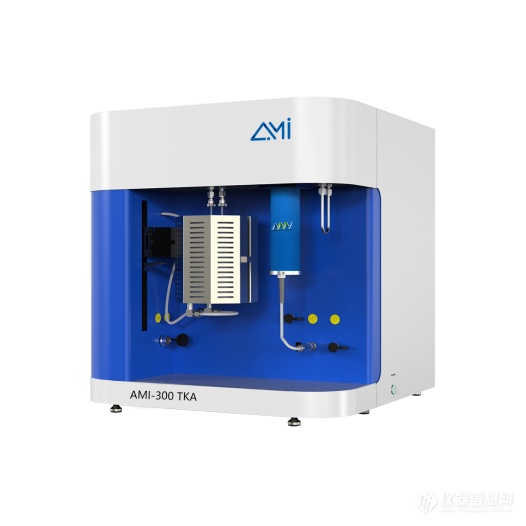
AMI-300TKA
AMI-300TKA in-situ infrared characterization instrument quickly switches reactantsIt can detect the isotopic composition of a certain reactant in the system and monitor the dynamic evolution of the labeled products in real time, thereby realizing functions such as analysis of reaction mechanisms, measurement of kinetic parameters, characterization of catalysts, and distinction of parallel reaction pathways.




When you visit any website, it may store or retrieve information on your browser, mostly in the form of cookies. This information might be about you, your preferences or your device and is mostly used to make the site work as you expect it to. The information does not usually directly identify you, but it can give you a more personalized web experience. Because we respect your right to privacy, you can choose not to allow some types of cookies. Click on the different category headings to find out more and change our default settings. However, blocking some types of cookies may impact your experience of the site and the services we are able to offer.