▲First author: Hyunchul Oh
Corresponding author: Michael Hirscher, Torben R. Jensen, Yaroslav Filinchuk
Correspondence units: Tohoku University, Japan, Aarhus University, Denmark, Catholic University of Leuven, Belgium
DOI:10.1038/s41557-024-01443-x
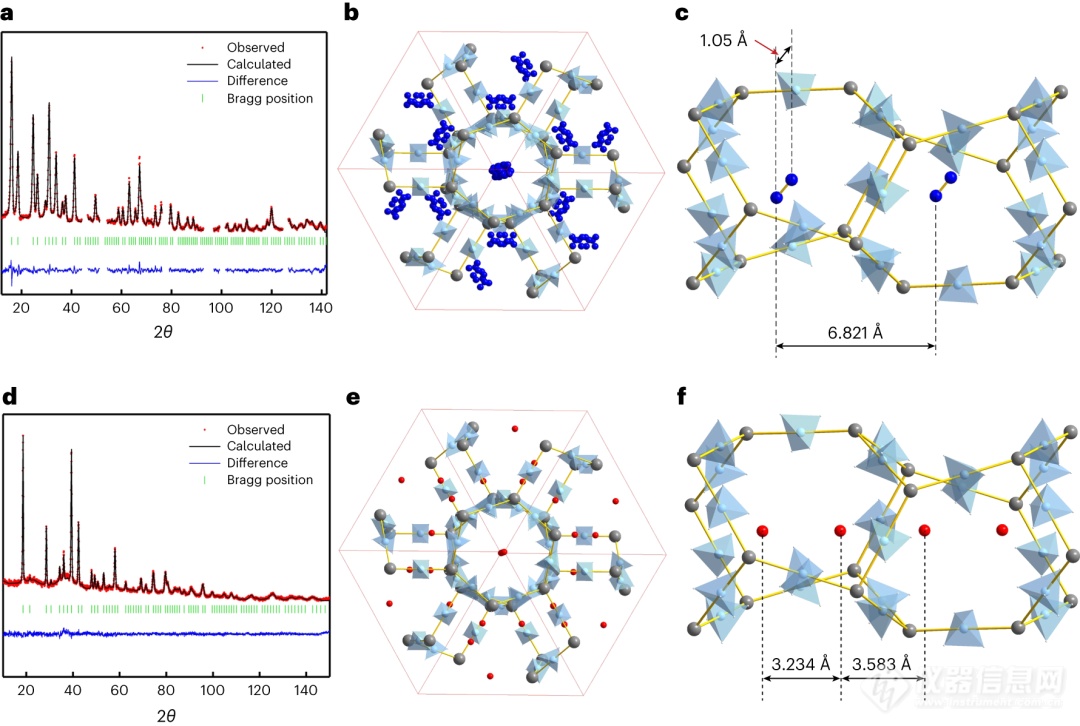
The widespread use of hydrogen as a fuel for personal and public transportation is limited by the significant challenges of hydrogen storage. Current technology focuses on the storage of molecular hydrogen in its gas or liquid state. Unfortunately, current technology is limited in the volumetric and weight density it can provide. As a molecule, hydrogen can be physically adsorbed in porous materials through weak van der Waals interactions. Porous materials provide high weight ratio hydrogen adsorption, but the volumetric storage capacity still needs improvement. Nanoporous materials have received widespread attention for their gas storage properties, but achieving high-volume hydrogen storage remains a challenge.By using neutron powder diffraction, volumetric gas adsorption, inelastic neutron scattering, and first-principles calculations, this study analyzes a magnesium borohydride framework with small pores and a partially negatively charged non-flat interior for hydrogen and nitrogen absorption. Hydrogen and nitrogen respectively occupy different adsorption sites in the pores, and their ultimate capacities are very different, respectively for each Mg(BH4)2The molecule holds 2.33 H2and 0.66 N2. Molecular hydrogen is extremely densely packed, with a density approximately twice that of liquid hydrogen (144 grams H per liter of pore volume2). This study also discovered a five-hydrogen dimer in which H at one position2The molecule has rotational freedom, and the H of the other position2The molecules are clearly oriented and have directional interactions with the framework. This study reveals that densely packed hydrogen can be stably stored in small-porous materials at normal pressure.Graphic and text analysisFigure 1 | Nitrogen and deuterium loading γ-Mg(11BD4)2NPD profile, and projection of the crystal structure.
1. This study found that D2not like N2That's in the center of the hole (Fig. 1b,c). On the contrary, D2The molecule is located near the exit of the pore, and the two D's in the pore2The molecules are symmetrically equivalent and described by a crystallographic point D11 (Fig. 1e, f).2. The composition of this structure corresponds to each Mg(BD4)24/3 D2, that is, Mg(BD4)2·1.33D2, and this easily saturates at P=27 mbar and T=25 K. In structural models, deuterium is represented by a quantum rotor, often called a "superatom" whose center of mass is around D2The nuclear density sphere of the molecule's center of mass; that is, the molecule has completely free rotation about its center of mass. It is described by a position parameter, an occupancy factor (representing two atoms in the molecule, that is, a occupancy number of 2 represents a molecule) and an atomic displacement parameter. The D11 site is located on the three-fold axis, forming a 1D chain along the [111] direction of the cubic unit cell (Fig. 1e). The guest-guest contacts between deuterium molecules within the same pore and between different pores are 3.234(5)Å and 3.583(5)Å respectively (Figure 1f).Figure 2 | Deuterium loaded γ-Mg( at 25K and 203 mbar11BD4)2。
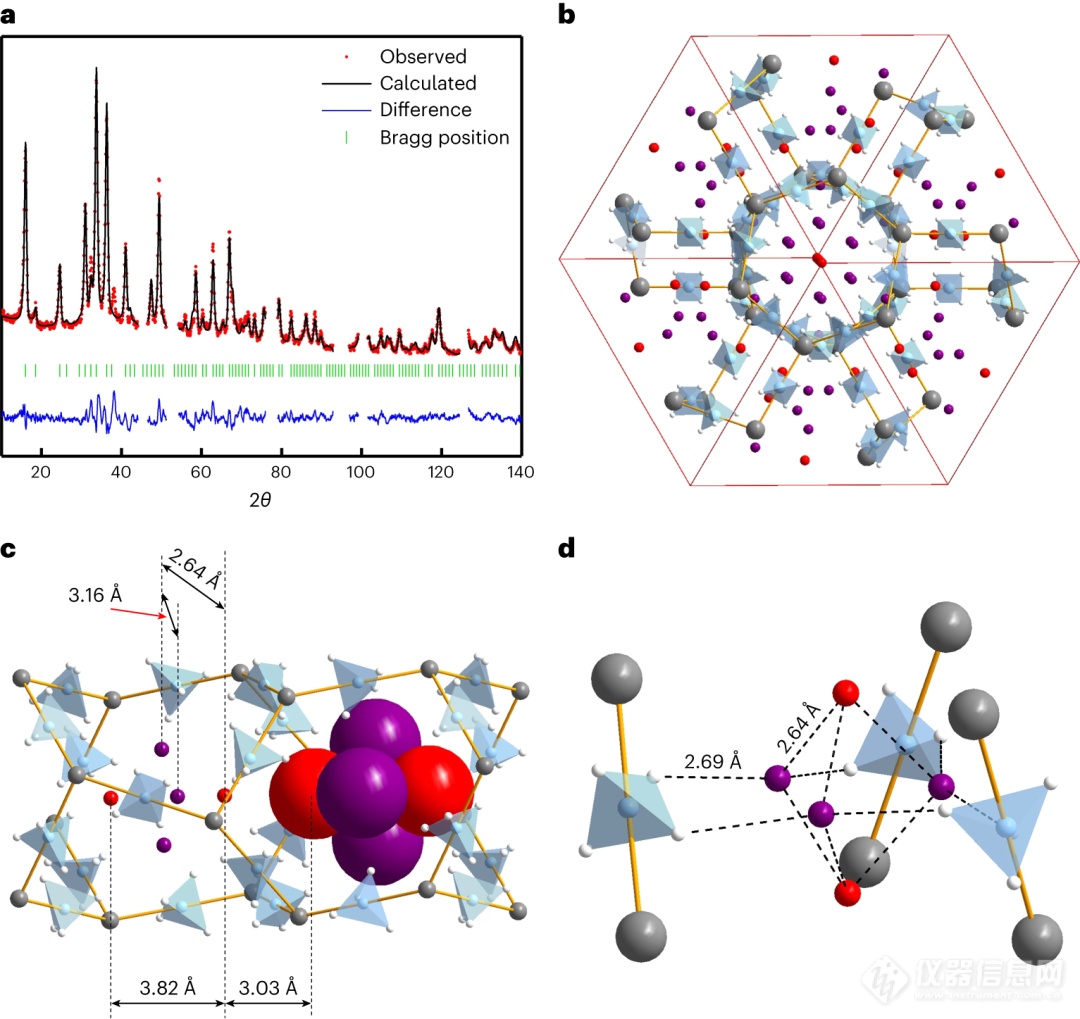
1. At higher deuterium pressure, at 25 K, the second stage of gas absorption was observed in this study. Analysis of NPD data shows that the second D2The site, labeled D22, begins to be occupied (Fig. 2b), in pD2= 205 mbar and T=25K reaches saturation. The D22 site is not located on the three-fold axis, but passes through the center of the channel, thus forming a short D22...D22 distance (1.94Å) between the two bypass channels. Therefore, the ultimate occupancy rate of the D22 site is 50%. Carefully reanalyze in pD2Diffraction data measured at = 27 mbar and T = 25K show that the D22 site is 14% filled at this pressure, while at 203 mbar it becomes fully occupied (50%), reaching γ−Mg(BD4)2·2.33D2The ultimate composition, that is, occupying the D11 and D22 positions at the same time. Rietveld's refined spectrum is shown in Figure 2a. Additional weak diffraction peaks appear in γ-Mg(BD4)2·2.33D2The NPD pattern indicates that this body-centered structure changed into the original structure, most likely due to the ordering of the D22 site in a lower symmetry space group (possibly Pa−3).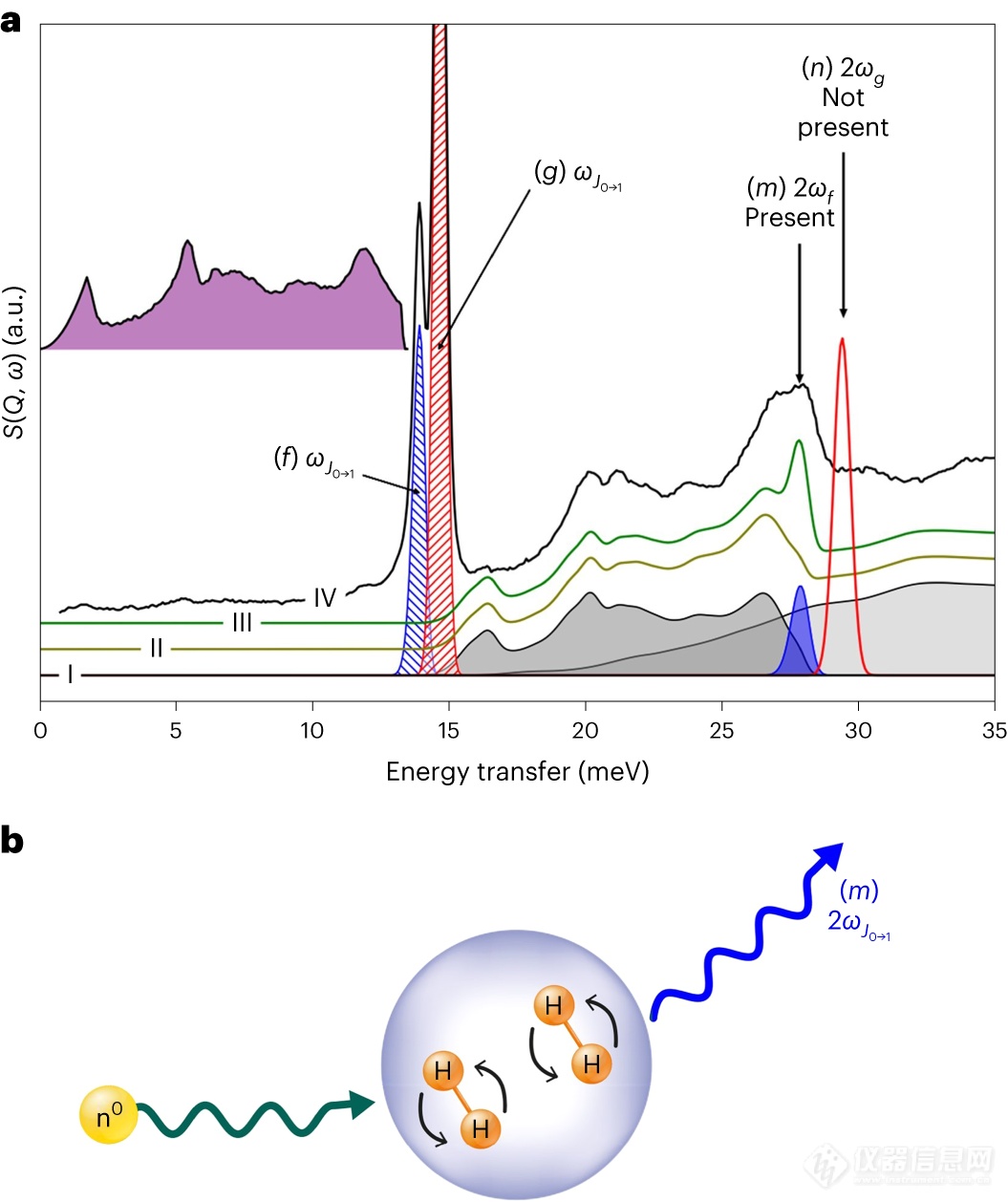
Figure 3 | Deuterium-loaded γ-Mg (BD4)2The inelastic neutron scattering spectrum of
1. Figure 3a shows γ-Mg(BD4)2Adsorbed hydrogen (p-H2), corresponding to the INS spectrum of Mg(BD4)2·1.46H2. By modifying ~30% amorphous non-porous magnesium borohydride, the payload of the crystalline porous portion is 2.06 H per Mg atom2, indicating that the D11 site is fully loaded and the D22 site is heavily loaded. The spectrum contains two rotational peaks at 13.9 meV and 14.6 meV. The higher energy transition is consistent with a free hydrogen rotor (Fig. 3a, red dashed area), similar to solid hydrogen and confined hydrogen. Therefore, it can be assigned to the D11 locus. The second rotation peak is less intense and has lower energy, consistent with a disturbed rotor (blue dashed area), and can be attributed to the D22 site.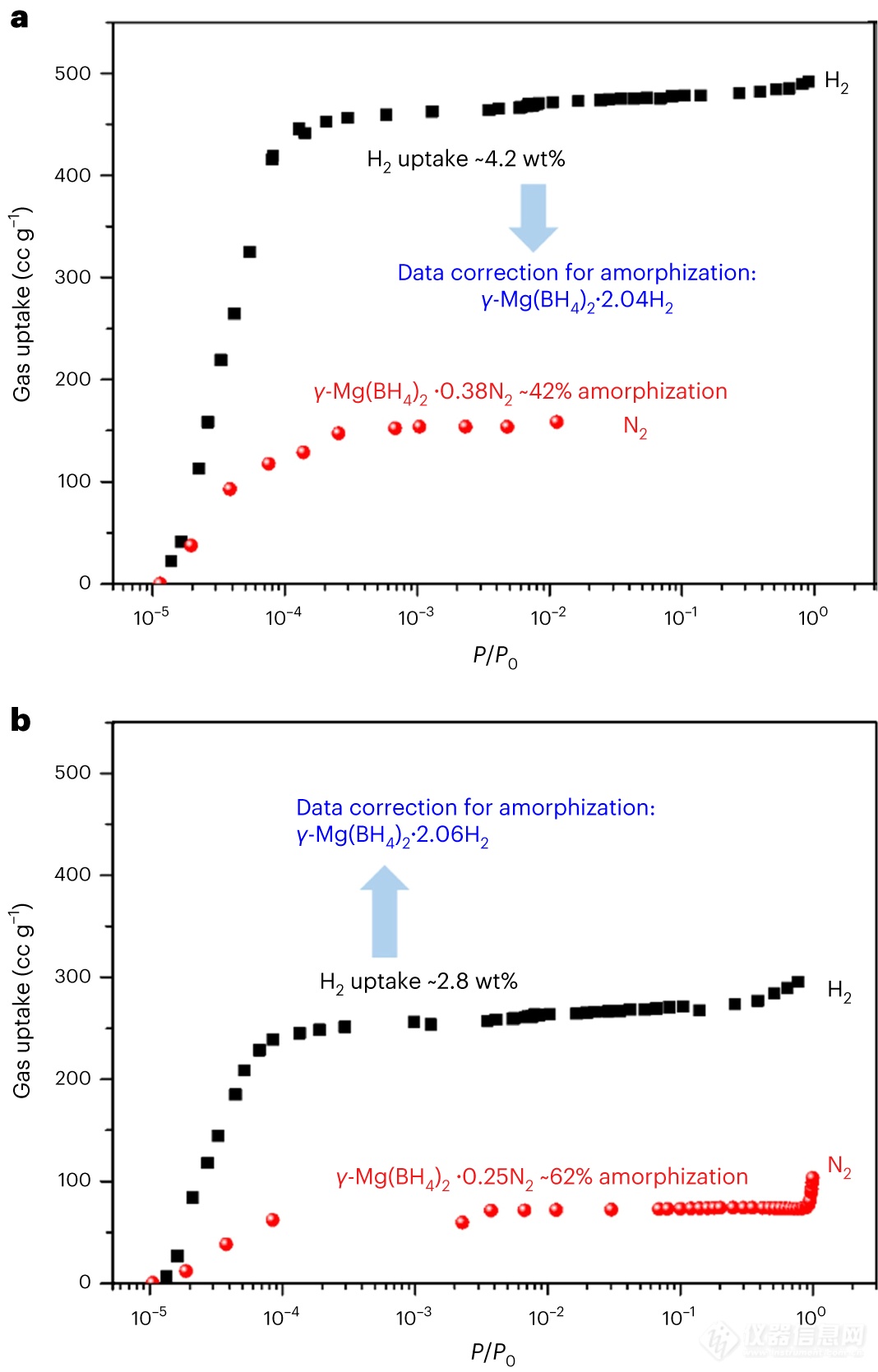
Figure 4 | N2and H2Adsorption isotherms at 77K and 20K respectively
1. This study found that compared to N in each sample2adsorption, H2The adsorption is approximately three times greater. These may be two similar probe molecules, H2and N2, have very different interactions with surface topology. Similar to the gas absorption in Figure 4, N from 77 K2Isotherms determined for γ-Mg(BH4)2The Brunauer–Emmett–Teller (BET) specific surface area is only SBET (N2)= 610 m2 g−1, while from 20 K H2Isotherms calculated for SBET (H2)= 1,787 m2 g−1or 1,577 m2 g−1, based on the cross-sectional area of hydrogen molecules at liquid or solid density, respectively (Fig. 4a). In addition, N from 77K2Isotherms determined for γ-Mg(BH4)2The total specific pore volume (SPV, maximum absorption/sample mass/liquid gas density) is only 0.12 ml g−1, while the H from 20K2The SPV calculated from the isotherm is 0.51 ml g−1。2. Crystallographic studies revealed that γ-Mg(BH4)2The aperture and orifice allow H2and N2Enter and reach saturation. This study therefore provides clear evidence that there is a strong correlation between measured specific surface area and probe molecules due to different interactions with non-planar surface topology, rather than restricted access to the porous regions of the structure modulated by pore size. Note that even though the total absorption decreases due to sample amorphization (Fig. 4b), the probe molecule effect still shows a similar trend (for the second batch of samples, SBET (N2)= 310 m2 g−1and SBET(H2)= 1,110 m2 g−1, based on liquid or solid H2cross-sectional area, SPV (N2)= 0.08 ml g−1and SPV (H2)= 0.41 ml g−1; Figure 4b).Figure 5 | Characterization of γ-Mg(BH) by volumetric method4)2Adsorption of medium hydrogen
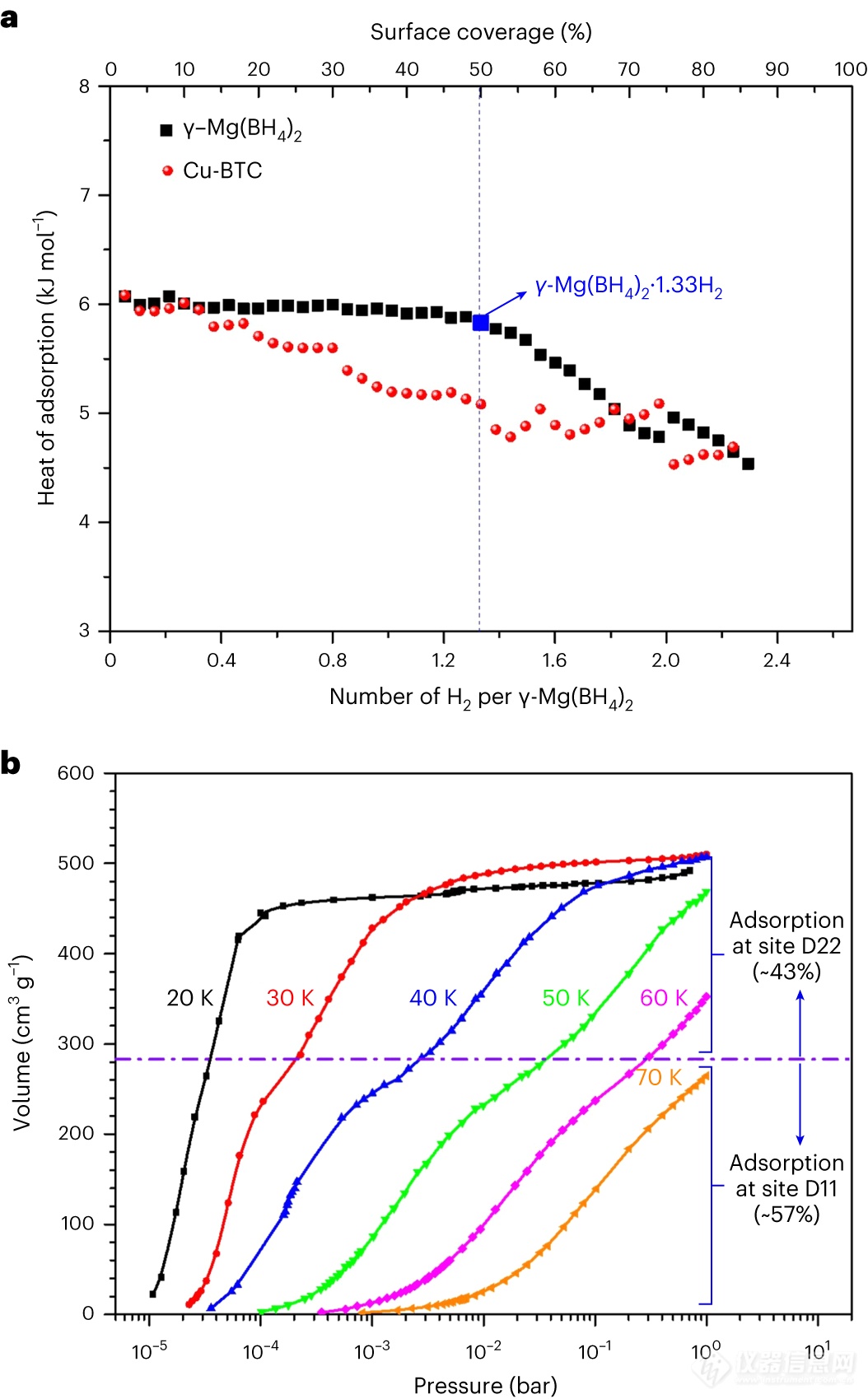
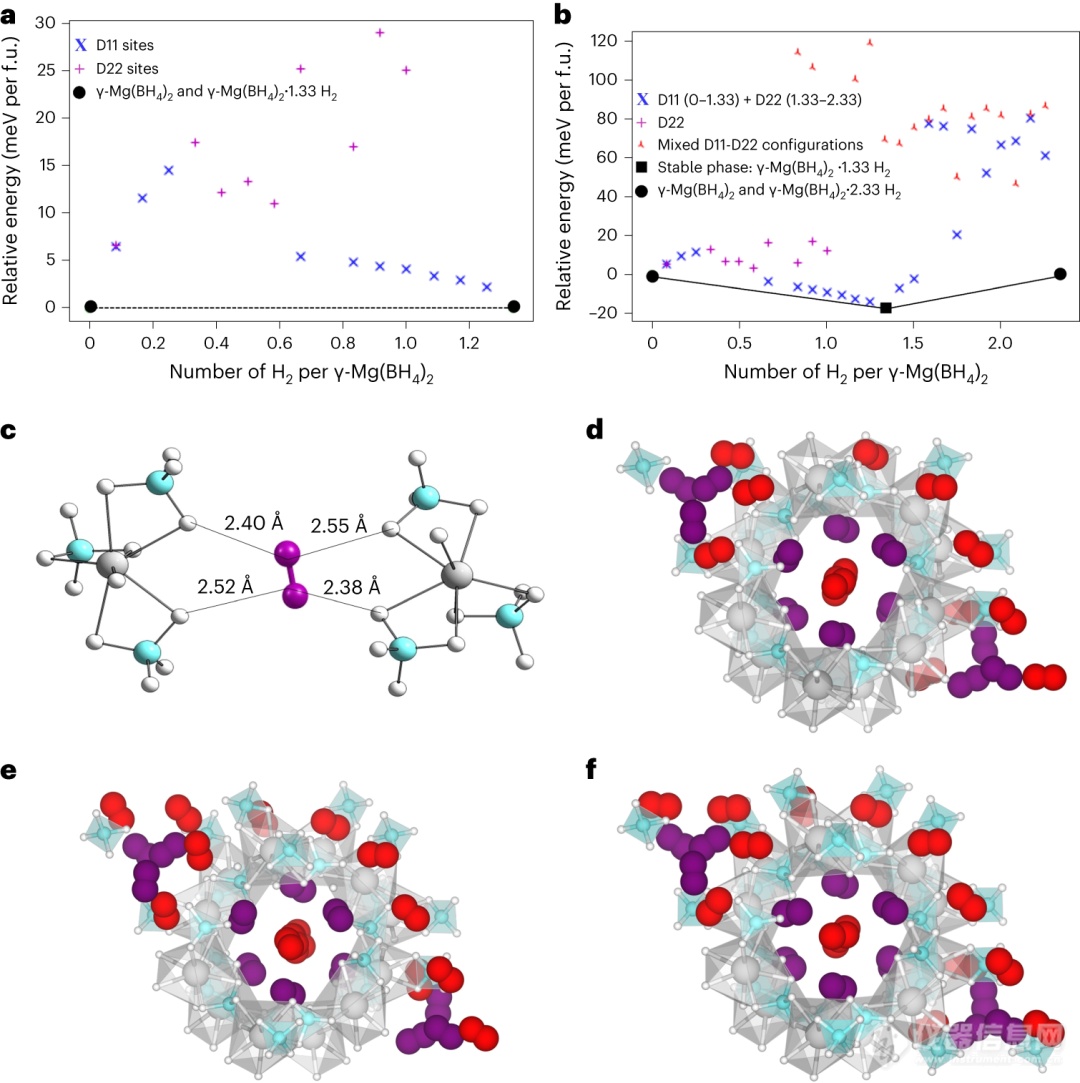
1. Temperature-dependent gas adsorption experiments also provide insights into adsorption isotherms, which characterize the strength of host-guest and guest-guest interactions. Figure 5a shows γ-Mg(BH4)2and with similar aperture and H2Hydrogen adsorption isotherm heat as a function of isotherm coverage of the cuprobenzene-1,3,5-tricarboxylic acid (Cu-BTC) MOF. The hydrogen adsorption enthalpy remains almost constant at 6.1 kJ mol below about 50% coverage-1, then dropped to 4.5 kJ mol-1, while similar MOFs, such as Cu-BTC, usually decrease with coverage. As the load exceeds 1.33 H2Per Mg, the decrease in isotherm heat of adsorption can be explained by host-guest and guest-guest repulsions involving atoms in the D22 site, which is also consistent with a 0.67% expansion of the unit cell volume (while no expansion was observed when filling the D11 site).2. Further evidence was also observed for high-resolution low-pressure H2The adsorption isotherm is shown in Figure 5b. In logarithmic pressure scale, the isotherm exhibits a two-step behavior, indicating sequential adsorption on two main sites with different retained energies. Assuming monolayer adsorption in these sites, the maximum hydrogen content expected in the first adsorption site (D11) is approximately 57% of the total uptake. Therefore, the remaining approximately 43% was assigned as the second site (D22), which was also in good agreement with the NPD results.Figure 6|γ-Mg(BH4)2H on2Thermodynamic convex hull analysis of adsorption, and γ-Mg(BH4)2Up(B−Hδ−)2···H−H···(Hδ−−B)2Schematic diagram of connectivity and H2distributed.Nanoporous γ-Mg(BH4)2is a hybrid framework with partially negatively charged hydrogen atoms, thus forming the inner surface of the pore. N2and H2Molecules can enter the pore, but H2The amount of gas absorbed is N2three times. N2is located at the center of the hole, and H2The molecule is located at BH4Part of the group has its own site near the negatively charged hydrogen atom. This study highlights the opportunity to develop hybrid porous frameworks with high-density hydrogen storage capabilities, or as possible future materials with high-temperature superconductivity and near-normal pressure stability. High H in the hole2Density is due to H2The anisotropic shape of molecules, usually seen as densely packed ellipsoids at near normal pressure. Furthermore, at very high pressures, hydrogen molecules may display more complex ordering patterns. Although previous reports have reported H2The molecules form so-called hydrogen aggregates, in which H2The distance between molecules is actually lengthened. However, this study observed through experiments and theoretical calculations that the entire process only formed a five-hydrogen molecular cluster in which two molecules rotated freely around their center of mass and were bound only by van der Waals interactions. This is in contrast to three other molecules that form six hydrogen bonds, (B−Hδ−)2···H−H···(Hδ−−B)2. Furthermore, theoretical calculations show that the formation of a five-hydrogen dimer is more favorable than the statistical distribution of hydrogens at two positions. These types of hydrogen interactions differ from previously theoretically defined triple hydrogen bonds involving hybrid hydrogens or charge-reversed hydrogen bonds.
Source of article: Yanzhi Chengli