
Being close to users continues from every meeting, Haineng goes to ARABLAB again
Company News
Oct 30, 2026

Quick overview of full text
Background introduction
crystal structure
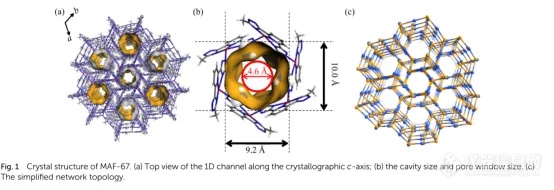
Key points:This framework contains crystallographiccone dimension of axis(1D)aisle. These channels consist of alternating cavities(9.2×10.0 Å)and window(4.6Å)composition. Each well window is modified with three different methyl groups。
adsorption isotherm
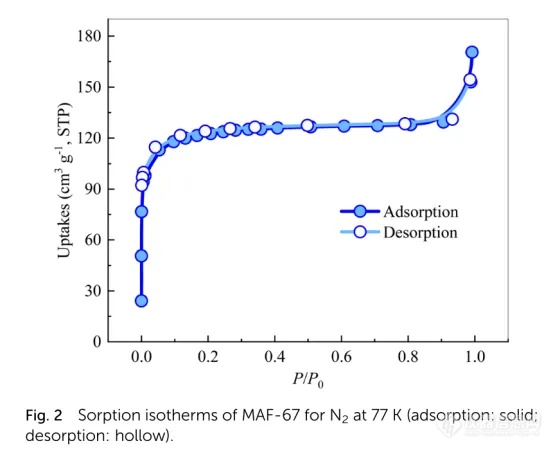
Key points:MAF-67ofN2adsorption isotherm(exist77 KDown)show typicalItype isotherm(The saturated adsorption capacity is5.71 mmol g-1, equivalent to0.198 cm 3g-1pore volume, which is close to the theoretically calculated value derived from the crystal structure0.182 cm 3g-1。
Study on the adsorption of benzene on small particle samples
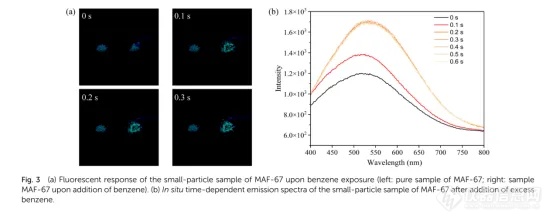
Key points:MAF-67The pore size in the gas is larger than the molecular size of most gases, including light hydrocarbons, and its4.6 ÅThe pore size is smaller than that of hexacyclic hydrocarbons(C6 H6:5.9 ÅC6H10:6.1ÅandC6H12:6.1 Å)aperture size. In terms of adsorption separation,MAF-67The pore characteristics of can be used to differentiate between benzene, cyclohexane, and cyclohexene. After exposure to benzene, it was observedMAF-67rapid fluorescence reaction. in ultraviolet light(365 nm)down, joinC6H6Within one second,MAF-67There will be obvious fluorescence "turning on"(picture3a). This response phenomenon was further confirmed by in situ time-dependent fluorescence spectroscopy.(picture3b). It is worth noting thatMAF-67The fluorescence intensity ofC6 H6The joining of0.2Approximately displayed within seconds42%rapid enhancement. These preliminary results indicateMAF-67Benzene can be adsorbed with very fast adsorption kinetics.
Adsorption Kinetics of Small Particle Samples
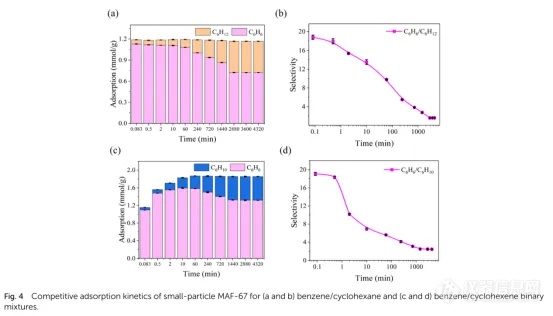
Key points:For equimolarC6H6/C6H12mixture,MAF-67in front5Second(0.083 min)InternallyC6H6The selectivity is approximately18.7. In this experiment,MAF-67rightC6 H6The maximum adsorption capacity is1.13 mmol g−1. As the soaking time increases,C6H6The adsorption amount gradually decreases, andC6 H12The amount of adsorption gradually increases. butC6H6andC6H12The total intake remains almost constant. soak48 hFinally, competitive adsorption slowly reaches equilibrium.C6H6The equilibrium selectivity is only1.6(picture4aandb). forC6H6/C6H10existMAF-67adsorption in the initial5Within seconds, the correspondingC6H6The selectivity is approx.19.1(0.083 min), showing the intake is1.10 mmol g−1,exist0.5 minwhen further increased to1.48 mmol g−1. same,24hours later,C6H6The selectivity gradually reaches2.5balance (Fig.4candd)
Adsorption mechanism
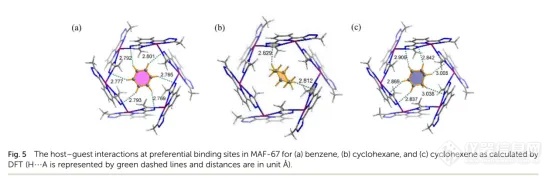
Key points:loadC6H6ofMAF-67The host-guest interaction in PTFE is mainly multiple weak intermolecular interactions between the host skeleton and benzene molecules. believed to beMAF-67The pore characteristics in , especially the absence of strong binding sites near the pore diameter, facilitate thisMOFRapid adsorption kinetics in .
Large particles of paraben/Cyclohexene mixture (1:1) adsorption capacity and selectivity
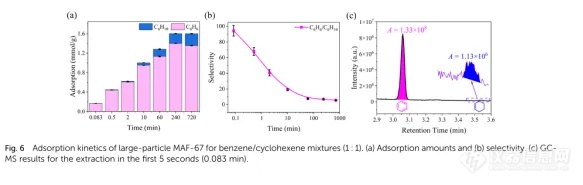
Key points:forC6 H6/C6 H10adsorption, the selectivity is5Second(0.083minutes)94.3,C6 H6The adsorption capacity is0.166 mmol g-1. exist0.5 min, the selectivity is reduced to71.3, the adsorption capacity increases to0.442 mmol g−1(MAF-67absorptive34%)(picture6)。
big/Comparison of liquid adsorption of small particle samples
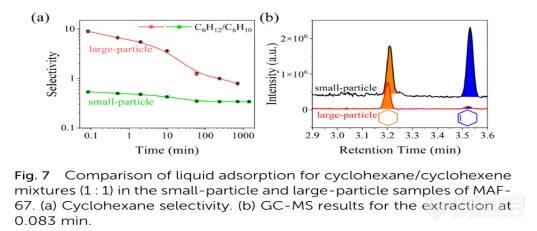
Key points:MAF-67The large particle sample showed anC6H12relative toC6H10Better selectivity, as opposed to what is the case in small particle samples(picture7)。C6H12/C6H10The selectivity is in0.083 minWhen adsorption begins, it is measured as8.7. This can be attributed to the fact that adsorption in large particle samples is mainly controlled by the diffusion rate, in the orderC6H12> C6H10. For small particle samples, the surface adsorption step is the rate-limiting step. Therefore, the adsorption rate of small particle samples isC6H10> C6H12. By adjusting the particle size of the adsorbent, it can be achievedC6H10reverse adsorption, thus directly obtaining pureC6H10。
Summary and Outlook
Original link:
https://pubs.rsc.org/en/content/articlelanding/2024/ta/d4ta02030h




When you visit any website, it may store or retrieve information on your browser, mostly in the form of cookies. This information might be about you, your preferences or your device and is mostly used to make the site work as you expect it to. The information does not usually directly identify you, but it can give you a more personalized web experience. Because we respect your right to privacy, you can choose not to allow some types of cookies. Click on the different category headings to find out more and change our default settings. However, blocking some types of cookies may impact your experience of the site and the services we are able to offer.