
Being close to users continues from every meeting, Haineng goes to ARABLAB again
Company News
Oct 30, 2026

The temperature rose from 25℃ to 85℃ and stabilized in ten minutes. When the humidity climbs from 50%RH to 85%RH, it often takes another half an hour, and the number on the screen always ticks back and forth in the last few bars.
Anyone who has done a humidity test has this experience: temperature is a "hard" parameter, which is what it says; humidity is a "soft" parameter, which is actually a calculated number.
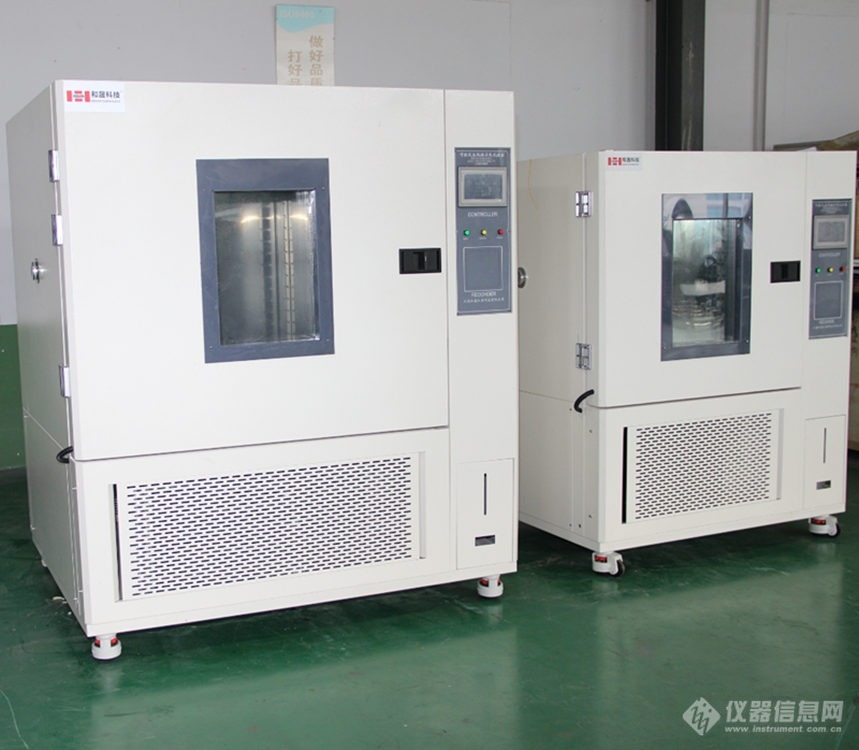
The humidity in the box is mostly measured by the wet and dry bulb method: a wet bulb thermometer is wrapped in gauze, the water evaporates and takes away heat, and the temperature difference between the dry bulb and the wet bulb corresponds to a relative humidity. That is to say,Humidity accuracy is inherently dependent on temperature accuracy。
The temperature control accuracy is ±0.3℃ and the analysis accuracy is 0.01℃, which is the prerequisite for stable humidity. As soon as the temperature drifts, the humidity immediately distorts - there are many complaints about "inaccurate humidity", and it turns out that the temperature sensor has drifted.
Humidification is easy, just heat and evaporate it in the water tank; dehumidification is the real skill.
The conventional approach is refrigeration and dehumidification - keeping the evaporator surface below the dew point to precipitate water. But this trick will fail in the low temperature range: the temperature itself is low, and the evaporator will freeze no matter how low it is, and the dehumidification capacity will drop off a cliff.
Humidification water flows directly into the inner tank. When using tap water, calcium and magnesium ions will scale, blocking the humidification pipe, contaminating the water tank, and leaving white marks on the sample. There is no problem in the short term, but the humidity will start to drift after a year.
The standard practice is to use pure water or deionized water, change the water regularly, and clean the sink. This is the cheapest and easiest to ignore.
Paper, textiles, plastics, wood, and pharmaceutical excipients all absorb moisture and release moisture. Put a stack of paper into the box, and it will absorb the moisture first, let the moisture fall out, and then slowly balance out - this process can take up to several hours.
The "stabilization time" specified in the standard is not just a formality. The GB/T 2423 series requires the sample to reach temperature and humidity balance before it can start timing. Reading in advance measures the response speed of the box, not the performance of the product.
Humidity sensors age and drift faster than temperature sensors. Many laboratories calibrate their temperature probes every year, but their humidity probes have not been touched for three to five years.
A practical suggestion: put the temperature and humidity recorder into the box for comparison. If the deviation exceeds ±3%RH, it is time to calibrate or replace it.
How much load can the low-humidity section carry and still be stable? What are the requirements for humidification water? How often should humidity sensors be calibrated?
The parameter lists of temperature and humidity chambers are all similar, and the difference lies in the details that no one has written down.




When you visit any website, it may store or retrieve information on your browser, mostly in the form of cookies. This information might be about you, your preferences or your device and is mostly used to make the site work as you expect it to. The information does not usually directly identify you, but it can give you a more personalized web experience. Because we respect your right to privacy, you can choose not to allow some types of cookies. Click on the different category headings to find out more and change our default settings. However, blocking some types of cookies may impact your experience of the site and the services we are able to offer.