 Gold Member
 Business License
The "15th Five-Year Plan" for coalbed methane sets the tone: With the output target of 26 billion cubic meters, which monitoring links will face rigid demand?
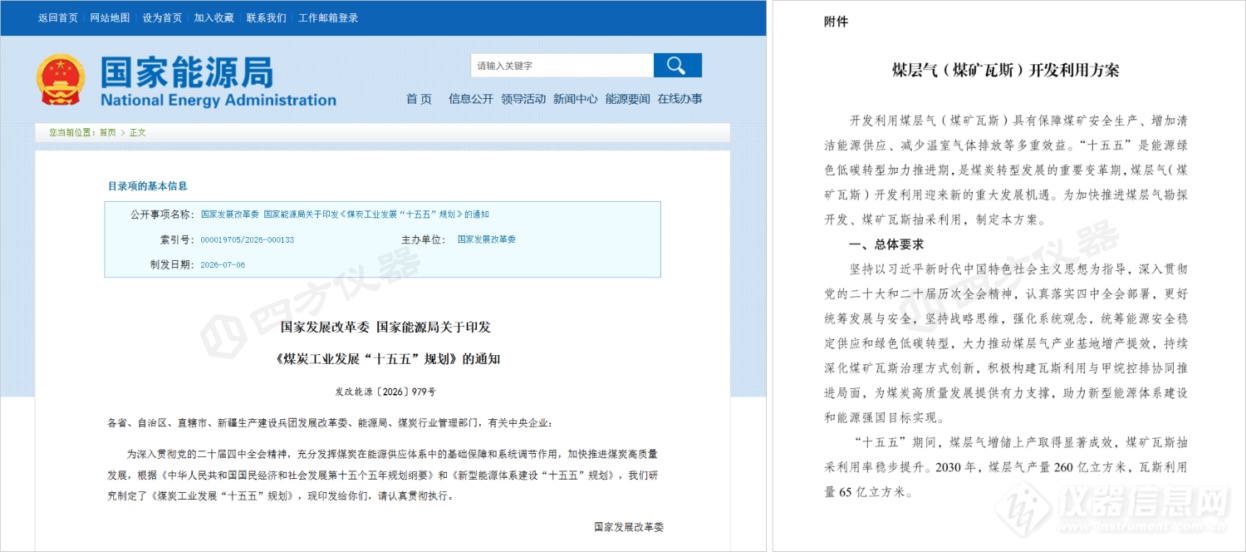
Recently, the National Development and Reform Commission and the National Energy Administration released the "15th Five-Year Plan for the Development of the Coal Industry" and the supporting annex "Coalbed Methane (Coal Mine Gas) Development and Utilization Plan" (hereinafter referred to as the "Plan"), officially setting the development path of coalbed methane during the "15th Five-Year Plan": by 2030, coalbed methane production will reach 26 billion cubic meters, and gas utilization will reach 6.5 billion cubic meters. The "Plan" puts forward comprehensive task requirements from exploration and development, extraction and utilization to external transmission pipeline network, covering the entire coal bed methane industry chain.
For coal mining enterprises and coalbed methane development companies, this is not only an increase in production indicators, but also means that the entire chain, from gas reservoir evaluation in the exploration stage, to concentration classification control in the extraction stage, to safety and compliance in the utilization process, has put forward more rigid and diverse demands for gas monitoring technology. In the new round of expansion cycle of the coal bed methane industry, gas analysis instruments are becoming a basic and indispensable equipment.
Exploration logging: component analysis evolves to on-site and real-time
The "Plan" clearly proposes to promote stable and increased production in the Qinshui Basin, rapid production increase in the eastern Ordos Basin, accelerate the industrial development of coalbed methane in Xinjiang, and actively expand new areas such as the Western Guizhou Basin and Sichuan Basin. From the precise development of old areas to the construction of new production capacity, from deep resource exploration to new block testing, the pace of exploration and development has accelerated across the board.
Traditional gas composition analysis mostly relies on laboratory inspection, which has a long cycle and low frequency, making it difficult to meet the needs of rapid exploration decision-making. The industry is accelerating its transformation to an "on-site, real-time, and online" analysis model.
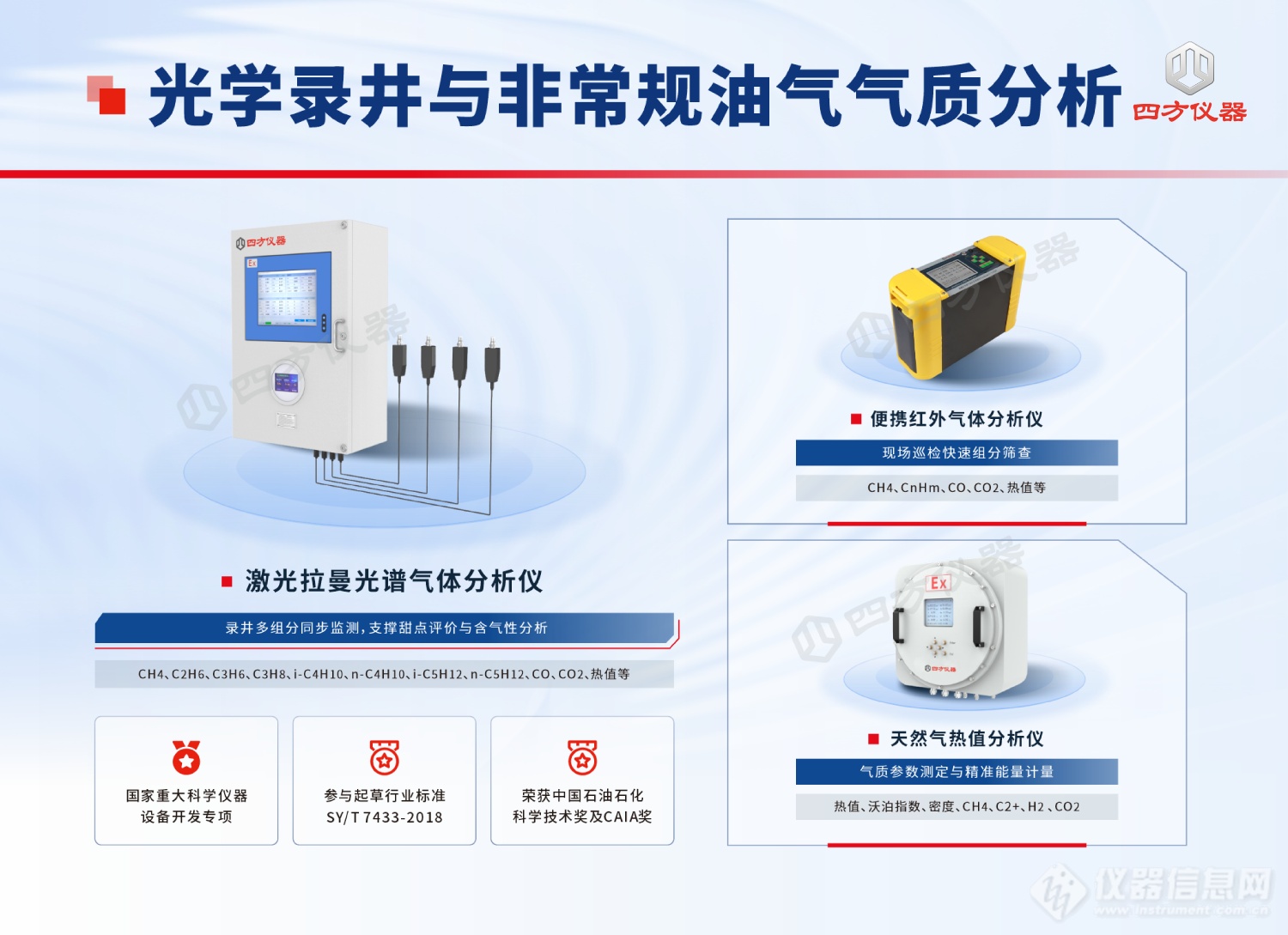
Taking Sifang Instruments as an example, its laser Raman spectroscopic gas analyzer captures the characteristic Raman scattering spectrum of the gas without separation or carrier gas. It can simultaneously monitor multiple components in coalbed methane online in real time and quickly output component and calorific value data on site. This technical route has passed the acceptance of the "National Major Scientific Instrument and Equipment Development Project" and can conduct accurate composition and concentration analysis of gas samples from exploration wells, assisting on-site personnel to accurately understand the geology and gas storage conditions.
The portable infrared gas analyzer is suitable for on-site inspections to quickly screen components. It can simultaneously measure the concentrations of CH4, CnHm, CO, CO2 and other components and calculate and display the calorific value. It is easy to operate and can be measured immediately.
The natural gas calorific value analyzer is used to measure the calorific value and energy parameters of produced natural gas. It can output calorific value, Wobbe index, density, CH4, C2+, H2, CO2 concentration and other parameters to support natural gas energy measurement and trade settlement.
For coalbed methane development companies, the more accurate and timely the gas composition data during the exploration phase, the more reliable the basis for subsequent production capacity evaluation and development plan adjustments.
Gas Drainage: Full Concentration Utilization Forces Accurate Monitoring
The "Plan" has more specific deployments on the extraction and utilization side: steadily carry out the purification and utilization of gas with a concentration of more than 30%, vigorously develop the power generation utilization of gas with a concentration of 8% to 30%, and encourage the use of thermal storage oxidation, catalytic oxidation and other methods to utilize gas with a concentration of less than 8%. This means that gas utilization is moving from "partial utilization" to "full concentration utilization", and the utilization methods of different concentration gradients put forward higher requirements for the monitoring accuracy and real-time performance of gas drainage.
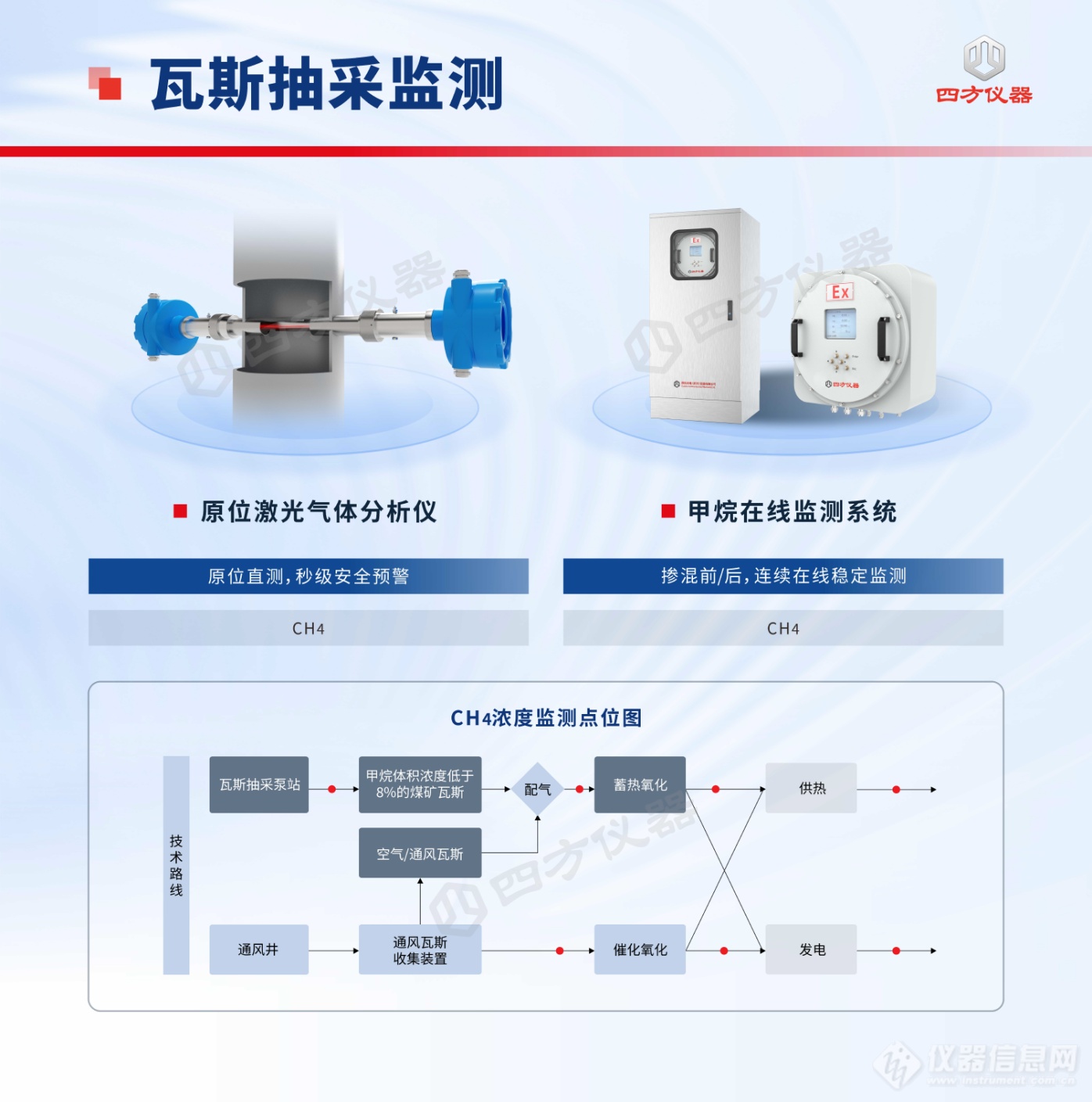
At key nodes such as gas extraction pumping stations, the front/back end of blending and gas distribution, and the front/back end of oxidation, the core issues that monitoring equipment needs to solve are: accurate concentration measurement and timely safety warnings. Taking Sifang Instruments as an example, its gas drainage monitoring solution is based on an in-situ laser gas analyzer and a methane online monitoring system, which can achieve real-time online accurate monitoring of CH₄ concentration at key points.
Among them, the in-situ laser gas analyzer uses TDLAS technology, which has the advantages of high measurement accuracy, in-situ installation, no need for sampling pre-processing, and fast response speed (T90≤1s). It can be applied in both underground and surface extraction stations, and is responsible for safety warning work at key points. The methane online monitoring system is equipped with a cabinet with a high-performance pretreatment system and an explosion-proof host machine, which is suitable for continuous online monitoring before and after blending.
For coal mining enterprises, the gas drainage monitoring system is not only a "line of defense" for safety management, but also an "abacus" for the economic benefits of gas utilization. Accurate monitoring data can make gas sales clear and efficient.
CCUS: CO2 displacement and storage monitoring has become a new demand
Driven by the "dual carbon" goal and CCUS policy, CO2 injection and storage in coalbed methane development is becoming a new technical direction. CO2 displacement technology can not only greatly increase the recovery rate during the mining process of oil, natural gas, coal bed methane, etc., but also achieve geological storage of CO2. It is an important path for the integration of the coal bed methane industry and CCUS.
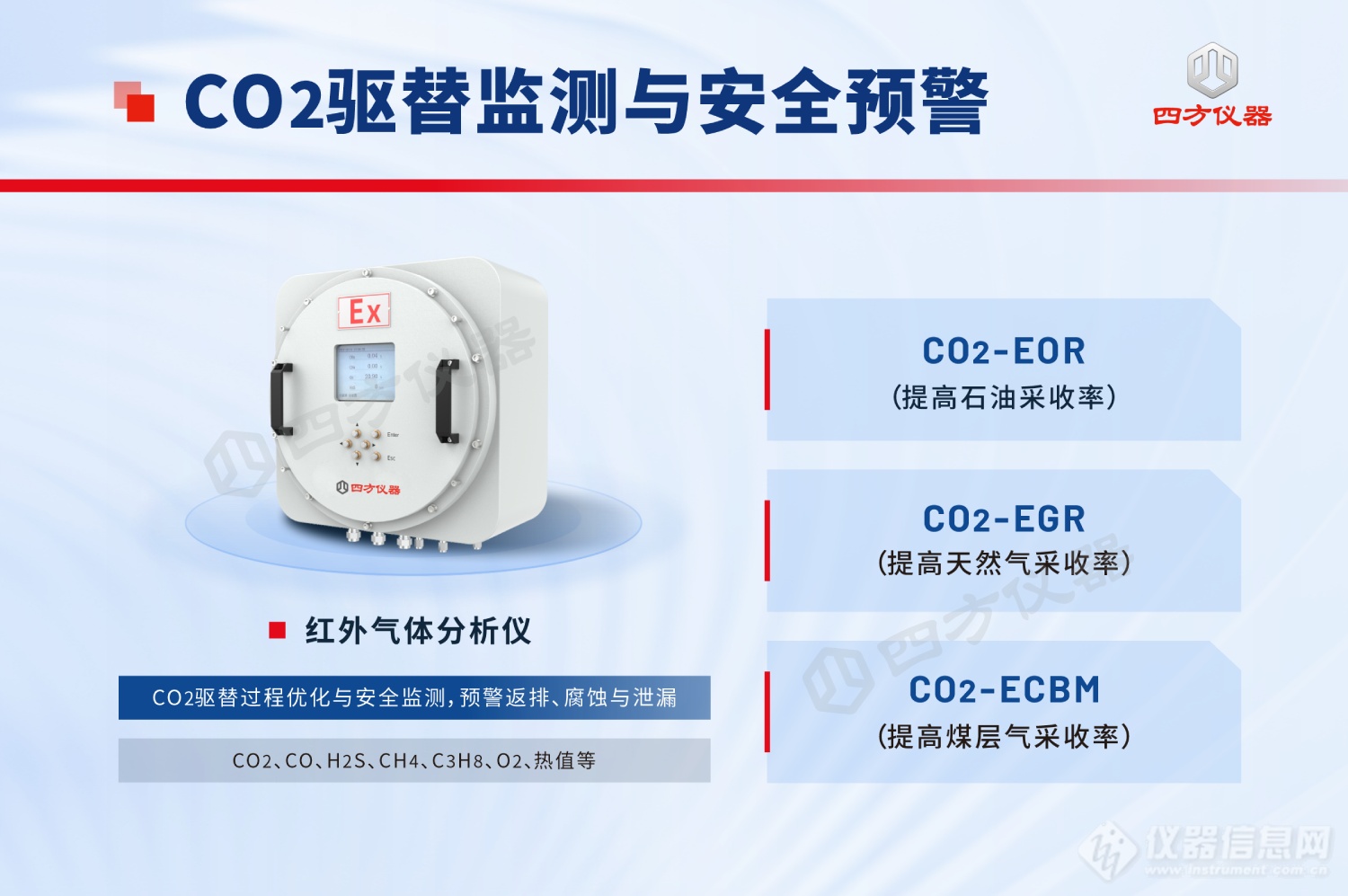
In this process, gas monitoring assumes the dual tasks of process optimization and safety warning. For CO2 displacement projects, the change in CO2 concentration in the produced gas is a key signal to determine whether gas channeling occurs at the front end of the displacement; and the monitoring of impurity components such as H2S is directly related to pipe string corrosion risk assessment and wellbore integrity management. Take Sifang Instruments' NDIR infrared gas analyzer as an example. This equipment can simultaneously measure CO2, CO, H2S, CH4, C3H8, O2, calorific value and other parameters, and is used for CO2 injection process optimization and safety monitoring, and accurate early warning of flowback, corrosion and leakage risks.
Industry Observation: Gas monitoring capabilities are becoming the “new infrastructure” for coalbed methane development
From exploration logging, gas extraction to CCUS displacement and storage, gas monitoring is changing from an "auxiliary link" in coal mine production to a "prerequisite". After the "Plan" is implemented, it can be expected that the demand for gas analysis instruments in the coal bed methane industry chain will continue to be released. The current core proposition is not "whether the equipment is available", but "whether the equipment is suitable for the scenario": the exploration well site must quickly generate data, the extraction pumping station must be explosion-proof and stable, and the CCUS project must be able to provide early warning of gas channeling and leakage. It is reported that domestic manufacturers have formed independent monitoring solutions covering the entire coalbed methane industry chain, and have accumulated application experience in key coal mining areas and coalbed methane blocks. For coalbed methane development enterprises and coal mining units, early evaluation and deployment of adaptation plans during the policy window period will be important basic work in the next one to two years.
View More from This Booth
Sifang Instruments laser Raman analyzer facilitates efficient analysis of CO2 electrocatalytic gas phase products
Sifang Instruments | A new generation of natural gas calorific value analyzer solves the problem of industrial energy measurement of multiple gas sources
Coal Chemical Process Gas Monitoring Plan (3) - Purification Chapter