

 Gold Member
 Business License
Analysis of testing accuracy of samples with small specific surface areas by dynamic method and static method

For samples with small specific surface areas, such as battery materials, organic materials, biological materials, metal powders, abrasives and other materials with small voids, due to the small adsorption amount, the test results of the static method have larger errors than the high-precision dynamic method instrument containing a wind-heat desorption device and a detector constant temperature device. Why is it difficult to guarantee the accuracy of the static method in testing samples with small specific surface areas? The reasons are as follows:
Taking a sample with a specific surface area of 1m2/g as an example, the adsorption capacity of 0.5g of this sample for nitrogen is about 0.1ml under standard conditions within the BET partial pressure range, and the volume at the liquid nitrogen temperature of the adsorption environment during the test is about 0.03ml; the remainder of the sample tube loading part The volume (that is, the background volume) is about 3-5ml. To accurately quantify the total adsorption volume of 0.03ml in the sample tube volume of 3-5ml and ensure the accuracy is within 3%, it can be calculated that the accuracy of the pressure sensor must be above 0.03%; However, the accuracy of the best imported pressure sensors at present is only 0.1%, and the pressure sensors usually used in specific surface and pore size analyzers have an accuracy of 0.15%. That is to say, the highest accuracy pressure sensor at present, even if the temperature field is ideally measured and the liquid nitrogen surface is ideally constant, Under ideal and accurate conditions of ambient temperature, the uncertainty in determining the amount of adsorption can only reach 0.003ml, that is, the uncertainty reaches 10%; if the specific surface is small or the packing density is small, that is, the sample loading volume is difficult to large, the accuracy can be imagined. However, for samples with medium and large specific surface areas, the adsorption amount is generally not that small, and the accuracy of the static method can easily be guaranteed to be within 2% or even 1%, which is not a problem;
Therefore, in terms of testing small specific surface samples, the static method can only reduce the error by increasing the sample loading volume. It is common that static methods are generally equipped with large-capacity sample tubes for small specific surface area samples. However, since the background volume (adsorption chamber volume) also increases, the accuracy improvement is also limited; and some manufacturers claim that the lower limit of small specific surface testing by the static method can reach 0.0001m2/g, which is irresponsible;
For high-precision dynamic method instruments with wind-heat assisted stripping, constant temperature detectors, and low-temperature cold traps, the accuracy is significantly improved compared to standard dynamic method surface meters without such devices; dynamic method surface meters are similar to other analytical instruments, and their accuracy and sensitivity mainly depend on the signal-to-noise ratio; that is, to improve accuracy and sensitivity, it is necessary to control from three aspects: increasing signal strength, suppressing background noise, and eliminating external interference. Methods to increase signal strength generally include increasing sample volume and detector current. However, when detector current is increased, the noise will generally increase at the same time, so the detector current will have an optimal range. Therefore, more work can be done to suppress noise and eliminate external interference. The error sources originating from the instrument itself mainly include: detector temperature drift, signal sharpness ; Use the detector constant temperature device to suppress temperature drift, and the air-heat desorption device can improve the sharpness of the signal. For a sample with a specific surface area of 1m2/g, the adsorption capacity of 0.5g of nitrogen for nitrogen can be guaranteed to be within 2% of the error between the desorption peak area and the background when the partial pressure is about 0.2;
Therefore, for samples with small specific surface areas, the advantages of sensitivity and resolution of dynamic method instruments with wind-heat assisted removal, constant temperature detectors, and low-temperature cold traps are reflected; but for samples with medium and large specific surface areas, due to strong signals, both ordinary dynamic method specific surface area meters and static method specific surface area meters can guarantee accuracy; this is like the difference between a ten thousandth analytical balance and a thousandth balance;
But the vast majority of materials containing micropores, mesopores and other voids will not have a very small specific surface; for materials with a very small specific surface, the research value of their porosity is limited;
In summary:
1. For samples with small specific surface (below 10m2/g), it is preferable to use dynamic chromatography specific surface instrument with air-thermal desorption and detector constant temperature device, taking advantage of its advantages of high resolution and sensitivity;
2. For samples with medium and large specific surfaces, if only the specific surface area is tested, there are no obvious advantages and disadvantages between the dynamic method and the static method. The dynamic method has the advantage of quickly determining the specific surface because it has a solid standard sample reference method. The static method has the advantage of saving time and consuming less liquid nitrogen than the BET multi-point method;
3. For samples that need to measure specific surface and pore size distribution, it is recommended to use a static volumetric specific surface and pore size analyzer;
View More from This Booth
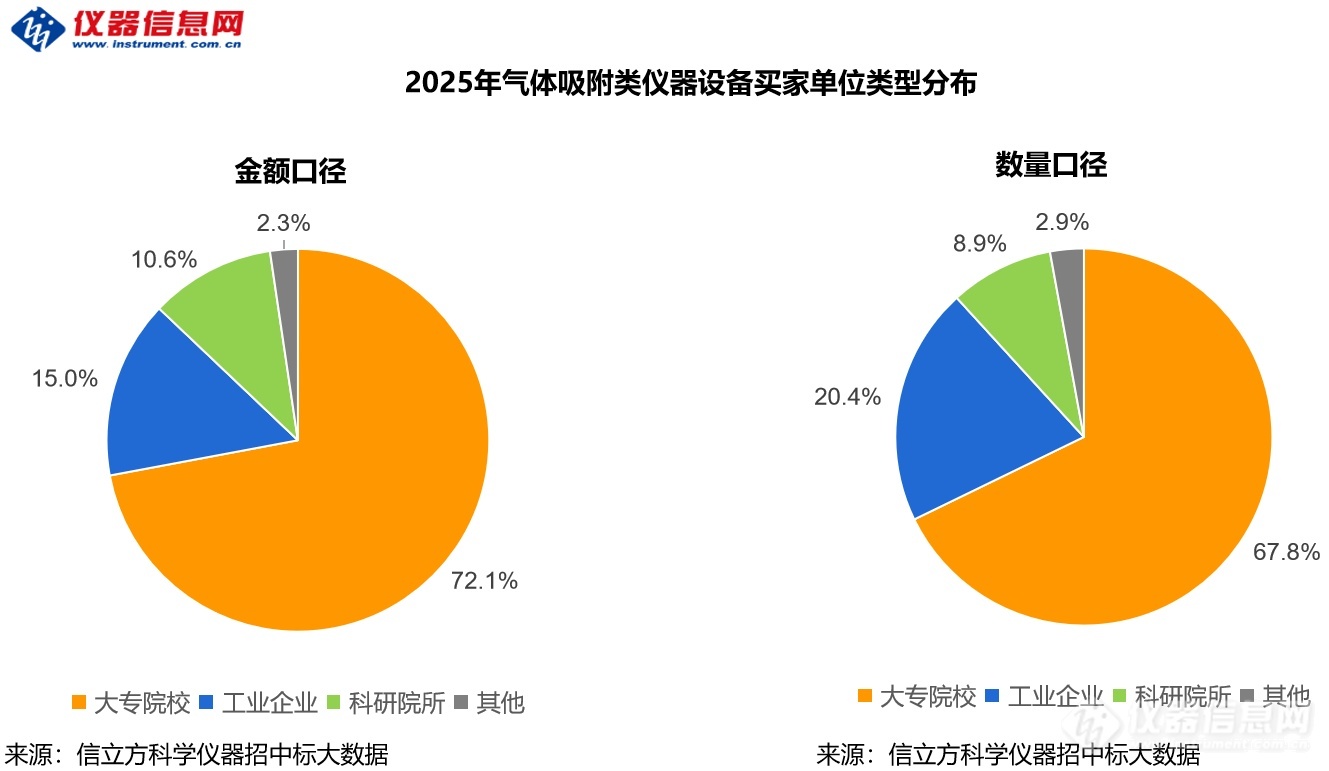
2026 Gas Adsorption and Specific Surface Area Pore Size Analyzer Industry Procurement Data Report (Official Survey by Instrument Information Network)
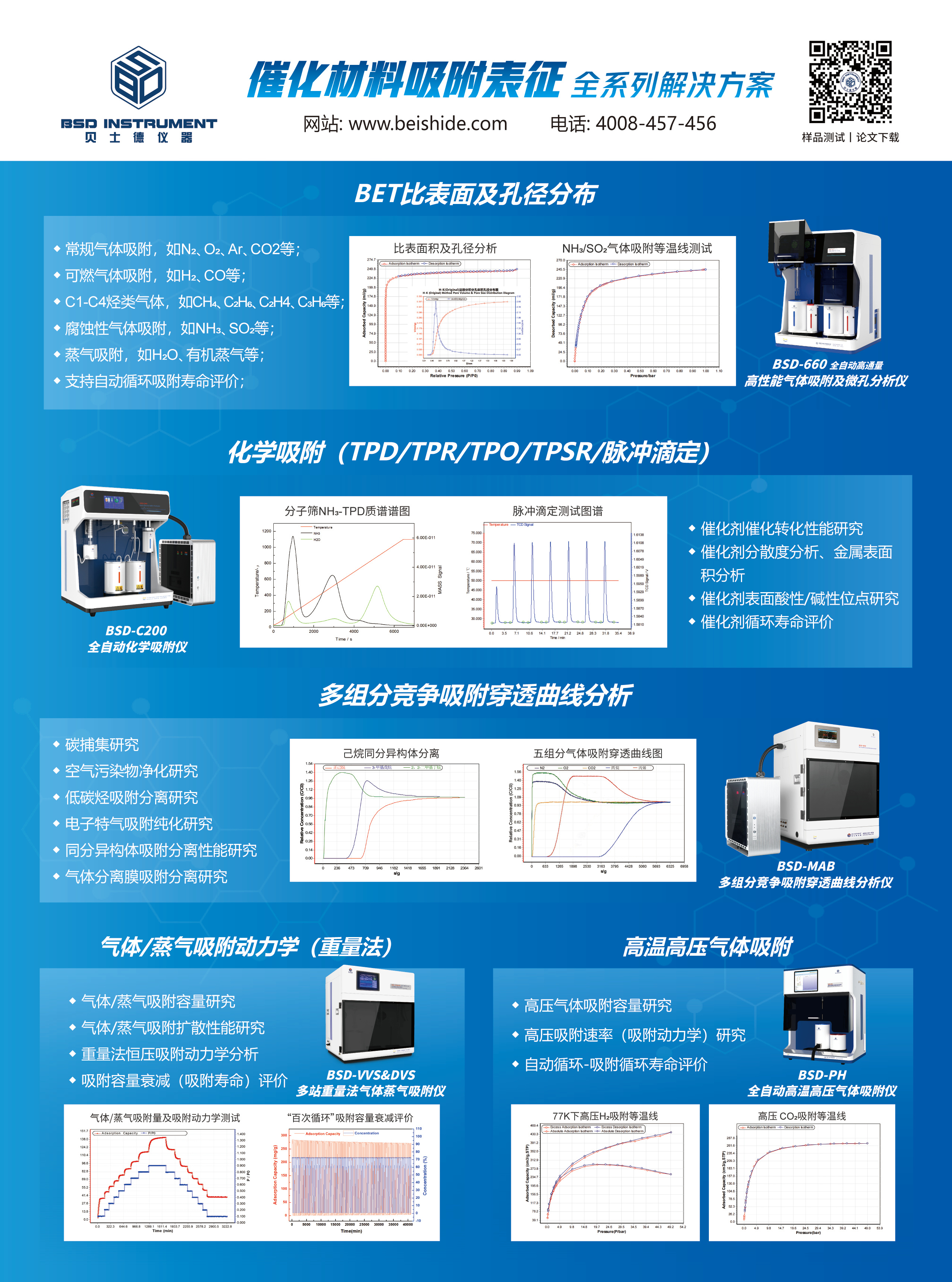
Best Instruments | BSD series adsorption BET specific surface area and adsorption characterization analyzer National high-tech enterprise source manufacturer

Hydrogen storage materials, Nature Chemistry!

【JMCA】Rapid adsorption and kinetic separation of benzene, cyclohexane and cyclohexene in microporous metal azole framework
Recommended Products

Fully automatic high-throughput specific surface area and pore size analyzer
Negotiable
Model:BSD-660系列
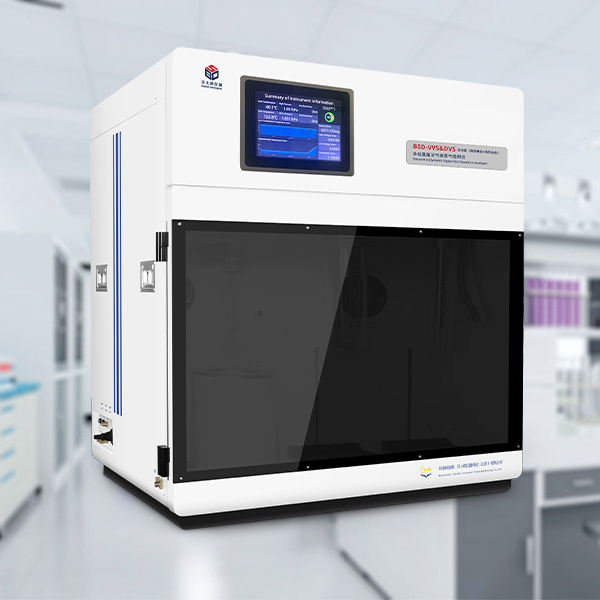
BSD-VVS&DVS multi-station gravimetric gas vapor adsorption instrument
US$ 69930.00-139860.00
Model:BSD-VVS&DVS