

 Gold Member
 Business License
Rapid heating furnace helps PdO/Co3O4 nanosheets containing high-valence Pd⁴⁺ species achieve efficient CO₂ photocatalytic methanation
【User results] Prec. Chem., team of Professor Sun Yongfu of the University of Science and Technology of China: Rapid heating furnace helps PdO/Co containing high-valent Pd⁴⁺ species3O4Nanosheets achieve efficient CO₂ photocatalytic methanation
DOI:10.1021/prechem.6c00109
Quick overview of full text
Photocatalytic CO₂ methanation faces two major bottlenecks: fast carrier recombination and difficult CO₂ activation. In this study, PdO species containing high-valence Pd⁴⁺ were anchored on Co₃O₄ nanosheets, and their unoccupied d orbitals were used as electron traps to promote the capture of photogenerated electrons and form d-π feedback with CO₂, and the polarization weakened the C=O bond. In-situ XPS shows that the CO₂ reduction site switches from Co to Pd; in-situ FTIR and EPR confirm that Pd⁴⁺ accelerates the *COOH→*OCH₃ hydrogenation step. DFT calculations show that the required excitation energy decreases from 1.62 to 1.03 eV, and the *CO₂→*COOH energy barrier decreases from 1.27 to 0.70 eV. The optimal catalyst has a CH₄ yield of 136.6 µmol g⁻¹ h⁻¹ and a selectivity of 93.8%. This work reveals the mechanism by which high-valence species regulate the CO₂ hydrogenation pathway.
Background introduction
Photocatalytic CO₂ reduction to CH₄ has both carbon emission reduction and renewable energy storage value, but the efficiency is limited by the rapid recombination of photogenerated carriers and the inertness of CO₂ molecules (C=O bond energy 750 kJ mol⁻¹, requiring 8 steps of PCET). The strong oxide-carrier interaction in binary metal oxides can achieve charge separation, but low-valent metal cations have insufficient ability to accept photogenerated electrons, making it difficult to polarize and activate CO₂. High-valence metal sites have unoccupied d orbitals, which are expected to serve as electron traps and establish d-π feedback bonds, which are the key to improving CO₂ methanation activity and selectivity.
Highlights of this article
(1) High-valence Pd⁴⁺ site: PdO is anchored in Co₃O₄ nanosheets. XAFS and XPS confirmed the formation of high-valence Pd⁴⁺, and Bader charge calculations verified it;
(2) Electron traps and d-π feedback: Pd⁴⁺ unoccupied d orbitals capture photogenerated electrons, form d-π feedback bonds with CO₂, and polarize C=O bonds;
(3) Hydrogenation path acceleration: In-situ FTIR and EPR confirmed that Pd⁴⁺ accelerates the key hydrogenation step of *COOH→*OCH₃;
(4) The CH₄ yield is 136.6 µmol g⁻¹ h⁻¹, the selectivity is 93.8%, and the cycle is stable.
Graphic and text analysis
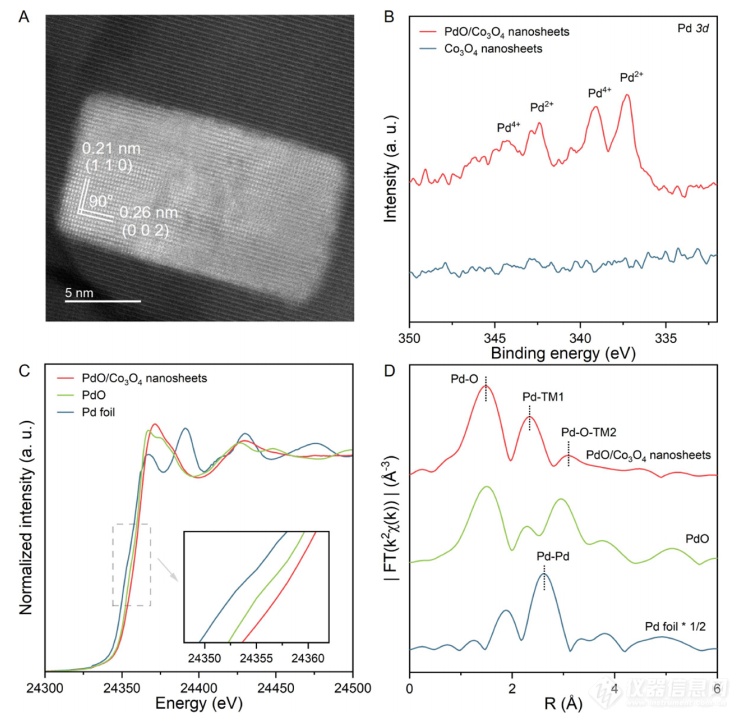
Figure 1: Structural and electronic state characterization
HAADF-STEM (Figure 1A) clearly distinguishes the two phases of PdO and Co₃O₄. XPS (Figure 1B) detected Pd⁴⁺ characteristic peaks at 339.1 and 344.4 eV. The absorption edge of XANES (Figure 1C) shifts positively relative to the PdO standard sample, confirming the existence of high-valence Pd⁴⁺. EXAFS (Figure 1D) shows the coordination of Pd-O (1.48 Å), Pd-TM1 (2.34 Å) and Pd-O-TM2 (3.09 Å), confirming the strong interaction between PdO and Co₃O₄.
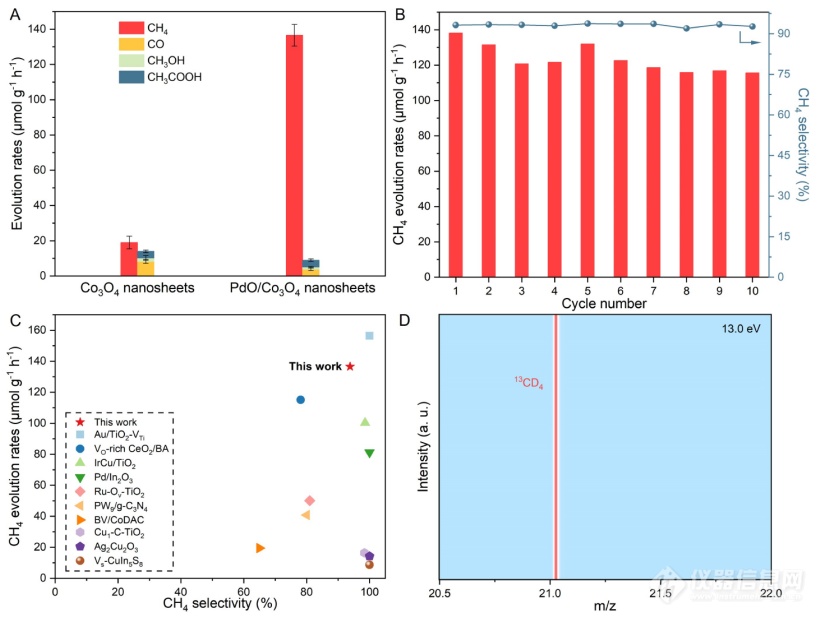
Figure 2: Photocatalytic performance
The CH₄ yield of Co₃O₄ is only 19.0 µmol g⁻¹ h⁻¹ and the selectivity is 57.6%, while that of PdO/Co₃O₄ reaches 136.6 µmol g⁻¹ h⁻¹ and the selectivity is 93.8% (Figure 2A). There was no obvious attenuation after 10 cycles (Figure 2B). The performance is better than that of most reported catalysts (Figure 2C). Isotope labeling (Figure 2D) detected ¹³CD₄, confirming that C came from CO₂ and H came from H₂O.
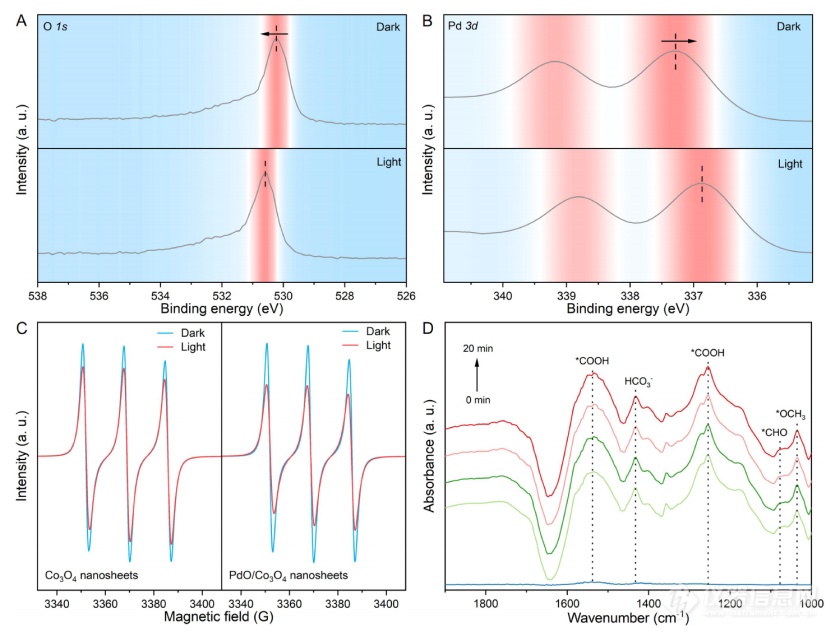
Figure 3: Mechanism study
Under illumination, O 1s moves to high binding energy and Pd 3d moves to low binding energy (Figure 3A-B), confirming that the photogenerated electrons migrate from the O site to the high valence Pd site. EPR (Fig. 3C) shows that TEMPO consumption of PdO/Co₃O₄ is faster, confirming that Pd⁴⁺ promotes electron-hole separation and H generation. FTIR (Figure 3D) detected *COOH (1538/1253 cm⁻¹), *CHO (1077 cm⁻¹) and *OCH₃ (1036 cm⁻¹), confirming that Pd⁴⁺ accelerates *COOH→*OCH₃ hydrogenation.
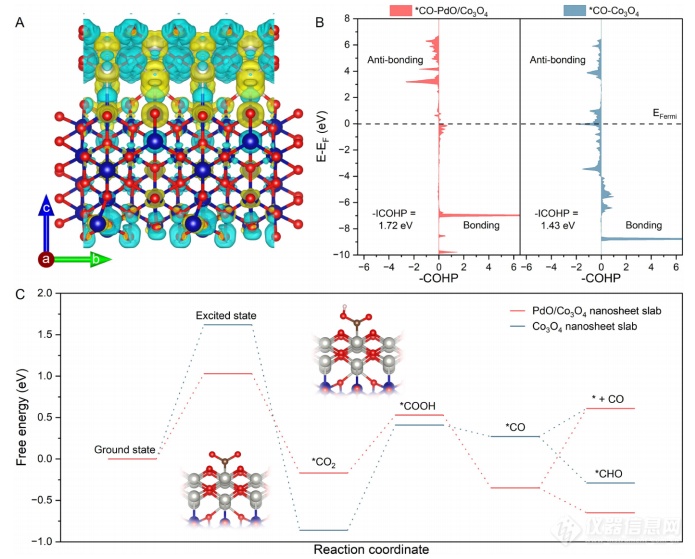
Figure 4: DFT calculation
The electron-hole distribution (Figure 4A) shows that electrons are enriched in Pd sites and holes are enriched in O sites. COHP (Fig. 4B) shows that the -ICOHP value of CO on PdO/Co₃O₄ (1.72 eV) is higher than that of Co₃O₄ (1.43 eV). The free energy diagram (Figure 4C) shows that the excitation energy required for PdO/Co₃O₄ (1.62) is reduced compared to the excitation energy required for Co₃O₄ (1.03 eV), and the *CO₂→*COOH energy barrier decreases from 1.27 to 0.70 eV.
Summary and Outlook
This study anchored high-valence Pd⁴⁺ species on Co₃O₄ nanosheets and successfully achieved efficient and selective CO₂ photocatalytic methanation. Pd⁴⁺ acts as an electron trap to promote charge separation and activates CO₂ through d-π feedback bonds, accelerating the *COOH→*OCH₃ hydrogenation step. The optimal catalyst CH₄ yield is 136.6 µmol g⁻¹ h⁻¹, and the selectivity is 93.8%. This work provides a new idea for high-valence metal sites to regulate CO₂ hydrogenation pathways.
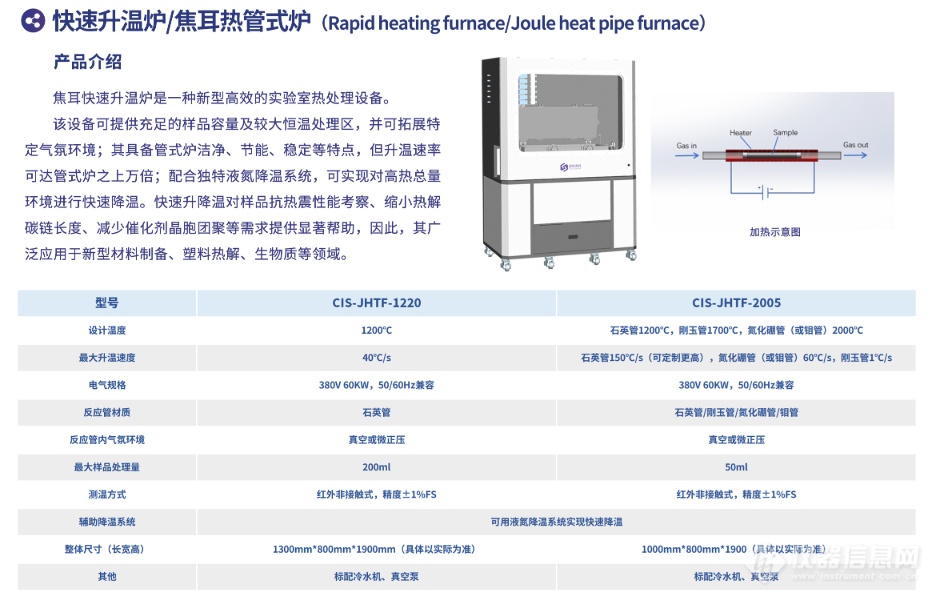
The rapid heating furnace used in this article was developed by Hefei In-situ Technology Co., Ltd. Thank you to the teacher for your support and recognition!

Brief introduction of the corresponding author
Sun Yongfu,Professor at University of Science and Technology of China, doctoral supervisor. For many years, he has been engaged in research on the precise preparation, fine structure analysis and photo/electrocatalytic reduction of carbon dioxide in two-dimensional ultra-thin inorganic materials. Relevant research results have been published in more than 80 papers in domestic and foreign journals such as Nature, Nature Energy, Nature Commun., Chem. Soc. Rev., Acc. Chem. Res., J. Am. Chem. Soc., Angew. Chem. Int. Ed., Adv. Mater., Joule, Natl. Sci. Rev., Sci. China Chem., etc. His papers have been cited more than 10,000 times. Relevant results were selected into the 2016 "Top Ten Progress in Chinese Science" and the 2012 "Major Scientific and Technological Infrastructure Major Achievements of the Chinese Academy of Sciences", and were invited to participate in the 2021 National "13th Five-Year Plan" Scientific and Technological Innovation Achievements Exhibition. Undertaken the NSFC Outstanding Youth Fund, NSFC General Project, NSFC Joint Fund, NSFC Outstanding Youth Fund and the National Key Research and Development Program "Nanotechnology" key special projects, etc.; selected as the first outstanding young scientific and technological talents in Anhui Province (2022), Fellow of the Royal Society of Chemistry (2019), Outstanding Member of the Youth Promotion Association of the Chinese Academy of Sciences (2019), Youth Yangtze River Scholars of the Ministry of Education (2016), and New Century Outstanding Talent Support Plan (2013). As the first completer, he won the first prize of the Anhui Provincial Science and Technology Award (natural science category, 2019), and also won the Chinese Chemical Society Evonik Outstanding Young Scientist Award (2022), the Chinese Chemical Society Youth Chemistry Award (2016), the Chinese Chemical Society Nanochemistry Emerging Award (2016), and the Chinese Academy of Sciences Lu Jiaxi Young Talent Award (2015).
View More from This Booth
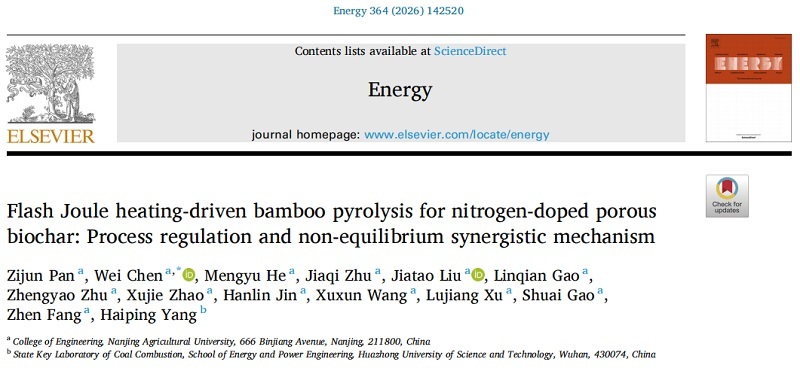
Nanjing Agricultural University Chen Wei’s team Energy, Joule heat assists bamboo pyrolysis, and prepares nitrogen-doped porous biochar-enriched synthesis gas in 20 seconds
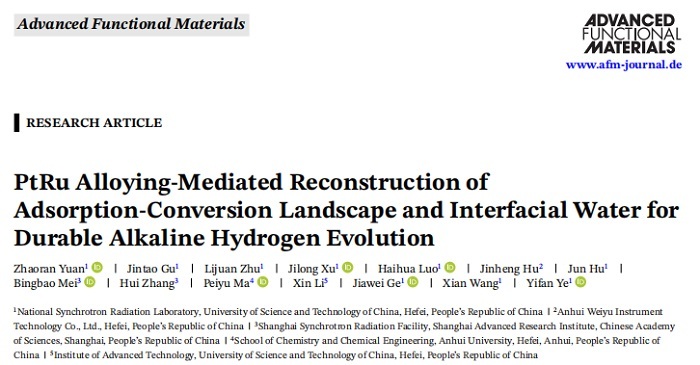
Joule heat assists the AFM team of Ye Yifan/Wang Xian of the University of Science and Technology of China: Constructing ultra-low loading PtRu alloy catalyst for efficient alkaline hydrogen evolution
Joule Thermal Equipment Small: Waste plastic can be converted into limited carbon in seconds, acidic CO₂ can produce ethylene FE up to 70%, and the total C₂ FE exceeds 80%
Joule heating assists the coordinated regulation of asymmetric sites and vacancies to construct efficient and stable ruthenium selenide nanocrystals for hydrogen evolution from seawater
Recommended Products

CIS-JH-4.0 Joule heating device, millisecond level temperature rise 1000-3000℃
Negotiable
Model:CIS-JH-4.0